

Difference Between Full Stack Developer and Software Engineer Explained
 Aug 07, 2026
Quick Answer
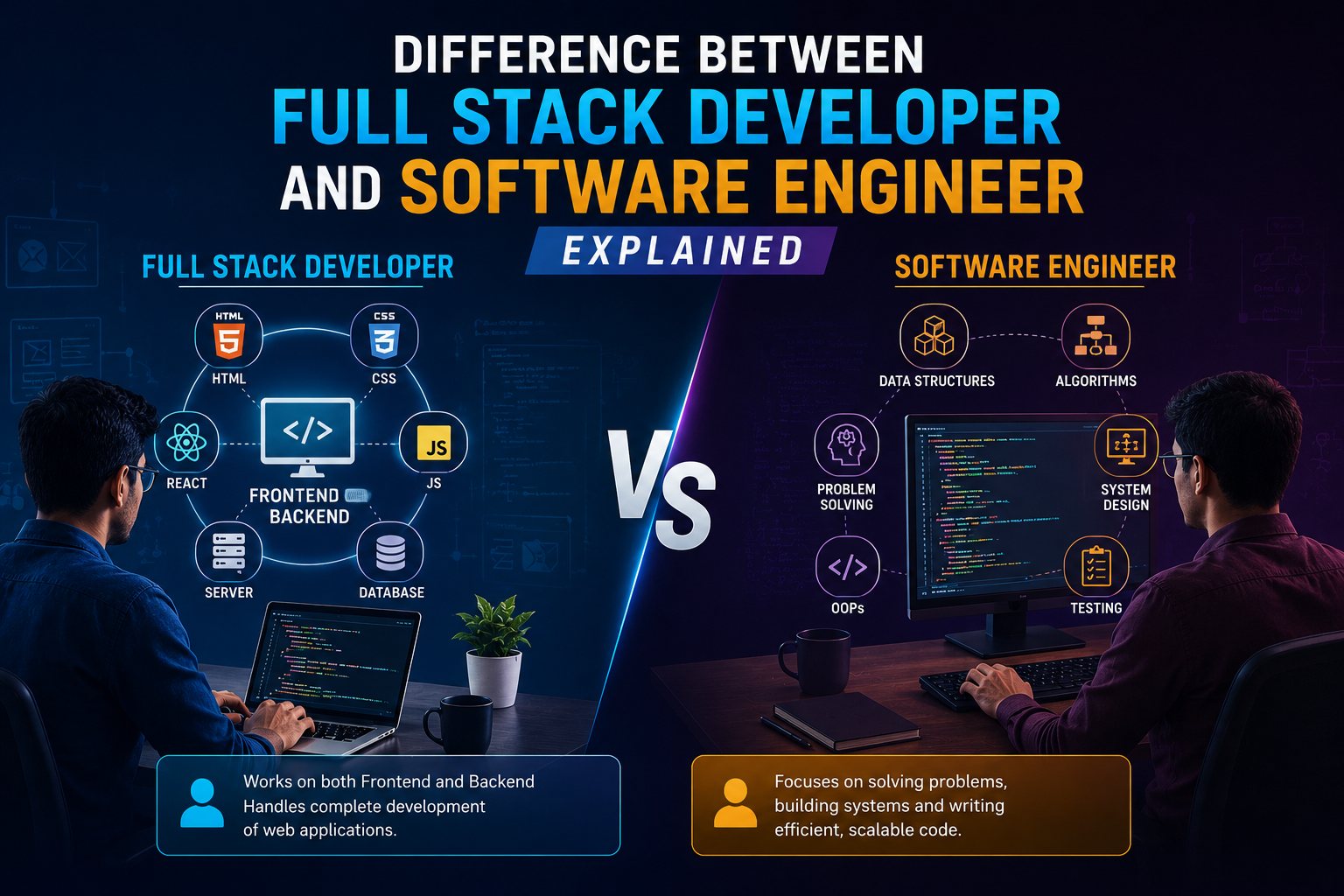
The term full stack developer is used for those who develop front end and back end of web application together. This means that a full stack developer will work on the UI layer, server layer, database, and APIs all within one application. However, software engineers focus more on the engineering aspect of programming such as system design, algorithms, architecture, and software development life cycle. Thus, in general terms, any full stack developer could be termed as a software engineer, while all software engineers are not necessarily full stack developers.
Who Is a Full Stack Developer?
A full stack developer is a professional with skills and expertise to develop a full web application both visually (the front end) and technologically (the back end).
This involves the following areas of expertise:
- Front-end development — HTML, CSS, JavaScript, and such frameworks as React and Angular
- Back-end development — use of such server-side programming languages as Node.js, Python, or Java
- Database management — use of SQL or NoSQL databases such as MySQL and MongoDB
- Integration with APIs — integration between the front and back ends via REST and GraphQL APIs
- Deployment basics — hosting, version control using Git, and cloud computing
Full stack developers are especially valuable to startups and small teams because one person can handle multiple layers of a product, reducing dependency on separate specialists.
Who Is a Software Engineer?
The job of a software engineer involves the application of engineering practices to design, construct, test, and maintain software systems ranging from simple web applications to complex embedded systems and enterprise software systems. The duties include the following:
- System Design and Architecture - designing a system’s architecture and component interaction
- Algorithms and Data Structures - coding efficiently and optimization
- Software Development Life Cycle (SDLC) - systematically going through various SDLC phases like requirements analysis, implementation and maintenance.
- Testing and Quality Assurance - unit tests, integration tests and debugging
- Version Control and Collaboration - working as part of an engineering team
Software Engineering is a much more generalized term. A Software Engineer may have expertise in full stack web development, but there are also software engineers who may be specialized in machine learning systems, cloud computing, or mobile applications.
Full Stack Developer vs Software Engineer: Key Differences
| Aspect | Full Stack Developer | Software Engineer |
| Scope | Front-end + back-end of web apps | Broader — web, mobile, systems, infrastructure |
| Core focus | Building complete web applications | System design, architecture, and engineering principles |
| Skill depth | Practical, tool-based (frameworks, APIs, databases) | Theoretical + practical (algorithms, data structures, design patterns) |
| Typical projects | Websites, web apps, dashboards | Large-scale systems, software products, platforms |
| Team size fit | Startups, small teams, agencies | Startups to large enterprises |
| Career flexibility | Web-development focused | Can pivot into many specializations |
There is an intersection between these two roles; in fact, many full stack developers are software engineers who focus on web technologies. This becomes more apparent when one considers that software engineers need to have a more comprehensive understanding of computer science and systems architecture than web developers do.
Real-World Example
Full Stack Developer scenario: The new startup requires a booking website that includes the front-end, back-end, and database for managing orders. The full stack developer is responsible for developing the whole system from user interface in React, server-side programming in Node.js, and database in MongoDB.
Software Engineer scenario:Redesigning the backend structure of a large e-commerce website to manage many simultaneous users is what an engineer at a large e-commerce company does. The engineer specializes in system design including load balancing, caching techniques, database sharding, and scalability and works along with specialists in front-end and full stack development teams.
Both roles require strong coding skills, but the depth of system-level thinking and the breadth of technology exposure typically differ.
Skills Needed for Each Career Path
For Full Stack Development
- HTML, CSS, JavaScript fundamentals
- A front-end framework (React, Angular, or Vue)
- A back-end language (Node.js, Python, or PHP)
- Database basics (SQL and NoSQL)
- Git and basic deployment/hosting knowledge
For Software Engineering
- Strong programming fundamentals (often starting with C, C++, Java, or Python)
- Data structures and algorithms
- Understanding of system design and software architecture
- Testing methodologies and debugging practices
- Exposure to specialized domains (cloud, AI/ML, mobile, or DevOps) as career progresses
A structured software development foundation course is often the best starting point for beginners, since it builds the core programming logic both roles rely on, before branching into a specialization like full stack development.
Which Career Path Should You Choose?

For those who like developing tangible and useful products rapidly and are interested in the whole application layer, full-stack development is an excellent choice for them, specifically for startups, freelancing, and agencies. Our full-stack development course at Surat focuses on all of this with real projects in the front end, back end, and databases.
In case you are interested more in the underlying mechanisms involved in building, scaling, and optimization of the system, and relish solving problems from a structural perspective, then the broader path of software engineering might be more suited for you, eventually taking up roles like architecture, DevOps, or engineering specializations. Students in Madhya Pradesh can begin their journey down this route through our full stack development program in Bhopal.
For those who don’t have any idea about what they should be doing, going for a basic course on software development from Surat is a good choice, as the course will teach you C, C++, and data structure and algorithm, which are the basics required in software engineering.
Career Scope and Growth

Both job options provide good opportunities in India’s expanding tech sector:
- Full stack developer jobs - highly in demand among startups, digital firms, and products companies developing web platforms
- Software engineer jobs - highly in demand among enterprises, product companies, and specialized domains such as fintech, healthtech, and SaaS.
With software engineering becoming more intertwined with data systems, many software engineers are moving towards learning other related topics such as AI and automation. For those who have an interest in such topics in Bhopal, the AI/ML & Data Science course in Bhopal is a great way forward.
Frequently Asked Questions
What is the primary difference between hacking and ethical hacking? The primary difference lies in the permission and the motive behind performing the act. Unauthorized hacking is both illegal and often malicious while ethical hacking is legal as the permission is sought before starting the process.
Is ethical hacking legal in India? Ethical hacking is perfectly legal in India provided that there is proper authorization from the owner of the system or the network within the scope of agreement.
Can a hacker become an ethical hacker? It is quite possible that many ethical hackers were once hackers themselves until they have gained certification and undergone training.
What are the qualifications required to be an ethical hacker? Formal qualifications are not essential to enter into this profession, as practical knowledge and certification take precedence over education alone.
Is ethical hacking a good career option in 2026? It certainly is as the increasing cyber threats and digitalization in the world makes the demand for ethical hackers increase every year in India and all over the world.
Summary
Hacking versus ethical hacking is not about having a certain level of skill; it is about the permissions, intentions, and legality involved. The same methods and skills that can take down a company can also be used to safeguard the company, which is what ethical hacking has to offer as a career choice. With the proper training and lab experience, anyone can become an ethical hacker.
Related Post:
Types of Ethical Hacking Explained: Skills, Career & Scope
Difference Between Hacking and Ethical Hacking: Meaning, Examples & Career