

How to Become a Data Scientist After 12th: Complete Career Guide
 Oct 05, 2026
Data Science has now become one of the most popular career options as businesses rely on data for decision making, customer analysis, product improvement, and process automation. For those students who have studied up to class 12 and are interested in mathematics, technology, coding, and problem-solving, data science can become a great career option.
So if you are thinking about how to become a data scientist after 12th, you will first need to choose the right stream and then learn different programming languages and mathematics, data analysis, and machine learning along with gaining practical experience.
What is even more interesting is that students can begin preparing themselves for such a career right after completing their schooling. You do not have to know everything right away. With gradual development of knowledge, you can build necessary skills.
What Does a Data Scientist Do?
Data scientists have the responsibility of analyzing large sets of data in an attempt to uncover meaningful patterns, insights, solutions to business problems, and decisions to be made.
A typical data scientist may engage in any of the following activities:
- Gathering and structuring the data
- Data cleaning and structuring
- Analyzing the data to identify trends
- Representing the data visually
- Predictive modeling
- Applying machine learning algorithms
- Building statistical models
- Reporting the results to business firms
- Application of artificial intelligence
The sectors in which data scientists operate can include finance, health care, e-commerce, technology, manufacturing, education, telecommunication, and marketing.
Can You Become a Data Scientist After 12th?
Yes. It is possible for students to begin their career towards data science after class 12.
There is no standard path of education which all future data scientists must take. Many students opt for a bachelor’s degree in computer science, information technology, mathematics, statistics, data science or artificial intelligence.
Other than formal education, students can also gain practical knowledge from specialized courses, projects, internships, certification and personal learning.
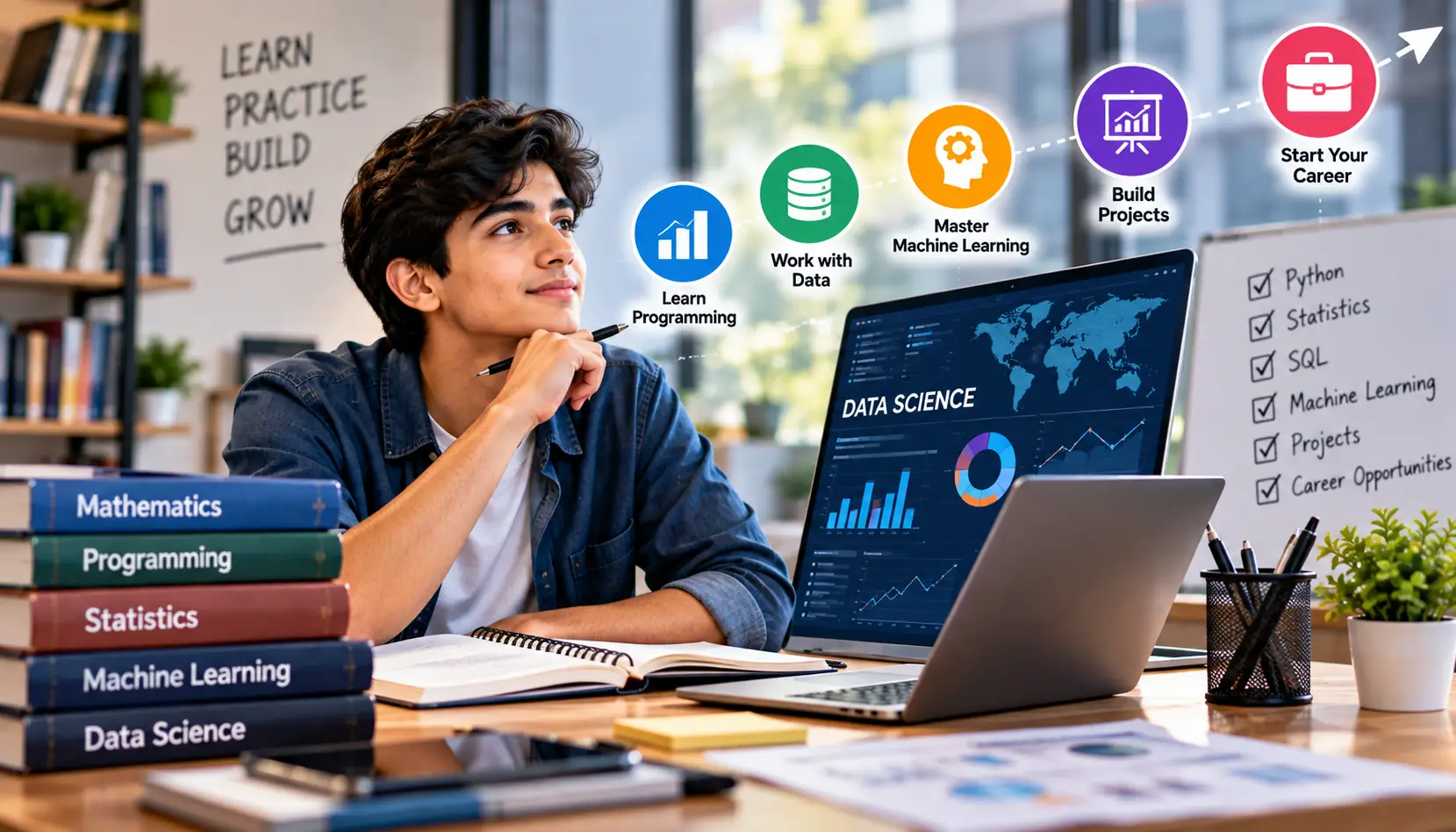
The most important thing is to develop the necessary background in mathematics, programming, statistics, data analysis and machine learning.
Which Stream Should You Choose After 10th?
If you are deciding on the stream that you would like to opt for in class 11th and 12th, then opting for the science stream with mathematics can be quite helpful in laying down a strong base for a career in data science.
The subjects like mathematics and computer science can be quite helpful owing to the fact that data science involves number analysis, statistics, logic, and programming.
Nevertheless, your specific eligibility for an undergraduate program can vary according to the admission criteria of the college or university to which you wish to apply.
Step-by-Step Guide: How to Become a Data Scientist After 12th

Step 1: Build a Strong Foundation in Mathematics
Mathematics plays a very fundamental role in data science.
The following are some of the concepts students must familiarize themselves with:
- Algebra
- Probability
- Statistics
- Functions
- Calculus
- Matrices
- Basic mathematical modeling
One does not have to be an expert in complex mathematics right away. Begin with basic principles and slowly learn about how mathematics is used in solving real world problems.
Having a solid knowledge of math will help one understand statistics and machine learning better.
Step 2: Learn Programming
Programming is an important part of data science today.
Among others, Python is a popular choice in data science due to the availability of many libraries and easy-to-use syntax.
Start by mastering:
- Variables
- Data types
- Conditional statements
- Loops
- Functions
- Lists and dictionaries
- File handling
- Object-oriented programming basics
When you have an understanding of programming fundamentals, it’s time to work with data-oriented Python packages.
Some examples are:
- NumPy
- Pandas
- Matplotlib
- Seaborn
- Scikit-learn
Programs learned via hands-on projects are more beneficial than just learning the language syntax.
Step 3: Learn Data Analysis
Before diving deep into machine learning, you need to know how to deal with datasets.
Data analysis entails gathering, cleaning, transforming, exploring, and understanding data.
You can perform data analysis on a dataset that includes:
- Customer purchases
- Website traffic
- Student performance
- Product sales
- Financial transactions
- Social media engagement
It is advisable to know how to spot missing data, eliminate duplicate data, find out any strange data, organize data and spot trends.
Step 4: Study Statistics
Statistics is important to data science as it enables individuals to comprehend and analyze data to see if the trends identified have any meaning.
Concepts that are important include:
- Mean, median, and mode
- Variance and standard deviation
- Probability distributions
- Correlation
- Regression
- Sampling
- Hypothesis testing
- Confidence intervals
Understanding statistics helps you interpret results rather than simply producing numbers or charts.
Step 5: Learn SQL and Databases
The data scientists work with data stored in databases, and hence SQL becomes an essential technology skill for them.
You must know how to:
- Retrieve data
- Filter records
- Sort information
- Join tables
- Group data
- Calculate aggregate values
- Work with multiple database tables
Learning SQL alongside Python can give you a stronger foundation for working with real-world datasets.
Step 6: Understand Machine Learning
Once you are an expert at programming, statistics, and data analysis, then only can you move ahead to machine learning.
Machine learning involves the ability of a computer to discover patterns in the data and make predictions from those patterns.
Basic aspects of machine learning include:
Supervised Learning
Supervised learning involves using labeled data in order to train models for making predictions and classifications.
Some applications would be home prices prediction and email classification.
Unsupervised Learning
Unsupervised learning deals with unlabeled data and helps to find out patterns and groupings.
Some examples are customer segmentation and clustering.
Model Evaluation
Learning about machine learning requires an understanding of the various ways to evaluate models as well. Accuracy, Precision, Recall, F1, Mean Squared Error, Cross-Validation, and others might all be applicable depending on the kind of problem.
Step 7: Learn Data Visualization
Among other skills, knowledge of data analysis is what makes you fit for becoming a good data scientist; however, it is also essential to be able to convey your findings.
Data visualization helps you to turn complex datasets into visual charts and dashboards.
Tools and libraries you will study are:
- Matplotlib
- Seaborn
- Plotly
- Power BI
- Tableau
Good visualization should make an insight easier to understand rather than simply making a report look attractive.
Step 8: Explore Artificial Intelligence
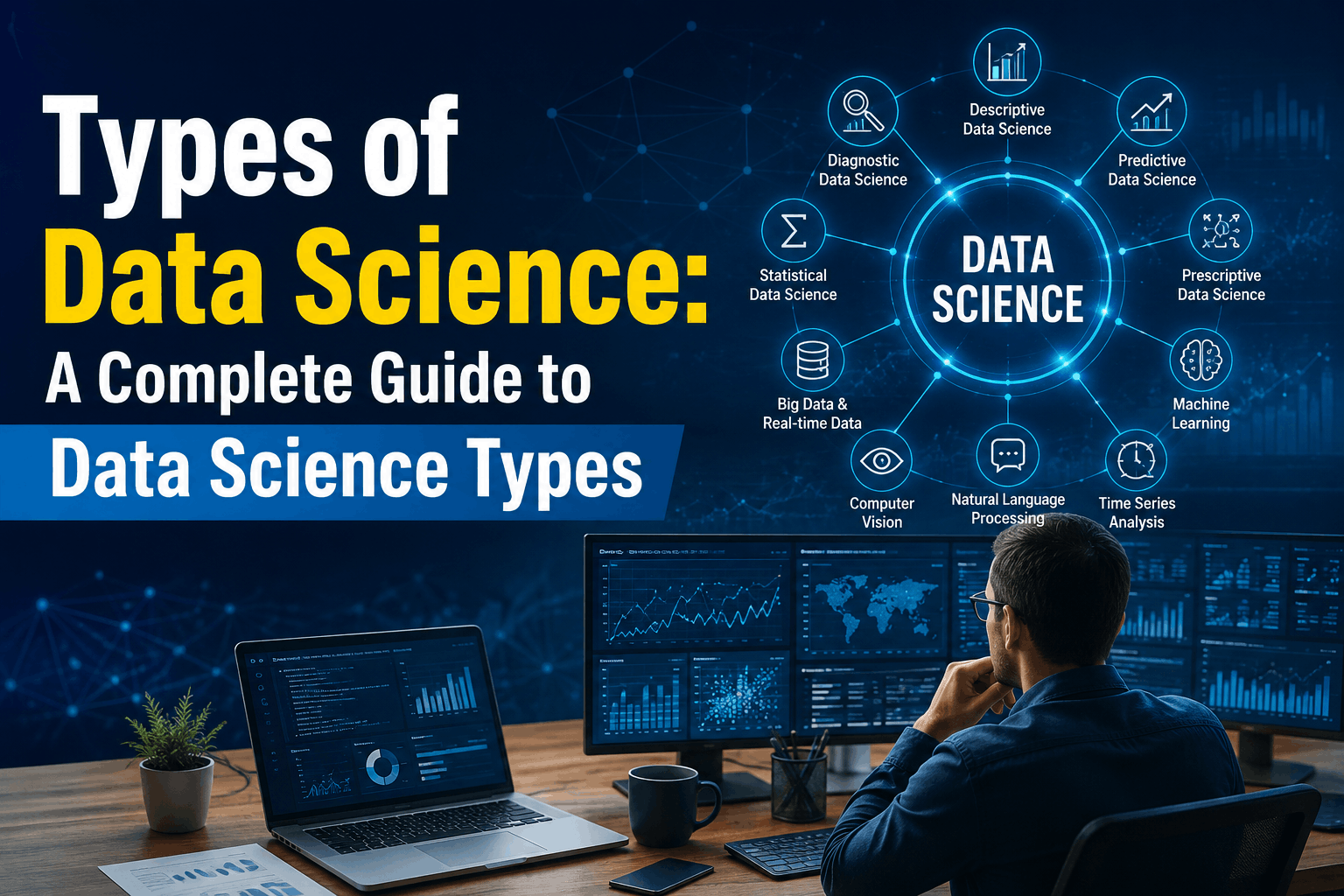
Artificial intelligence and data science are highly related disciplines. While moving ahead, one can delve into topics like deep learning, natural language processing, computer vision, generative AI, and predictive analytics.
Those students who would like to have well-structured knowledge on this topic can consider a data science and artificial intelligence course.
Data Science & Artificial Intelligence Course in Surat
Step 9: Build Real-World Data Science Projects
Projects are crucial for students who would like to show off their abilities.
Do not limit yourself to solving theory tasks but work on real-life project tasks.
Some sample project tasks that can be done by beginners are:
Student Performance Analysis
Analyze student marks and identify factors that may influence academic performance.
Sales Forecasting
Based on past sales records, develop a simple model to forecast sales.
Customer Segmentation
Based on customer information, categorize customers who exhibit similar buying patterns.
House Price Forecasting
Develop a machine learning model to predict house price using a set of features.
Movie Recommendation System
Develop a simple recommendation system that is either based on user preferences or on movie attributes.
Document your projects by specifying the problem statement, dataset, methodology, tools used, results obtained, and limitations of your project.
Step 10: Develop a Strong Portfolio
A portfolio can help demonstrate what you can actually do.
Your portfolio can include:
- Python projects
- Data analysis reports
- Machine learning models
- Data visualization dashboards
- GitHub repositories
- Research or academic projects
- Internship projects
For each project, explain what problem you solved and what you learned.
A strong portfolio can be especially useful when applying for internships and entry-level positions.
Do You Need to Learn Web Development?
It is not necessary to have knowledge of web development for becoming a data scientist. However, having an idea about the functioning of the website might prove useful in the future while deploying the ML model.
Students who wish to learn about website development can take a course in web design.
If you want to move further into interactive web applications, learning modern JavaScript frameworks can also be useful. A React JS training program can help learners understand how dynamic web interfaces are developed.
What About Graphic Design Skills?

Nevertheless, visual communication and design are not part of the mandatory skills in data science, yet they may be useful in the event of dashboards and presentation of data. Visual design principles will come in handy in the communication of information.
In case a student wants to learn about visual communication skills, he/she should consider taking the course on Graphic Design.
Graphic Design Course in Surat
Is Cyber Security Useful for a Data Scientist?
While cyber security and data science have some differences, there is some overlap between them in certain fields where data security, fraud detection, anomaly detection, and security analytics play an important role.
For instance, the use of machine learning can be utilized for anomaly detection within a network or suspicious activity.
The students that want to pursue a career in the IT industry might consider studying cyber security courses as well.
Cyber Security Course in Surat
What Degree Should You Pursue After 12th for Data Science?
There are various ways to go about pursuing a data science career while still an undergrad.
Based on the eligibility and career goals, one may choose from courses in the field of:
- Computer Science
- Information Technology
- Data Science
- Artificial Intelligence
- Mathematics
- Statistics
- Computer Applications
- Engineering
The best choice will vary depending on interest, educational background, accessibility of colleges, coursework, and career objectives.
While choosing, do not just focus on the title of the course, but compare all the other factors mentioned above as well.
Skills You Need to Become a Data Scientist

A successful data scientist needs a combination of technical and soft skills.
Technical Skills
Important technical areas include:
- Python
- SQL
- Statistics
- Mathematics
- Data analysis
- Machine learning
- Data visualization
- Database fundamentals
- Artificial intelligence
- Version control
Soft Skills
Technical knowledge alone is not enough. Data scientists also need:
- Problem-solving ability
- Critical thinking
- Communication skills
- Curiosity
- Business understanding
- Attention to detail
- Ability to explain technical findings
A data scientist often needs to explain complex results to people who do not have a technical background.
How Long Does It Take to Become a Data Scientist?
There is no defined time frame since that would depend upon one’s education level, schedule, knowledge level, and career objectives.
An individual can start learning programming and statistics from after class 12th and slowly build up skills in the college.
Here is how it could be:
After 12th: Mathematics + programming fundamentals
Year 1: Python, SQL, statistics, and basic data analysis
Year 2: Machine learning and data visualization
Year 3: Advanced projects, internships, and portfolio development
Final year: Specialization, practical experience, job preparation, and advanced projects
The timeline can vary significantly, so focus on building skills rather than rushing through topics.
Career Opportunities in Data Science
Data science skills may help you obtain a number of technology careers based on your educational background and specialization.
Career opportunities include:
- Data Analyst
- Junior Data Scientist
- Data Scientist
- Machine Learning Engineer
- Business Intelligence Analyst
- Data Engineer
- AI Engineer
- Research Analyst
- Machine Learning Specialist
Some of these roles require different levels of programming, statistics, mathematics, engineering, or domain knowledge.
Tips for Students Starting Data Science After 12th
And here are some pointers for you to remember if you have just begun your journey:
Start from Basics
Instead of going straight into the complexities of artificial intelligence, get yourself acquainted with programming, math, statistics, and data analysis.
Practice Constantly
Even 30-60 minutes of constant practice will be better than reading about many things irregularly.
Work with Actual Data
Use your time for cleaning, analyzing, visualizing, and modeling actual data from public sources.
Create projects
Creating projects helps in implementing what you know in theory.
Keep learning
Technology evolves rapidly. Keep updating yourself with new technologies, techniques, and application areas as you move ahead in your learning journey.
Do Not Compare Yourself With Others
While some students will pick up programming faster, some may take more time. Concentrate on understanding concepts and improving yourself.
Conclusion
As far as you ask yourself about how to become a data scientist after 12th, the best thing you can do is to concentrate on the foundation and not rush with learning all kinds of advanced technologies.
Pick the proper educational path, improve your math and statistics knowledge, master such programming languages as Python and SQL, perform data analysis, learn the basics of machine learning and artificial intelligence, and develop some projects. Internship, certification, portfolio, and practice can help you to reach your goal step-by-step.
In the first place, prepare yourself to perceive data science as a never-ending process of education. It is this combination of technical skills, analytical thinking, communication, and problem solving that is going to lay the foundation for future success in the sphere of data and AI.
Frequently Asked Questions
Am I eligible to become a data scientist after 12th?
Yes. It is certainly possible to get prepared for your future career as a data scientist even after class 12 through undergrad degree programs and acquiring knowledge in programming, mathematics, statistics, data analysis, and machine learning.
What stream should I take after 10th for becoming a data scientist?
Science and Mathematics combination may also work well because mathematics is essential for data science. However, the qualification criteria may vary from one college/university to another.
Do I need to know Python in data science?
One of the programming languages commonly used in data science is Python. Learning Python can therefore be a good way of beginning to understand data science and machine learning.
Do I need mathematics for data science?
Of course. Mathematics and statistics play an important role in data analysis, probabilities, machine learning algorithms, and models’ evaluation.
Can I learn data science without computer science degree?
Surely. There are other degrees like computer science besides others. Experts in fields like mathematics, statistics, data science, artificial intelligence, and others can also become data scientists.