


Importance of Digital Marketing: How It Helps Businesses Grow
 Oct 05, 2026
Today, digital marketing is an inseparable tool that is used by businesses in their efforts to capture the interest of potential clients, build brands, and earn revenues. Since consumers are relying more and more on search engines, social media, websites, emails, and other means of digital communication in order to conduct their research, the presence of the company online is necessary for being competitive.
It should be pointed out that the significance of digital marketing lies not only in the possibility of the promotion of the business online. With its help, companies can communicate with targeted audiences, track customer behavior, analyze the effectiveness of their marketing strategies, and build lasting customer relations.
What Is Digital Marketing?
Digital Marketing can be defined as marketing of products, services or brands through digital channels and technology. Instead of relying solely on conventional methods of advertisement, such as print media, television, radio, and even hoarding, organizations can use digital platforms to connect with their potential customers.
Popular digital marketing media are:
- Search engine optimization (SEO)
- Search engine marketing (SEM)
- Social media marketing
- Content marketing
- Email marketing
- Pay per click advertising (PPC)
- Online reputation management
- Influencer marketing
- Video marketing
- Mobile marketing
These channels can work together to attract visitors, generate leads, increase conversions, and encourage repeat purchases.
Why Is Digital Marketing Important for Businesses?

The face of business has undergone great changes as customers have taken their research and shopping processes online. A potential customer may get introduced to a company via Google, do comparisons using social media, read online reviews, and visit websites before making a purchasing decision.
Digital marketing can help companies participate in this process.
Here are some of the main reasons why digital marketing is important.
1. Helps Businesses Reach a Larger Audience
One of the most prominent benefits of digital marketing is the capacity to engage the customers outside the geographic limits of the business.
The use of an optimized website will enable the business to attract potential customers searching for such products or services from other cities, regions or even countries. Social media and digital ads will further increase the scope of the business.
This can help a lot for businesses with online sales or serving customers at various places.
2. Builds Brand Awareness
Customers are more inclined towards brands that are familiar and trustworthy to them. In the case of digital marketing, there are various opportunities for a brand to reach out to prospective customers.
These include:
- Social media posts
- Blog articles
- Videos
- Search results
- Display advertisements
- Email campaigns
- Online publications
that can assist in delivering the brand message.
Eventually, by constantly delivering quality digital content, businesses can become recognizable within their target market.
3. Makes It Easier to Reach the Right Customers
Classic advertisement always addresses a wide audience even if not all of the individuals belong to the target group for the company.
In contrast, digital marketing enables companies to target their marketing campaigns taking into account such characteristics as:
- Location
- Search behavior
- Interests
- Demographics
- Previous website interactions
- Purchasing behavior
- Professional characteristics
For instance, a locally-based firm can concentrate its marketing activities on the customers of particular cities and regions without addressing those customers who have no access to their services.
4. Increases Website Traffic
The website of a business acts as the focal point where people go when they wish to find out more about a particular business.
Marketing methods using the internet may direct traffic towards the website.
SEO is one way by which webpages may be made visible through organic searches, while social media, online advertising, email marketing, and content marketing act as other sources of web traffic.
What is much more important than generating web traffic is attracting the right kind of web traffic.
5. Generates More Leads and Sales Opportunities
Digital marketing can assist companies in guiding their potential customers through various stages of the buying process.
The buyer’s journey could start from the discovery of the company via a blog post. Then the prospect finds the content useful and decides to join the email list, get a quote, contact the company, or buy a product.
Companies can assist this process by:
- Informative content
- Landing pages
- Contact forms
- Calls to action
- Lead magnets
- Email campaigns
- Retargeting campaigns
This creates multiple opportunities to turn online visitors into qualified leads and customers.
6. Provides Measurable Results
Another important benefit of digital marketing is measurability.
Businesses can track various performance indicators, including:
- Website traffic
- Search rankings
- Click-through rates
- Conversion rates
- Leads generated
- Advertising costs
- Customer acquisition costs
- Email open rates
- Engagement rates
- Online sales
This knowledge helps marketers determine what is working and where improvements might be necessary.
Rather than simply making assumptions, firms can rely on performance statistics when marketing their products and services.
7. Can Be More Cost-Effective Than Traditional Marketing
Alternative ways exist for the business in terms of how to distribute the marketing budget due to digital marketing.
Funds can be allocated both for organic options, such as SEO and content marketing, as well as for paid marketing options, such as PPC and social media advertising.
Marketing campaigns may be adaptive depending on performance. Different audiences, messages, landing pages, and offers can be tried out.
But digital marketing does not necessarily have to be cheaper. Campaigns require proper planning, content, and creativity to be successful. What is important in digital marketing is that spending can be measured relative to marketing results.
8. Helps Businesses Compete With Larger Companies
There can be many opportunities available for smaller firms in digital marketing for gaining online presence.
A small firm having valuable content, a technically sound website, good local SEO, and a value proposition can pull in customers looking for particular goods or services.
For instance, a local firm can optimize its website for location-based search engines and make valuable content that answers the questions of customers.
This is dependent more upon strategy and implementation rather than the size of the firm.
9. Improves Customer Engagement
There are numerous channels through which digital marketing helps business organizations to reach out to their customers.
With the use of social media platforms, companies are able to interact with their customers. Email marketing enables personalization of the information. Websites offer useful resources, FAQ pages, and support pages.
Such interaction helps business organizations to meet customer requirements and build strong relationships.
Customer engagement needs to be about providing value, not just putting out messages.
10. Supports Better Customer Understanding
Digital platforms offer pertinent information about customer interaction with the organization.
The organizations may analyze:
- Web pages visited by customers
- Content read by customers
- Products noticed by customers
- From where do customers exit?
- Lead generation campaigns
- Search queries used by customers
- Channels resulting in conversion
These insights can help companies improve their products, services, website experience, and marketing campaigns.
As businesses collect more customer and marketing data, data analysis and artificial intelligence can help identify patterns, understand customer behavior, and support better decision-making. Professionals looking to develop these skills can consider a data science and artificial intelligence course.
11. Helps Build Customer Trust
Trust building is necessary for the buying decision. Digital marketing can help the companies prove their authority.
The following are ways to establish trust through digital marketing:
- Educational value of content
- Customer reviews
- Testimonials
- Case studies
- Business information
- Reputable resources
- Transparency of product or service information
- Professional look of a website
- Effective communication
The online presence of a company should ideally help people know who the company is and what they offer.
12. Supports Long-Term Business Growth
It does not have to be purely transactional either. There are many digital marketing tools that add value in the long run.
For instance, a quality blog post optimized for search engines can keep driving traffic even years after its publication. An active email list will be a way to communicate with customers. And an active social media profile can help with brand recall.
This kind of approach to digital marketing can drive sustainable growth if viewed as a business strategy rather than individual campaigns.
Key Types of Digital Marketing
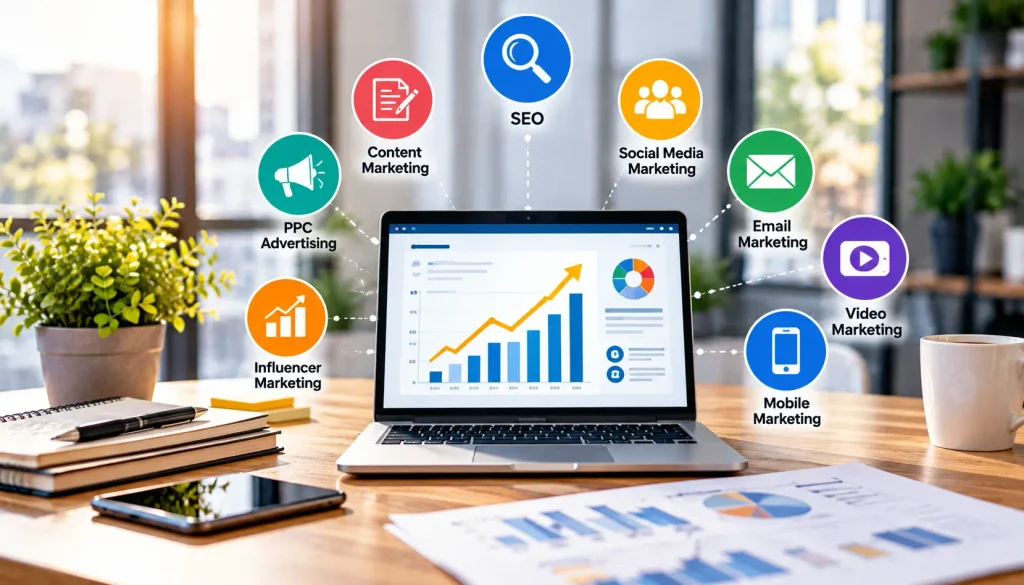
Different businesses may require different digital marketing strategies. Some of the most important areas include the following.
Search Engine Optimization
SEO concentrates on making a site more visible in organic search results. This may include researching keywords, creating content, technical optimization, building internal links, website performance, and user experience.
SEO is important as it enables companies to attract those individuals who are actively looking for the particular service.
Content Marketing
Content marketing involves creating useful and relevant material for a target audience.
Examples include:
- Blog posts
- Guides
- Case studies
- Videos
- Infographics
- Research reports
- FAQs
Good content can educate customers, answer questions, demonstrate expertise, and support SEO.
Content marketing often depends on more than written articles. Businesses also need attractive graphics, social media creatives, banners, presentations, and other visual assets, making graphic design skills valuable for modern digital marketing teams.
Social Media Marketing
Social media marketing makes use of various platforms like Instagram, Facebook, LinkedIn, YouTube, and more to reach out to potential clients.
The most appropriate platform depends on the organization as well as its target customers. This is because there are some businesses that will be entirely B2B organizations.
Pay-Per-Click Advertising
PPC advertising provides a way for companies to pay for their advertisements on different digital platforms including search engines.
This method gives relatively quick visibility, especially when competing on keywords, although the ads should be monitored continuously.
Email Marketing
Email marketing allows businesses to communicate directly with subscribers and existing customers.
Companies can use email to share:
- Product updates
- Educational content
- Special offers
- News
- Events
- Personalized recommendations
Building a permission-based email list can create a valuable long-term marketing asset.
How Digital Marketing Helps Different Types of Businesses

The importance of digital marketing can vary depending on the business model.
Small Businesses
Local SEO, social media, content marketing, and online reviews can all be used by small businesses to raise awareness and bring in customers through the service areas.
E-Commerce Businesses
Through combining SEO, PPC, social media, email marketing, product content and remarketing, e-commerce businesses may be able to reach customers and drive more sales through their website.
B2B Companies
B2B companies may use educational content, search engine optimization, LinkedIn marketing, webinars, e-mail marketing, and case studies to create and nurture their business leads.
Service-Based Businesses
Service providers can use location-based SEO, informative service pages, customer reviews, and lead-generation campaigns to attract potential clients.
Businesses also need strong visual communication across websites, advertisements, social media, and promotional materials. Professionals interested in developing these design skills can explore a CorelDRAW training course to learn practical graphic design techniques.
Digital Marketing vs. Traditional Marketing
Traditional marketing methods can still be valuable, but digital marketing provides several advantages in terms of targeting, measurement, flexibility, and interaction.
| Digital Marketing | Traditional Marketing |
| Can target specific audiences | Often reaches a broader audience |
| Performance can be measured digitally | Measurement can be more difficult |
| Supports two-way interaction | Often primarily one-way |
| Campaigns can be adjusted quickly | Changes may take longer |
| Can reach global audiences | Often focused on specific geographic areas |
| Multiple budget levels are available | Some channels can require significant investment |
The best approach is not necessarily to choose one over the other. Depending on the business, digital and traditional marketing can complement each other.
How to Create an Effective Digital Marketing Strategy
A successful digital marketing strategy starts with clear business objectives.
Step 1: Define Objectives
Define your objectives. It may include increasing website traffic, generating leads, raising brand awareness, making online sales or retaining customers.
Step 2: Identify the Audience
Find out who the target customer is, what problems he has, what information he needs and how does he look for the answer.
Step 3: Find Out What Your Competitors Are Doing
Analyze the competitors to find out their web strategy, content strategy, SEO strategy, social media strategy and consumer experience.
Step 4: Identify Relevant Marketing Tools
Not all the businesses need all kinds of digital marketing tools. Just select those which suit your market and objectives.
Step 5: Produce Useful Content
Ensure that you produce content which addresses consumers' concerns and represents your expertise. It must be relevant, accurate, unique and useful, not just anything.
Step 6: Measure Effectiveness
Identify the metrics which can tell you whether your marketing efforts are benefiting your bottom line.
Step 7: Improve and Adapt
Digital marketing is alway s evolving. Performance reviews should be ongoing to adapt your strategy in response to customer behavior, business performance, and market changes.
Building an effective strategy requires knowledge of SEO, content marketing, social media, paid advertising, analytics, and other digital channels. Individuals who want to develop practical skills across these areas can consider digital marketing training to build a stronger foundation.
Common Digital Marketing Mistakes to Avoid
Businesses can reduce wasted effort by avoiding common mistakes.
Focusing Only on Sales
Unending promotions for products without offering any information can bore your audience. You should balance promotion with informative and helpful content.
Ignoring Mobile Users
Much internet activity happens via mobile devices. Web sites need to be fast and readable on such devices.
Targeting Everyone
Marketing communications that attempt to speak to everyone tend to become irrelevant. Identify your target market, and then develop your message for them.
Not Measuring Results
In the absence of performance measurement, it may not be easy to know if a campaign contributes to business goals.
Expecting Immediate Results From Every Strategy
Certain channels like SEO and content marketing can sometimes need sustained effort before results start to show. Organizations must set realistic goals and measure their success in an appropriate time frame.
Future of Digital Marketing
Digital marketing is bound to develop further due to the development of technologies and customer behavior. Artificial intelligence, automation, personalization, video marketing, conversation experiences, and evolving search behavior are some examples of the factors that are currently impacting the way businesses connect with customers.
However, it is essential not to forget about the basics – to know the audience, offer relevant information, earn trust, offer great customer experience, and see what results it brings to the business.
As businesses focus more on interactive websites and user experiences, web development skills are also becoming increasingly valuable. Learning technologies such as React can help developers create dynamic interfaces that support modern digital experiences, and those interested can explore React JS training for practical development skills.
Conclusion
The importance of digital marketing stems from its ability to allow businesses to reach customers in places where they tend to spend more time, look for information, compare products, and decide to buy something.
It could help in increasing visibility on the Internet, lead generation, brand awareness, and understanding of consumer behavior, among many other stages of business development.
The best way to conduct digital marketing activities is not necessarily to employ all available digital marketing channels. It is better to have a targeted plan that will depend on such factors as target audience, objectives, available resources, and achievable results.
Frequently Asked Questions
Why is digital marketing important for businesses?
Digital marketing is useful for firms to get connected to their audiences, increase their visibility on the Internet, attract leads, interact with their customers, and evaluate their marketing activities. It may assist in both short-term and long-term operations.
What are the main benefits of digital marketing?
The key benefits that stand out include greater coverage, targeted marketing, improved performance, consumer engagement, traffic generation, lead generation, brand recognition, and business growth possibilities.
Is digital marketing suitable for small businesses?
Certainly. Small businesses can take up strategies such as local SEO, content marketing, social media marketing, email marketing, and even advertising in order to target their audience without having to engage in massive advertising programs.
How does SEO contribute to digital marketing?
SEO helps in increasing the visibility of websites on the natural search engines. By creating useful content and optimization of other factors, businesses can get to people who need such products or services.
How long does digital marketing take to show results?
It will depend on the strategy used, the industry sector, competitors, the website itself, and many other factors. Paid advertising ensures fast results, while SEO and content marketing require more time and patience to be effective.