

Difference Between Hacking and Ethical Hacking: Meaning, Examples & Career
 Aug 07, 2026
Quick Answer
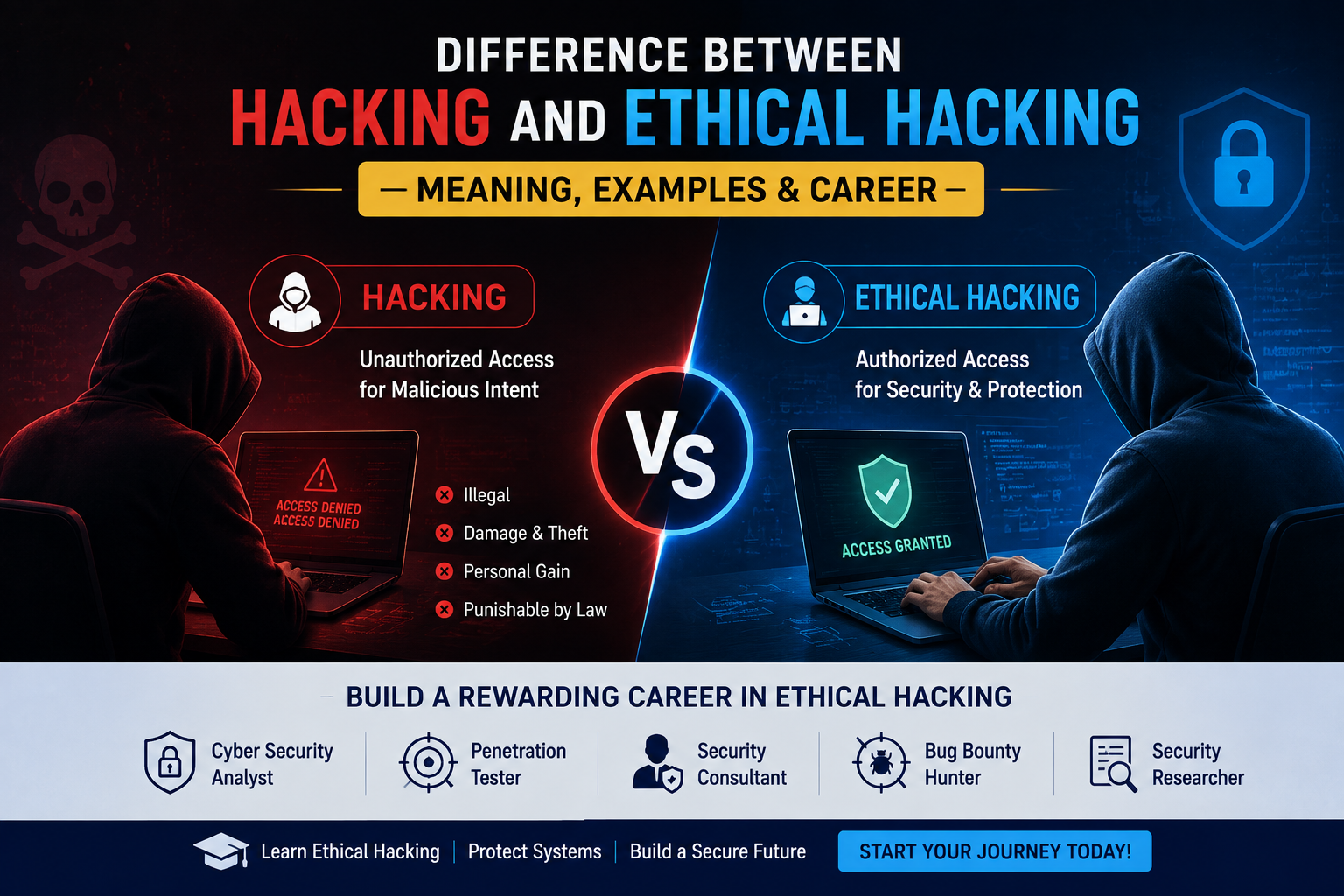
Hacking involves gaining unauthorized access to a computer network, computer system, or other devices both with and without authorization. On the other hand, ethical hacking involves hacking that occurs within the confines of law. While hacking may be either illegal or legal, ethical hacking is only legal and authorized. The main distinction between hacking and ethical hacking is whether there is intention and consent involved. Hacking could either be black hat or white hat whereas ethical hacking is always authorized by the owner of the system in question.
What Is Hacking?
The act of hacking, as a concept, involves uncovering and using vulnerabilities in any computer system or program to penetrate the system illegally. Hacking has a bad reputation because it's usually done for committing cybercrime – stealing information, distributing malicious software, etc.
Yet hacking by itself doesn't have to be illegal or malicious. It all depends on the hacker's motives and authorization behind the act. This is why security experts categorize hackers as:
- Black hat hackers — break into systems without consent, generally for their own personal advantage, information theft, or causing disturbances. This is termed as illegal hacking.
- White hat hackers — do hacking with prior consent from the owner in order to increase the security of that system. This is called ethical hacking.
- Grey hat hackers — fall somewhere in between the two, where they may disclose vulnerabilities in a system without permission, but not with any malice.
What Is Ethical Hacking?
Ethical hacking is legitimate hacking conducted with the aim of uncovering any vulnerabilities existing in an organization’s computer system so that the organization may fix them before any malicious parties are able to take advantage of them.
Some of the essential features that define ethical hacking are:
- Explicit permission from the system or network owner
- A defined scope of what can and cannot be tested
- Legal compliance with cyber laws and data protection regulations
- Responsible reporting of vulnerabilities found, instead of exploiting them
- No damage or data theft — the goal is to secure, not harm
This is precisely why ethical hacking has emerged as one of the most desirable specialties in a larger field of cyber security education, because firms need individuals who can think like a hacker but defend like a defender.
Hacking vs Ethical Hacking: Key Differences
| Aspect | Hacking (Malicious) | Ethical Hacking |
| Permission | No authorization from owner | Explicit, written authorization |
| Intent | Personal gain, disruption, theft | Improve security, find vulnerabilities |
| Legality | Illegal, punishable under cyber law | Fully legal within agreed scope |
| Outcome | Data breaches, financial loss, damage | Vulnerability reports, stronger defenses |
| Tools used | Same tools, used destructively | Same tools, used constructively |
| Career path | Leads to prosecution | Leads to jobs in cyber security |
Both hacking and ethical hacking use similar technical skills — network scanning, exploiting vulnerabilities, bypassing authentication — but the outcome and legality are completely different.
Real-World Examples of Hacking vs Ethical Hacking
Example of Malicious Hacking
A person who carries out an attack sends the email as if it were from a bank, and tricks the employee into entering the login information on a website. Using the login details, the hacker gets access to the system and steals the sensitive information without any authorization. It is a crime.
Example of Ethical Hacking
A firm engages an ethical hacker with certification credentials to check out the security of its emails. With documented permission, the hacker sends a fake phishing email to the staff of the company to see how many people open it. No information is stolen; the aim is to identify the level of awareness and improve training.
The difference between the two examples above is that while both use phishing, one of them is a criminal act, while the other helps in securing the business.
Why Ethical Hacking Matters in 2026

With companies in India becoming more and more dependent on digital networks, the likelihood of cyberattacks has also increased rapidly. Ethical hacking is now one of the most important strategies for protection. Reasons why ethical hacking is so relevant today include:
- Increase in the number of ransomware attacks and phishing scams targeting businesses in India
- Greater use of cloud computing systems, internet of things, and remote working arrangements – new vulnerabilities
- Data protection laws that mandate conducting security tests proactively
- More in-house and freelance penetration testers being hired
It is the reason that ethical hacking job opportunity scope is continuously increasing, particularly those who have gone through structured and practical cyber security training.
Skills Needed to Become an Ethical Hacker
From knowing what hacking is to becoming an ethical hacker, one must possess a certain skill set, which is:
- Networking fundamentals — TCP/IP, DNS, firewalls, and traffic analysis
- Operating systems — especially Linux, widely used in security tools
- Programming/scripting — Python is especially valuable for automating security tasks; students in our Python course in Surat often go on to apply these skills directly in ethical hacking labs
- Security tools — Nmap, Wireshark, Metasploit, Burp Suite
- Understanding of cyber law — knowing legal boundaries is what separates ethical hackers from criminals
- Analytical and problem-solving mindset — thinking like an attacker to defend like a professional
How to Start a Career in Ethical Hacking

- Build core IT knowledge — networking, operating systems, and basic programming.
- Learn ethical hacking fundamentals through a structured, hands-on program rather than scattered tutorials.
- Practice legally on platforms designed for safe hacking practice.
- Get certified to validate your skills to employers.
- Apply for entry-level roles like security analyst, SOC analyst, or junior penetration tester.
If you're based in Gujarat, our cyber security course in Surat is built around this exact path — covering networking, tools, and hands-on labs so you graduate job-ready rather than just certificate-ready. Students in Madhya Pradesh can explore the same structured path through our cyber security course in Bhopal, designed with the same industry-aligned curriculum.
Career Scope: Hacking Sk ills, Used Legally
Selecting the field of ethical hacking as a career provides opportunities for various positions:
- Penetration Tester – performs attacks to identify vulnerabilities.
- Security Analyst – detects real threats and manages networks
- SOC Analyst – works at the security operations center
- Vulnerability Assessor – determines and prioritizes vulnerabilities.
- Cybersecurity Consultant – advises companies on how to develop proper protection.
Ethical Hacking is also a field that goes well with other fields. For those who wish to learn about the relationship between security and data and automation, we have an AI/ML & Data Science course at Bhopal which teaches the concepts that are being used more and more in today's threat detection systems.
Frequently Asked Questions
What is the primary difference between hacking and ethical hacking? The primary difference lies in the permission and the motive behind performing the act. Unauthorized hacking is both illegal and often malicious while ethical hacking is legal as the permission is sought before starting the process.
Is ethical hacking legal in India? Ethical hacking is perfectly legal in India provided that there is proper authorization from the owner of the system or the network within the scope of agreement.
Can a hacker become an ethical hacker? It is quite possible that many ethical hackers were once hackers themselves until they have gained certification and undergone training.
What are the qualifications required to be an ethical hacker? Formal qualifications are not essential to enter into this profession, as practical knowledge and certification take precedence over education alone.
Is ethical hacking a good career option in 2026? It certainly is as the increasing cyber threats and digitalization in the world makes the demand for ethical hackers increase every year in India and all over the world.
Summary
Hacking versus ethical hacking is not about having a certain level of skill; it is about the permissions, intentions, and legality involved. The same methods and skills that can take down a company can also be used to safeguard the company, which is what ethical hacking has to offer as a career choice. With the proper training and lab experience, anyone can become an ethical hacker.
Related Post:
Top 15 Benefits of Data Science Every Student Should Know
6 Month Courses After 12th: Complete List, Eligibility & Career Options
Is UI/UX Design a Good Career Choice? Salary, Scope & Skills