


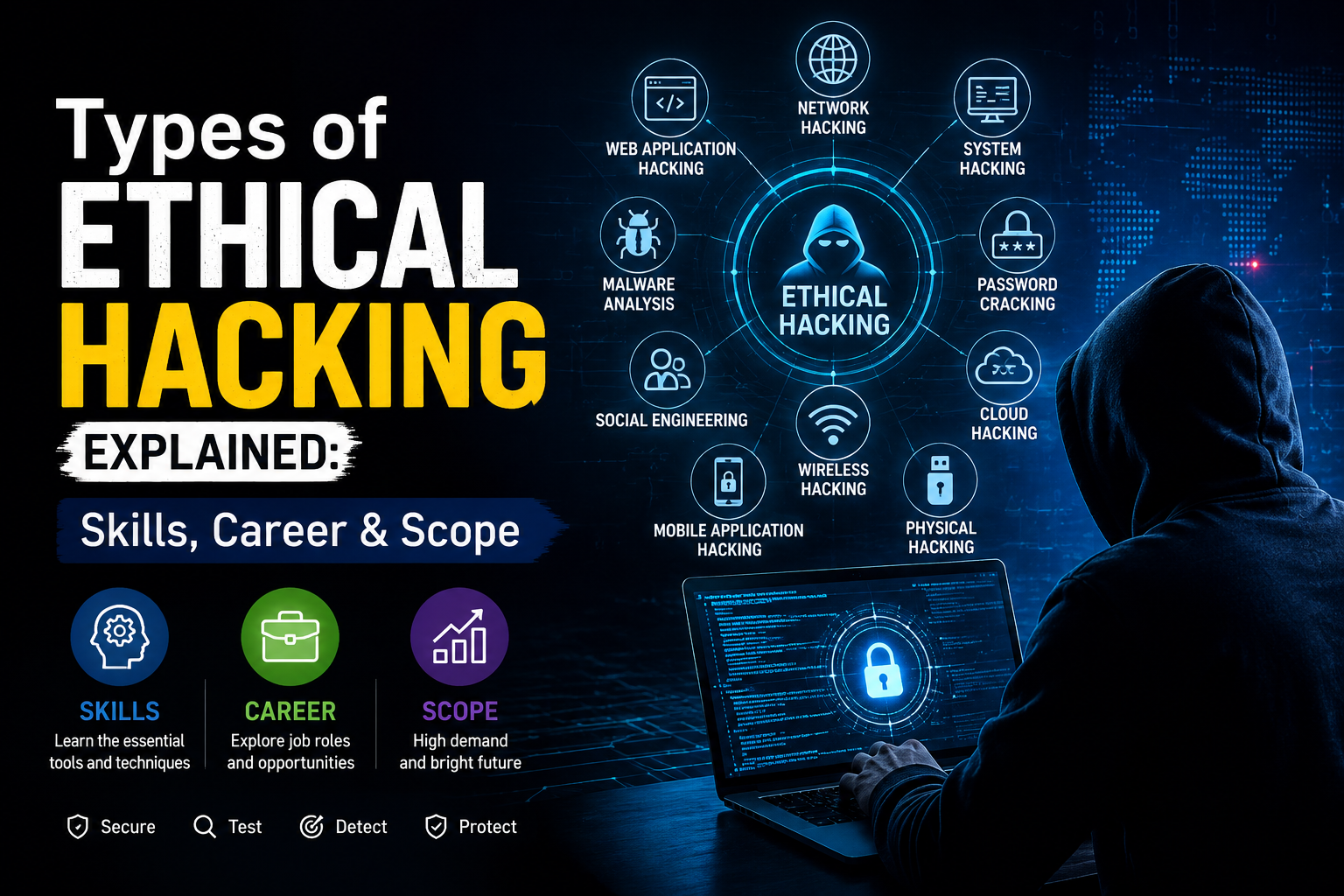
Types of Ethical Hacking Explained: Skills, Career & Scope
 Aug 07, 2026
Quick Answer
An ethical hacker is a person who tries to access systems, networks, and applications for security flaws without committing any illegal actions. There are various forms of ethical hacking, such as network hacking, web application hacking, wireless hacking, social engineering hacking, and system hacking. Each of these ethical hacking techniques targets a specific area of the digital infrastructure of an organization. An ethical hacker or white hat hacker requires expertise in networking, programming, and security tools. There is immense scope for this profession in India owing to increasing cyber-attacks and graduates from cyber security courses.
What Is Ethical Hacking?
Ethical hacking is legal hacking. An authorized person who performs this task, often referred to as an ethical hacker or white hat hacker, makes use of the exact software and skills that are used by cyber criminals — except he is doing it with the consent of his client and with the intention of defending systems from any threats. Corporations employ ethical hackers to perform pen tests (penetration tests) on their systems.
The increased number of businesses opting for online functioning in India – banks, hospitals, shopping sites, educational institutes etc., have made it imperative to have competent ethical hackers. This is precisely the reason why cyber security has become one of the most sought-after career choices for those planning to take up a course post 12th standard or upgrade their skills at work.
Types of Ethical Hacking

However, it is worth knowing that ethical hacking is not just one type of expertise. There are many specializations, all aimed at distinct surfaces of attacks. Below you can see all of them.
1. Network Hacking
Network hacking is the act of checking for vulnerabilities in the internal and external network of a company by identifying any open port, faulty firewall, obsolete protocols or poor encryption. Professional hackers utilize software such as Nmap and Wireshark to scan the network in order to see how they will exploit its vulnerabilities.
2. Web Application Hacking
Because the vast majority of companies operate their businesses through websites and web applications, web application penetration testing is one of the most popular forms of ethical hacking. This form of hacking tries to detect any vulnerabilities that may be found in the form of SQL injection, XSS (cross-site scripting), broken authentication, and insecure APIs.
3. Wireless Network Hacking
Wireless hacking focuses on Wi-Fi networks and other wireless forms of communications. The ethical hacker will look at the security of the encryption standards, access point security, and rogue devices to see how easy it will be for the attacker to get into the network without plugging anything in.
4. System Hacking
System hacking refers to the process where the hacker targets a particular device such as the personal computer, server or laptop as opposed to targeting the entire network. System hacking tests whether there are vulnerabilities such as weak passwords, privilege escalation and out-of-date software.
5. Social Engineering
Not all hacks are technical. Social engineering takes advantage of human behavior instead of flaws in the computer system — for example, through phishing emails, making telephone calls, or pretending to be someone else in order to get an employee to give out their password or allow access to something.
6. Web Server Hacking
Such hacking techniques concentrate on the servers that host the web sites and applications. The ethical hackers try to find out any misconfigurations or vulnerabilities in the server software that can allow an attacker to deface a web site or bring down the entire server.
7. Cryptography-Based Hacking
In this case, the ethical hackers will conduct an assessment to find out the strength of encryption applied in the encryption process. The aim is to check whether weak algorithms and poor key management might enable decryption by malicious users.
Skills Required to Become an Ethical Hacker

A career in ethical hacking requires both theoretical and practical knowledge. The following is what a beginner will require to develop:
- Networking basics – TCP/IP, DNS, firewalls, and data transfer through the network
- OS knowledge – preferably Linux, as all the security tools use Linux
- Programming and scripting – Python, Bash, or PowerShell help automate tasks and understand exploits
- Knowledge of security tools – Nmap, Metasploit, Wireshark, Burp Suite, and John the Ripper
- Web technology knowledge – HTTP/HTTPS, cookies, sessions, and web vulnerabilities
- Analytical skills – ethical hacking is essentially troubleshooting
- Compliance and laws awareness – since ethical hacking is always within the legal framework
All novices begin with basic IT and networking concepts and progress to specialized certifications and practical lab work to gain actual experience.
How to Start a Career in Ethical Hacking
For those who are curious about how one can be an ethical hacker in India, here is a feasible route:
- Gain the technical know-how – basics in computing sciences, networking, and operating systems.
- Gain programming skills – learn how to code in languages like Python since it is easy to learn.
- Enroll in a structured cyber security course — guided training with lab access speeds up learning far more than self-study alone.
- Engage in legal activities – use platforms like TryHackMe and Hack The Box that provide safe spaces to hack and practice your skills.
- Go for certification – get certified to prove your skills to future employers who may require it for employment.
- Apply for internships or entry-level jobs – positions like Security Analyst and SOC Analyst.
It is important to have an organized program for ethical hacking because it involves many fields like networking, web applications, cryptography, etc., and learning about all of these subjects on one’s own would take years. A properly designed cyber security course covers all of these aspects in a compact form.
Career Scope of Ethical Hacking in India
In India, the scope for cyber security careers has grown exponentially, thanks to the rapid adoption of digitization in various industries including banking, healthcare, retail, and governments. Various roles within ethical hacking include:
- Penetration Tester – tests systems to identify vulnerabilities prior to exploitation
- Security Analyst – detects and mitigates threats in real-time
- SOC Analyst (Security Operations Center Analyst) – responsible for incident detection and management
- Vulnerability Assessor – discovers and prioritizes security vulnerabilities
- Cyber Security Consultant – advises companies on security strategy improvement
The remuneration in this domain is highly competitive, and there is an increasing requirement for ethical hackers due to increasing threats in cyberspace. For those who are opting for a course post class 12th or even changing their profession, ethical hacking provides an extremely future-proof career option.
Cyber security career scope in India has expanded rapidly... RW Skill offers hands-on cyber security training across multiple cities, including Surat and Bhopal, to meet this growing demand.
Frequently Asked Questions
What are the major forms of ethical hacking?
The major forms include network hacking, web application hacking, wireless hacking, system hacking, social engineering, web server hacking, and cryptography hacking. Each one is targeting a particular layer of the company's computer system.
Is ethical hacking a good career path in 2026?
Yes. As cyber-attacks become more rampant and companies increasingly adopt digital technology, the demand for qualified and competent ethical hackers is continually increasing.
Do I need to have a college degree to be an ethical hacker?
No, not always. Most ethical hackers get into the profession without the aid of a four-year college degree.
Which are the major skills required to be an ethical hacker?
Networking skills, knowledge of the Linux operating system, basics of programming, preferably Python, and practical experience with Nmap, Metasploit, and Burp Suite security software among others.
How long does it take to be job-ready in ethical hacking?
A job ready beginner in ethical hacking can be job-ready in as little as 6 months with a structured cyber security course.
Summary
It is no more a specialized task but a fundamental aspect of any company’s defense strategy in today’s business environment. Knowledge of different kinds of ethical hacking like network, web application, and even social engineering can give you an idea about the extensive nature of ethical hacking.
If you want to become a cyber security professional, the most effective way of doing it would be through well-structured and hands-on training in all these areas instead of piecing everything together from different websites.
Related Post:
Difference Between Hacking and Ethical Hacking: Meaning, Examples & Career
Top 15 Benefits of Data Science Every Student Should Know
6 Month Courses After 12th: Complete List, Eligibility & Career Options