


What Are the Three Goals of Cybersecurity? A Complete Guide
 Oct 05, 2026
Today, cybersecurity is an integral aspect of technology as people have come to rely heavily on digital platforms whether it is for personal use or business transactions. From financial transactions done through the internet and the use of cloud applications, there is a lot of data that is processed through digital means. The protection of such platforms does not only involve installing anti-virus software or strong passwords.
So, what are the three goals of cybersecurity?
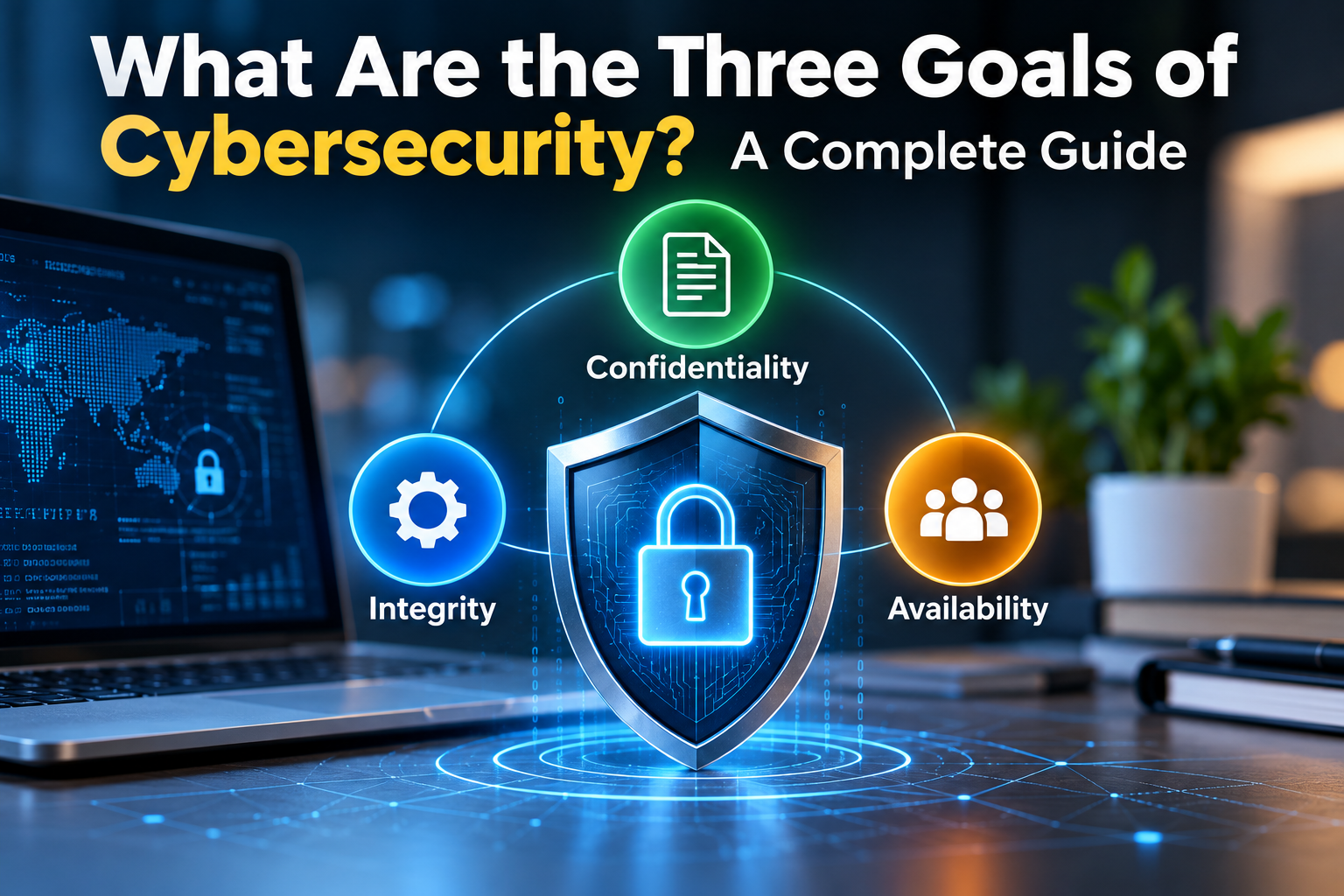
The first three objectives are Confidentiality, Integrity, and Availability, known collectively as the CIA Triad. These objectives serve as the cornerstone of protecting information and IT systems. The objective of Confidentiality is all about preventing unauthorized access, while the objective of Integrity guarantees that the information is accurate and reliable. Lastly, the objective of Availability guarantees access to systems and information for those who need it.
It is important to understand these objectives for everyone interested in information technology, ethical hacking, networking, or cybersecurity.
What Is the CIA Triad?
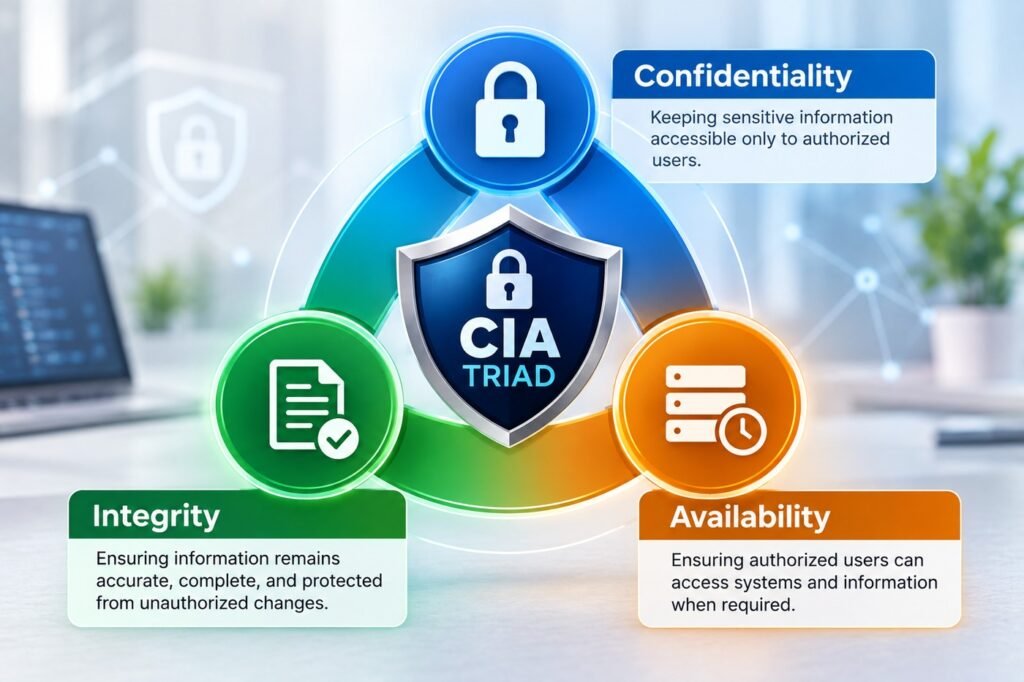
The CIA Triad is a fundamental cybersecurity model used to understand the three core objectives of information security:
- Confidentiality: Keeping sensitive information accessible only to authorized users.
- Integrity: Ensuring information remains accurate, complete, and protected from unauthorized changes.
- Availability: Ensuring authorized users can access systems and information when required.
The three objectives are interrelated such that even if an IT system has access controls in place, its security is still compromised if it is possible to modify the information without being authorized to do so. On the other hand, it may be the case that information is safe and accurate but not accessible to those who require it.
CIA Triad can thus offer a very useful tool for risk assessment and appropriate security control implementation.
1. Confidentiality
Confidentiality is the first objective of cybersecurity.
Confidentiality refers to safeguarding information against any kind of access or disclosure that is unauthorized. People, applications, or systems that have been given the necessary clearance should only be allowed to access such information.
For instance, an organization’s database on its employees might hold sensitive information like their personal details and salary. This information should not be easily available for everyone.
Why Is Confidentiality Important?
Any breach of confidentiality can lead to the leakage of sensitive data by cyber criminals, competitors, unauthorized personnel, etc. The stolen information may be used for various malicious purposes like identity theft, fraud, etc.
Various methods used to ensure confidentiality are:
- Authentication methods
- Multi-factor authentication
- Encryption of data
- Access control
- Permissions
- Network segmentation
- Secure communication
- Data classification
For instance, encryption transforms plaintext information into an unreadable format whereby only those who are authorized can read it.
Example of Confidentiality
Think about the case of online banking account. The user will definitely keep his bank balance, transactional history, and personal information confidential.
In case the attacker gets into the system and sees all these details, it can be said that confidentiality is breached.
It is easy to understand confidentiality in the following words:
“Who should see the information?”
2. Integrity
The other objective of cybersecurity is integrity.
Integrity implies the assurance of data authenticity, consistency, and reliability. The data should neither be tampered with, altered, nor deleted.
While ensuring that information is protected from any form of intrusion is essential, it is equally important that the data itself is accurate.
Why Is Integrity Important?
Imagine a company's accounting system contains a payment record for ₹25,000. If someone changes that amount to ₹2,50,000 without authorization, the information can no longer be trusted.
Integrity is particularly important in areas such as:
- Banking
- Healthcare
- Government
- E-commerce
- Manufacturing
- Education
- Financial reporting
Even a small unauthorized change to important information can have significant consequences.
Organizations can use measures such as:
- Hashing
- Digital signatures
- Access controls
- Audit logs
- File integrity monitoring
- Version control
- Database security
- Change-management procedures
Example of Integrity
Think of the digital patient record kept by the hospital. If there is any unauthorized modification in the patient’s medical information, the physicians will take decisions on the basis of wrong information.
The point here is not whether anyone accessed the information. It is whether the information is accurate or not.
There is a simple rule for integrity:
“Is the information reliable?”
3. Availability
Thirdly, there is availability.
Availability implies that systems, applications, networks, and information should be accessible to the right people at all times.
If a system is not available for use, it will not serve its intended purpose.
Why Is Availability Important?
Consider, for example, a case where an e-commerce website is down during a peak shopping period. Neither the customers nor the employees will be able to make any purchases, leading to potential losses to the business.
This holds true even for hospitals, banks, schools, governmental bodies, and any entity that relies on digital services constantly.
Factors affecting availability include:
- DDoS attacks
- Ransomware
- Hardware failures
- Software failures
- Network outages
- Power failure
- Natural disasters
- Server issues
- System configuration issues
Organizations can improve availability through:
- Routine Backups
- Redundancy
- Disaster Recovery Plans
- Failover Systems
- Load Balancing
- Monitoring Network
- Cloud Services Infrastructure
- Backup Power
- Business Continuity Planning
A simple way to remember availability is:
“Can authorized users access the system when they need it?”
Confidentiality vs Integrity vs Availability
The three cybersecurity goals can be understood more easily by comparing them:
| Goal | Main Purpose | Example |
| Confidentiality | Prevent unauthorized access | Encrypting customer information |
| Integrity | Prevent unauthorized changes | Protecting financial records from manipulation |
| Availability | Ensure access when needed | Keeping an online service operational |
A strong cybersecurity strategy considers all three rather than focusing on only one.
How the Three Goals Work Together
The CIA Triad is more effective when all three components are taken together into consideration.
Let’s take the case of online banking.
Confidentiality: Access to financial data should only be available to authorized customers and staff members.
Integrity: The transaction records and account balances should be accurate and should not be altered.
Availability: The customers should have access to accounts whenever necessary.
If confidentiality is compromised, sensitive data might be stolen. If there is a failure in integrity, incorrect data might be entered. When there is a problem with availability, users might not be able to access the service.
It proves why there is a need for balanced security.
Cybersecurity and Modern Technology Careers

Confidentiality, integrity, and availability are concepts that are applicable to various IT career paths. With knowledge of these basic concepts, the students may investigate various fields including network security, ethical hacking, cloud security, application security, and data protection.
IT security specialists should have knowledge about operating systems, networking, programming, security tools, and vulnerabilities assessment.
Students interested in developing practical cybersecurity knowledge can explore a structured Cyber Security Course in Surat, where cybersecurity concepts can be connected with practical technology skills.
Role of Web Development in Cybersecurity

Websites and web applications are often targeted by cyber-attacks. Hence, knowledge about how websites and web applications are created and built will be useful for individuals interested in knowing about the security threats and vulnerabilities.
Having a good understanding of HTML, CSS, JavaScript, database, server and web application architecture may be helpful for learners.
Students interested in developing foundational website knowledge can explore a Web Design Course in Surat as part of their broader technology learning journey.
Why Programming Skills Matter
Programming can be considered an additional useful skill in the area of cybersecurity. Programmers can apply their knowledge of programming languages to automate processes, analyze files, operate with security software, test applications, as well as analyze any suspicious activities.
It also helps them understand how certain applications process data and identify possible vulnerabilities.
Modern web technologies also rely heavily on JavaScript frameworks. Students who want to understand interactive web applications can explore React JS Training in Surat to build knowledge of modern front-end development.
Data and Artificial Intelligence in Cybersecurity

With cybersecurity, more and more there is an issue of analyzing huge amounts of data. Security personnel might have to analyze logs, authentication data, applications, and other sources of data in order to detect any anomalies.
Artificial intelligence can help in such areas as anomaly detection, fraud detection, threat detection, and security monitoring.
Understanding data analysis can therefore complement cybersecurity knowledge. Students interested in this area can explore a Data Science and Artificial Intelligence Course in Surat to learn about data-driven technologies.
Importance of Visual Communication for Security Professionals
Cybersecurity experts must be able to convey their technical knowledge using reports, presentations, dashboards, diagrams, and security awareness literature.
While graphic design is not necessarily a cybersecurity prerequisite, having some visual communication abilities may enable the expert to communicate complex information more effectively.
Students interested in developing these creative and communication skills can explore a Graphic Design Course in Surat.
Common Cybersecurity Threats Related to the CIA Triad
Various types of cyber threats have an effect on different aspects of the CIA triad.
Phishing
Phishing is a type of attack aimed at stealing confidential information from a user. It results in the violation of the confidentiality principle.
Ransomware
Ransomware makes it impossible for users to access files or systems, which makes availability an issue. Some ransomware attacks also include data theft.
Malware
The malware can steal information, change files, harm a system or hinder the performance of usual actions.
Denial of Service Attacks
These attacks are aimed at disrupting a service by overwhelming it. The availability of the service becomes impossible.
Insider Threats
Authorized users are capable of unintentionally or intentionally disclosing confidential information or making changes.
How Organizations Protect the CIA Triad
Organizations implement various types of security controls to ensure that their systems have confidentiality, integrity, and availability.
Authentication
It is a process of determining the identity of an individual before accessing the system.
Access Control
The controls are implemented to dictate the level of access permitted for authorized users.
Encryption
This control provides protection to sensitive data against any unauthorized access.
Backups
Organizations take backups to recover their data in case of accidental deletion, hardware failure, ransomware attacks, or any such incidents.
Security Monitoring
Monitoring systems and networks could help the organization detect suspicious activities.
Disaster Recovery
Disaster recovery planning aids organizations in restoring their key operations following a disruption.
There is no particular technology that would assure complete safety and security. It normally takes several layers of controls to secure an organization.
Why Should Students Learn the CIA Triad?
Students who wish to get into cybersecurity should know about the CIA Triad since it can serve as an essential basis for a lot of advanced cybersecurity subjects.
There are several questions one can ask when investigating a particular security breach situation:
Is the sensitive data compromised?
That is associated with confidentiality.
Is the data altered?
That is associated with integrity.
Is the data unavailable?
That is associated with availability.
Tips for Remembering the Three Goals
An easy way to remember the three cybersecurity goals is:
C — Confidentiality: Keep information private.
I — Integrity: Keep information accurate and trustworthy.
A — Availability: Keep systems and information accessible to authorized users.
Together, these principles form the CIA Triad.
Frequently Asked Questions
What are the three objectives of cybersecurity?
There are three main objectives of cybersecurity, which are confidentiality, integrity, and availability. They are collectively referred to as the CIA Triad.
What does confidentiality mean in cybersecurity?
Confidentiality refers to the protection of sensitive information and ensuring that it is accessed by authorized users.
What does integrity mean in cybersecurity?
It refers to the accuracy and consistency of information and making sure that it is not tampered with by unauthorized parties.
What does availability mean in cybersecurity?
Availability refers to the ability of authorized users to access information or systems at will.
Why is the CIA Triad relevant?
The CIA Triad is an essential framework of cybersecurity and helps in understanding what cybersecurity should aim at protecting, especially from risks of information leaks, manipulation, and interference.
Is the CIA Triad useful to students studying cybersecurity?
Yes, the CIA Triad is fundamental and will assist in studying other aspects of cybersecurity including hacking, network security, application security, incident response, and risk management.
Conclusion
Now, what are the three objectives of cybersecurity? The three objectives of cybersecurity are Confidentiality, Integrity, and Availability.
Confidentiality ensures that data is not accessed by any third parties, integrity ensures that data is authentic and correct, and availability ensures that authorized users have access to systems and data when needed.
The three concepts together form the pillars of CIA triad and still hold true in almost all fields related to information security. Regardless of whether one wants to know about ethical hacking, networks, web applications, data security, or artificial intelligence, having knowledge of the three objectives can serve as a good base while learning about cybersecurity.
For students interested in a career in the tech industry, cybersecurity is an exciting field that involves problem-solving skills, technical knowledge, analysis, and application. Understanding the CIA Triad is a good way to start.