

Why Gujarat Students Are Shifting to Skill-Based Learning (And What It Means for Your Career in 2026)
 Apr 27, 2026

RWn. Chakshu Adani
Subject Matter Expert
A few years ago, the plan was quite straightforward.
Study hard. Score well. Get a degree. Get a job.
Individually, a generation of students in Gujarat — in Surat, in Ahmedabad, in every city and town across the state — without questioning it, simply followed this formula. They did it because their parents had followed it. They did it because their teachers had validated it. The whole system was based on it.
One day, very quietly, something broke.
Students with degrees suddenly found it very hard to get jobs. Companies started dismissing even qualified candidates in their very first interview. Families started seeing that their children were highly educated yet unemployed — and no one really had a perfect explanation for it.
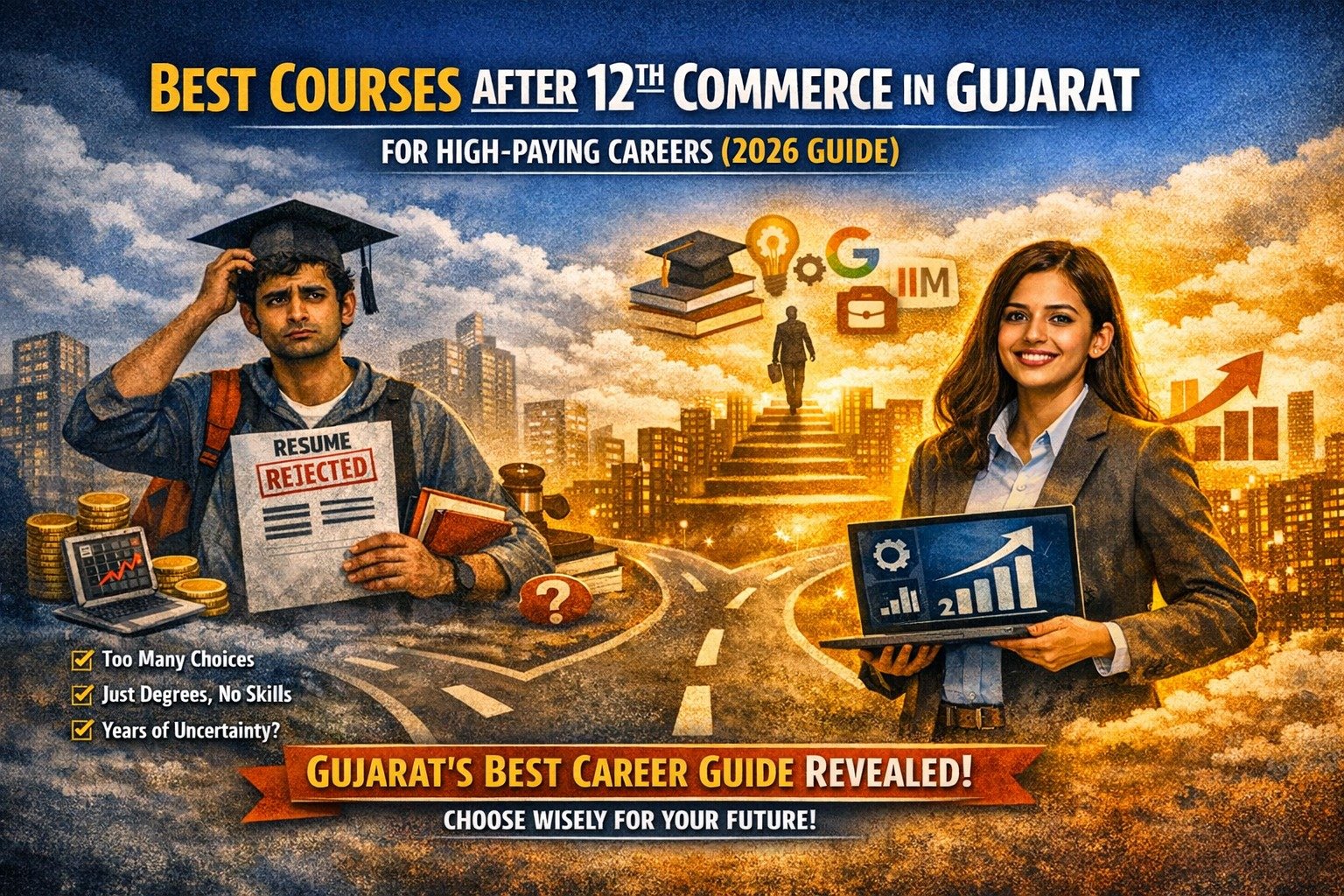
Well, the explanation is, the formula stopped working. Not because students became less capable, but because the job market changed in the way that the education system didn't keep pace with it. Skills demanded by companies in 2026 were not the skills that were being taught in colleges — and the gap between these two realities was the place where careers got stuck.
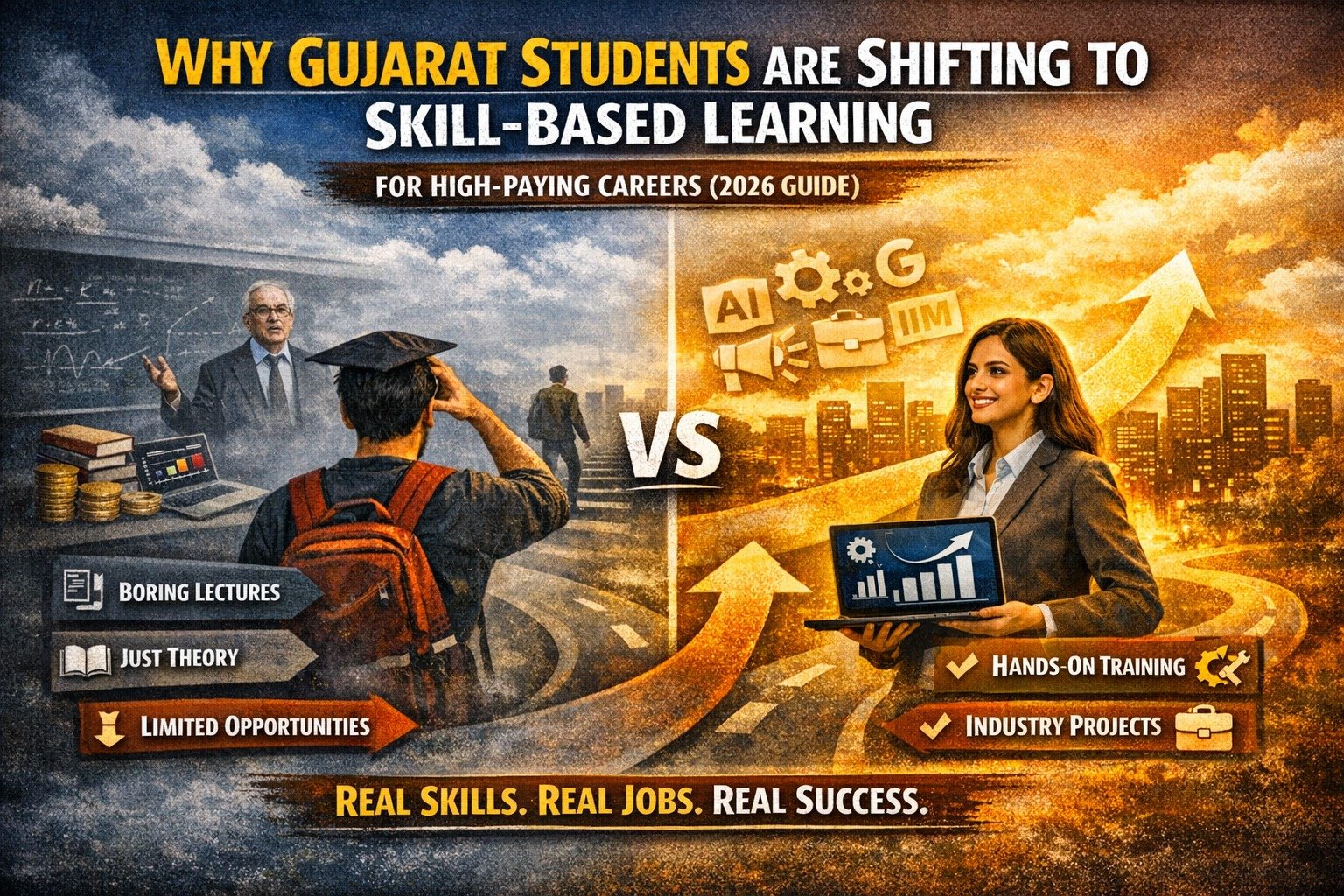
Presently, something else is happening across Gujarat. Students are realizing this fact earlier than ever. They are opting for skill-based learning in Gujarat alone or instead of just completing a degree passively — and the career results they are generating are very different from the generation before them.
This is not just a trend. It is a big change in the structure of things. And if you are a student or a newcomer in Gujarat, understanding this could be the biggest thing you do for your career this year.
What Is Actually Changing in the Job Market
Let's frankly acknowledge what has changed - after all, this isn't about being pessimistic but simply about being factual.
The Indian employment scenario, especially the business and marketing sector in Gujarat's prosperous commercial centres, Surat and Ahmedabad, has undergone a radical transformation during these last few years. Various factors are at play.
Businesses are replacing humans with machines for simple tasks. Running a piece of software, AI tool, or automated system is often enough for what would otherwise require several low-level workers. As a result, employers now set higher requirements for human employees - they won't pay a basic degree-holder anymore simply because of the degree. Students who want to stay relevant in this changing landscape can explore an AI/ML Course in Surat or an AI/ML Course in Ahmedabad to understand automation, data-driven decision making, and future-ready technologies.
The pace and demands of different sectors are increasing. Whether it is products, ads, or overall strategies - everything is happening at such speed that employees who can adapt, perform and learn quickly are needed. Those candidates only knowing theories will slow teams whereas ones having practical knowledge will help teams.
Companies have also become more discerning when it comes to hiring. Since several applications are received for each deserving role, recruiters from Surat and Ahmedabad won't entertain candidates who can not instantly prove their worth. The first interview is no longer a chat - it is a sort of test. And you cannot pass a test of skills you have never done the practice of.
Such situations are not temporary. They are what one can call a "new normal". And indeed, job-focused training institutions in Gujarat that equip students with these new norms are turning out the ones who are actually placed.
Why Degrees Alone Are No Longer Enough
Perhaps this is the moment that most students - not to mention parents - find uncongenial. However, it must be said quite plainly.
A degree is NOT a career. It’s a qualification. And in 2026, qualifications will be commonplace.
Nearly everyone you see sharing the same interview room with you will have a degree. Many of them will also have well-matched CGPA scores. A number of them will have graduated from equally good colleges. A degree, at this stage, is the ticket to getting your application consideration - but hardly accounts for what will occur after you get the nod.
What occurs behind closed doors is all about competence. Are you able to present yourself eloquently and professionally? Can you convey that you have an insight on how a business works? Are you able to indicate that you have familiarity with the company systems that the company depends on? Is there any evidence that you will be a valuable asset instead of needing months of mentoring before you ever become productive?
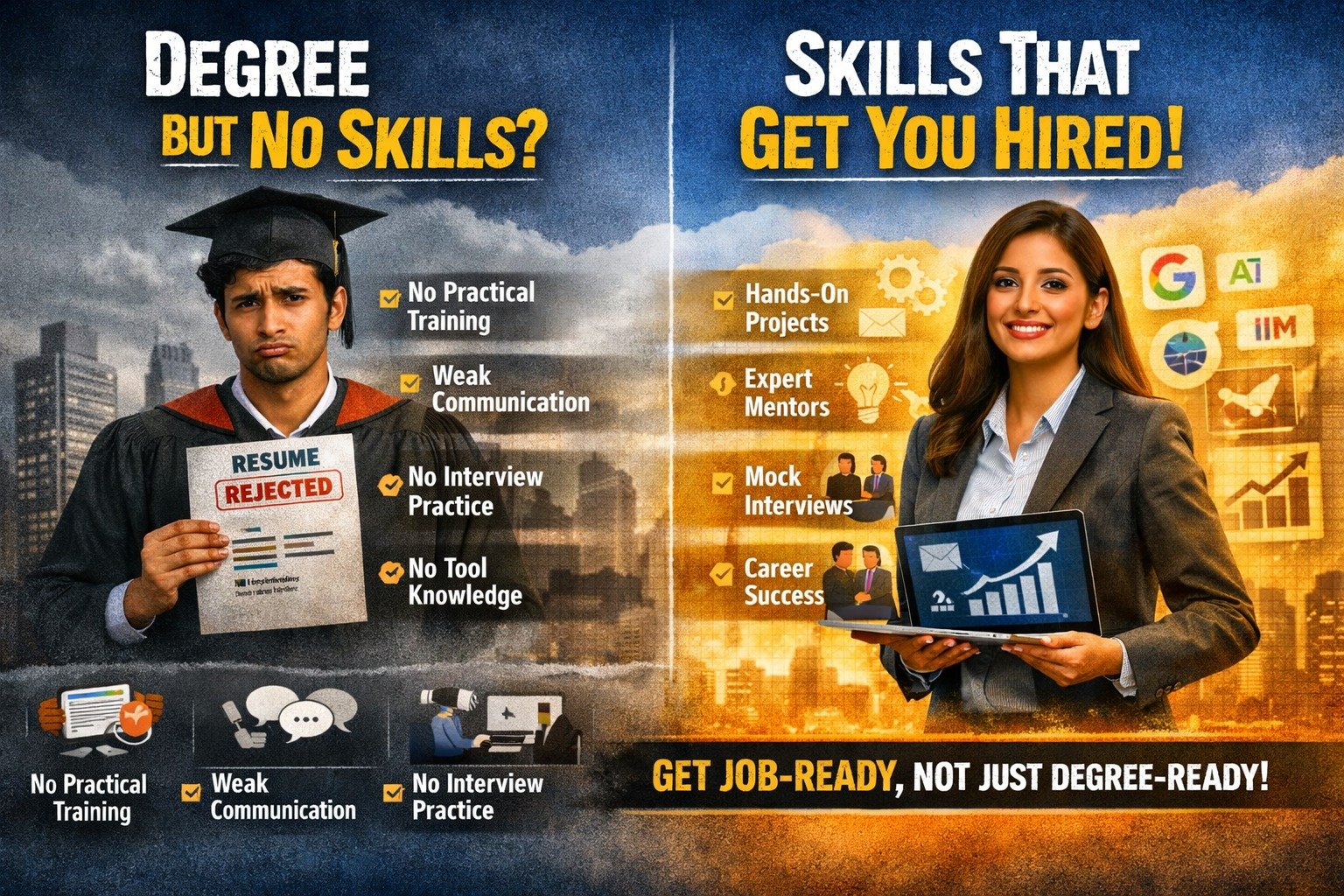
Of course, these are not the things that a mark sheet will tell you. Only hands-on experience and genuine skill can be the things that answer these questions. The very reason why students are not able to see the campus to corporate placements in India - and particularly in Gujarat - is that in fact, most college programmes in the country do not even aim at producing outcomes that can answer these questions.
It is not about brain power as such. It is about getting things done. A degree is proof that you attended the lectures. Skills prove that you have been able to do something using what you learned - and that’s a big point of difference in today's recruiting environment.
The Rise of Skill-Based Learning — And Why It Makes Sense
Skill-based education hinges on a completely different idea than traditional learning.
While traditional education focuses on the question, "What knowledge does this student have?" skill-based education focuses on, "What skills does this student have?"
Changing that one question completely transforms — the content, the method of teaching, the way of assessing, and eventually the job outcomes.
In a skill-based learning setting, students are not merely listening to lectures. They are engaging in hands-on work, such as using actual tools, conducting genuine campaigns, creating actual projects, and getting real feedback from industry professionals.
When they graduate, it's not a record of letters that they have written, but a sequence of works that they have done — and that's the portfolio that a recruiter, who was merely interested, offers.
Skill development courses in Surat and the whole of Gujarat are increasing both in number and quality as student demand is rising sharply. Year by year more students realise that passively following a degree through four years without practical work makes them almost helpless — and they are taking a different path.
When someone asks why skill-based education will be essential in 2026, they are not really asking a philosophical question. It is an economic one. Those who demonstrate skills will be employed. Those who do not will not. Placement data from practical training institutes in Gujarat supports this statement.
Students who want to enter high-demand fields can consider a Digital Marketing Course in Surat or Digital Marketing Course in Ahmedabad, where they learn real tools, campaigns, and job-ready skills.
Why Gujarat Students Are Adapting Faster Than You Might Think
Something specific about Gujarat's student population needs to be mentioned — and it is truly hopeful.
Gujarat carries a strong and culturally ingrained entrepreneurial spirit. The students from Surat and Ahmedabad are accustomed to seeing business around them all the time — in family business, trading communities, and the commercial hubs brimming with activity in both cities. This exposure makes them quite naturally inclined to practical thinking, to results, and to the real question of what actually works as opposed to what merely sounds right.
Therefore, the moment it became glaringly obvious that there was a mismatch between degrees and jobs, Gujarat students reacted. They didn't wait for colleges to revise their syllabuses. Instead, they found and attended practical training centres in Surat and Ahmedabad that taught the skills the job market was genuinely looking for.
Certain career-oriented programmes in Ahmedabad and the practical training centres all over Surat are witnessing a surge in enrolment of students who have consciously and deliberately opted for a particular stream — not those who, by default, have ended up in a course because they didn't know what else to do.
The heightened cognizance within the student fraternity in Gujarat is evident from the kinds of exchanges that are taking place in colleges, family circles, and through career guidance forums across the state. These days, the students are posing much more insightful inquiries: not merely "which course should I go for" but "what is it that this course will actually enable me to do?"
That is indeed a more enlightened line of questioning. And this is one that merits a well-thought-out answer.
The Real Benefits of Choosing Skill-Based Learning
If you are the kind of students who are contemplating this issue at the moment, here is what the difference in practice is like.
Faster job readiness. Practical courses for freshers in Gujarat that focus on real tools and real application shorten the time gap between education and employment by a large margin. Students who normally would spend a considerable time after graduation to get an understanding of the employers' expectations, are already prepared with this knowledge - and face the job market with true confidence.
Demonstrable capability. Rather than just recounting their study experience, students could demonstrate their actual work through a marketing campaign, an analytics report, a business presentation, or a communication portfolio. These are real, physical products that provide hiring managers with something solid to look at and demonstrate those students' work, setting them apart right away from the ones who can only talk about their degree.
Interview readiness built through practice. Interview preparation classes in Surat, when seamlessly integrated into a practical programme and not merely treated as additional content, result in students going through well-planned mock interviews, getting genuine feedback, and polishing their performance so that the real interview does not come as a shock but a familiar experience.
Long-term career growth. Becoming job-ready at the time of graduation is one thing. Growing continuously after getting the job is something else altogether. Those who start with practical, hands-on learning at an early stage have that skill with them lifelong and keep doing better than their peers who have never been taught through the method of doing.
How Our Institute Is Leading This Change in Gujarat
We didn’t wait until the education system aligned with the industry needs. Instead, we created a programme based on industry requirements and then worked backward to develop it.
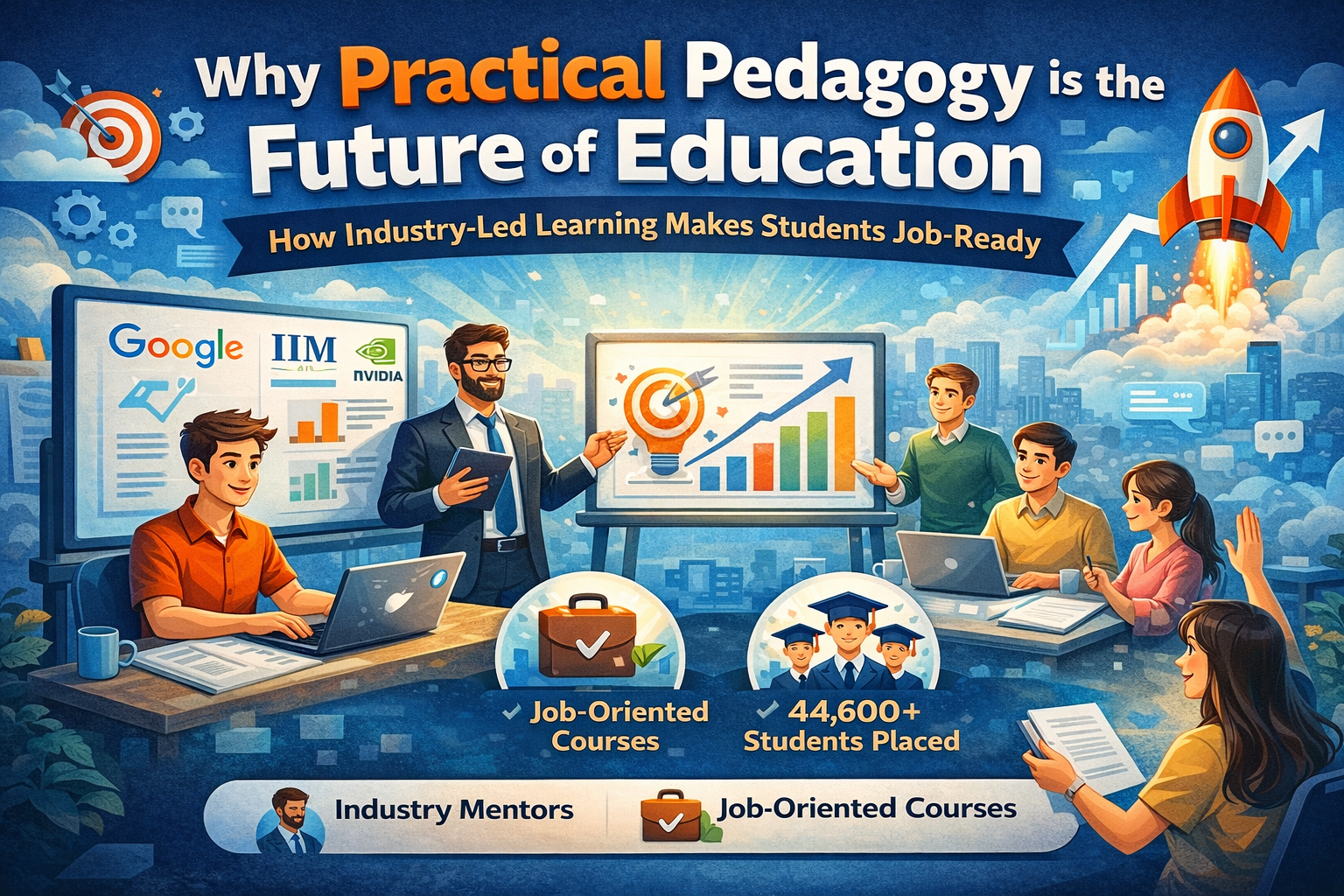
All our courses are co-created with industry mentors from leading companies like Google, IIM, NVIDIA, etc. These mentors are not only experts who understand our curriculum thoroughly but also the ones working in the sectors our students want to pursue. So, they help us design curricula that will equip students with skills relevant for 2026 directly.
Our programme students get exposed to actual business and marketing tools. They engage in completing genuine projects that build their portfolios. They undergo a thorough interview preparation scheme which simulates real hiring scenarios. Besides, students also get strong placement support by linking them with opportunities through authentic industry networks rather than through oceans of cold contacts spreadsheets.
Top courses that prepare one for jobs in Gujarat are definitely not those with the flashiest names. Instead, they are the ones evidenced with truthful outcomes. And our outcomes are verified and shared.
The Proof Is Already There
Our training system has successfully placed over 44,600 students. The highest package received is ₹2.6 Crore, a number that represents the perfect match of real preparation and real opportunity.
Such a result is not that one which is far from normal. They are the outcome of a stable system that is being used by the same students again and again who have decided to opt for practical and skill-based learning rather than merely finishing the degree in a passive way.
The students currently making their way in their careers in Surat and Ahmedabad — by earning competitive salaries, getting promotions quickly, and making their presence felt in every role they take — are mainly the ones who have developed real skills along with or even instead of merely gathering credentials.
That's not a mere chance. It is a cause and effect. Moreover, it can be done again and again.
The Path That Is Not Being Taken Is the One Falling Behind
Our training system has successfully placed over 44,600 students. The highest package received is ₹2.6 Crore, a number that represents the perfect match of real preparation and real opportunity.
Such a result is not that one which is far from normal. They are the outcome of a stable system that is being used by the same students again and again who have decided to opt for practical and skill-based learning rather than merely finishing the degree in a passive way.
The students currently making their way in their careers in Surat and Ahmedabad — by earning competitive salaries, getting promotions quickly, and making their presence felt in every role they take — are mainly the ones who have developed real skills along with or even instead of merely gathering credentials.
That's not a mere chance. It is a cause and effect. Moreover, it can be done again and again.