

Why 90% of Students Don’t Get Jobs After BBA/B.Com (And What They Should Do Instead)
 Apr 27, 2026

RWn. Chakshu Adani
Subject Matter Expert
Rajan did his BBA from a well known college in Surat. Seven and a half CGPA. No backlogs. He attended every class. Submitted every assignment on time.
Even after six months of graduation, he was still at home. Sending resumes. Waiting for calls that either never came or ended after the first interview round.
He wasn't lazy. He wasn't unqualified. He had a degree — the same degree that was supposed to open doors.
But the doors weren't opening.
If this story strikes a chord with you — if somehow you have been through a similar ordeal or have simply watched a friend go through it — you must have understood by now that something is seriously wrong with what colleges promise and what the job market really gives.
To find out why students are not getting jobs in India, and more specifically in Gujarat, is the first step to help the situation.
This blog is that step.
The Uncomfortable Truth Nobody Tells You Before Graduation
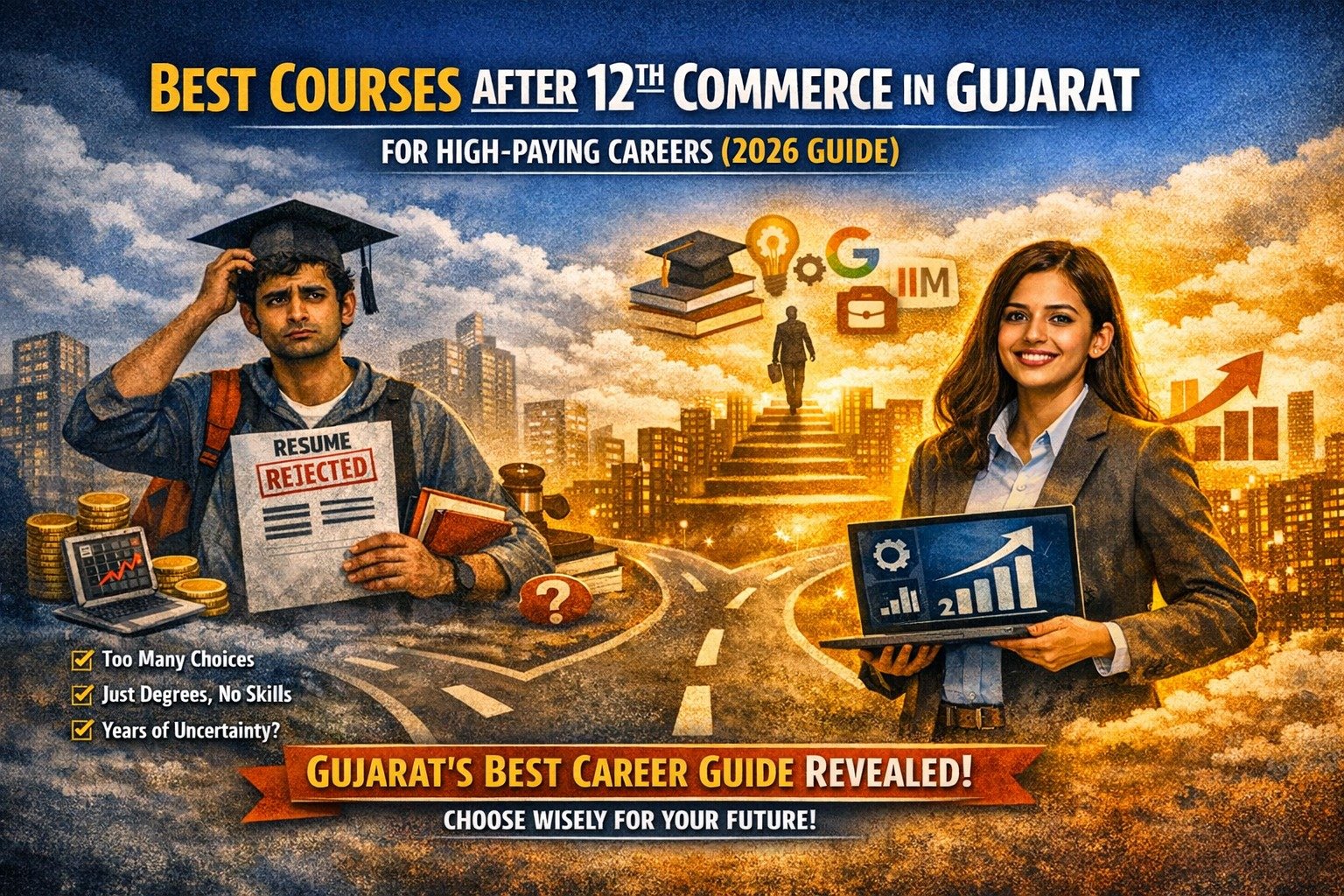
Each year, a great number of BBA and B.Com students graduate from colleges in Surat, Ahmedabad, and other parts of Gujarat. But a significant number of them remain unemployed for a considerable period of time, in some cases even more than a year, post their graduation.
This should not be seen as the student's failure. It is the system that has failed them.
The higher education sector was focused on churning out graduates. The job market was looking for skilled professionals. And in between those two extremes, no one thought about linking the two.
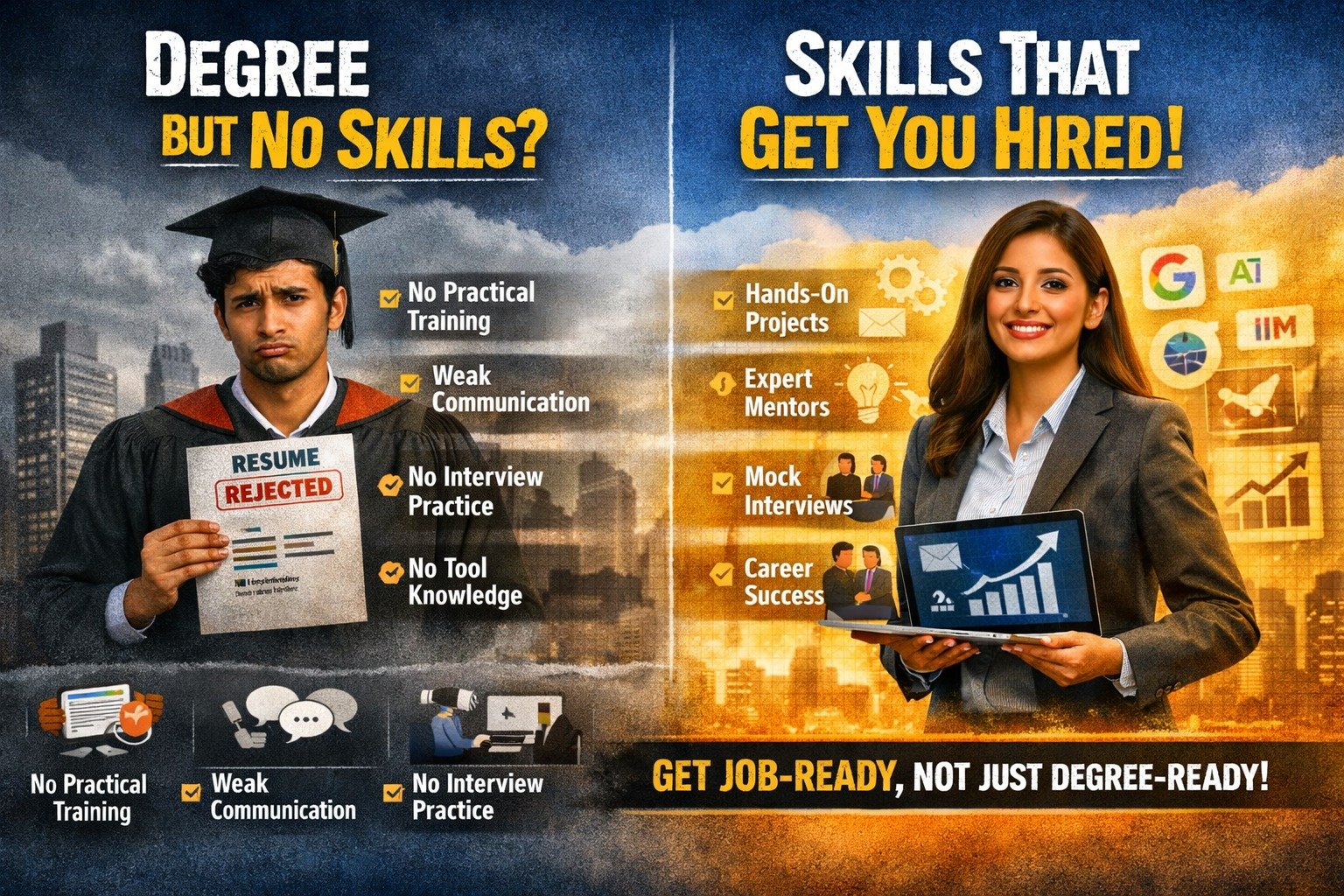
So what happened? Academic qualifications without the right perspective. Credentials without skills. Those who have been studying for years, yet they were not ready for even a day in the work environment.
Where to find a job after doing BBA in Gujarat is one of the highest searched queries on Google by the fresh graduates in the state — and the fact that so many people are asking it, speaks volume about how large this gap is.
Why Are BBA and B.Com Graduates Really Struggling?
Let's dig deeper than the surface, as the real reasons are not just "unfortunate" or "excessive competition" - these two factors are definitely true. In fact these reasons are structural and they can be remedied.
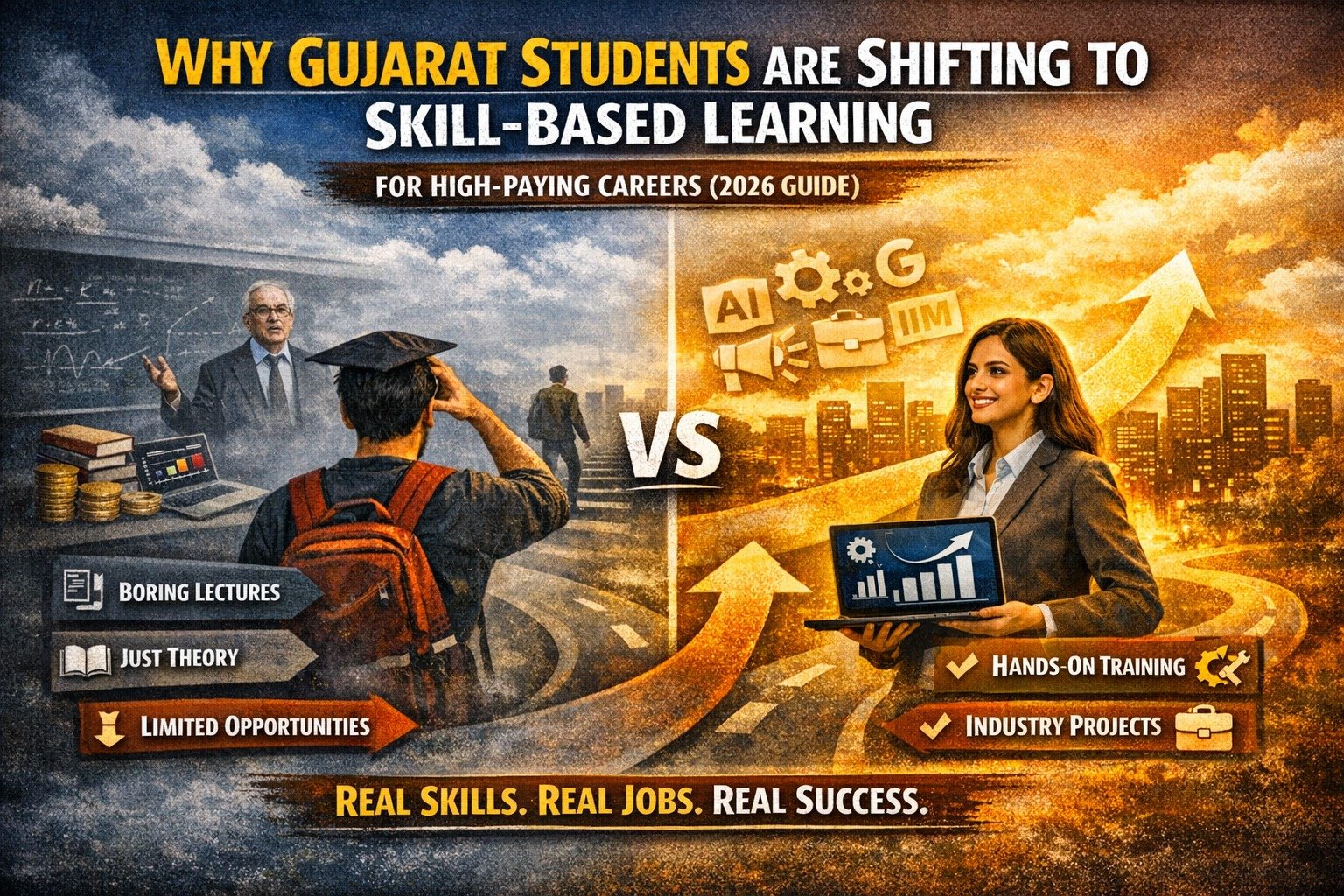
Over-reliance on theory with zero practical application
College curricula are designed primarily around delivering knowledge. Lecturers talk about the ideas. Students get them. Exams check how well they remember. And lastly — degree conferred.
However, the majority of students did not contact a real client, run a live marketing campaign, work on current business data, or be on the very same tools that companies are using daily while going through that whole learning process. They learned business theory — like watching a game from the stands and then being told that you're good enough to play professionally.
Communication skills were never actually developed
Most students discover this only when they attend their first interview: communication is not only about speaking English. It is about the ability to speak fluently even under pressure, the confidence to carry on a conversation, to ask the right questions and the ability to present oneself as a worthy candidate for the job.
The majority of schools consider communication as just another elective for a semester, not as a career skill. And the outcome is evident immediately — in the interviews where the talented and diligent students get flabbergasted, start talking nonsense or are totally unable to display the kind of confidence which recruiters are seeking.
Insufficient communication skills for job interviews is among the biggest factors why freshers in Gujarat are sent away right at the first round — even before their qualifications have been considered.
No interview experience before the real thing
Just picture playing your debut cricket game in front of the selectors without ever having trained with a real team. That's precisely the situation most newbies find themselves in.
They didn't have a chance to experience a well-organized mock interview. They never got a chance to figure out how effectively they communicate through their body language. They have not even been challenged with tough HR questions and required to think immediately. Therefore, the mere unfamiliarity of the situation can be the reason they lose their job offer during the actual interview.
Zero exposure to the tools businesses actually use
Nowadays, businesses rely heavily on different tools — CRM systems, analytics platforms, AI content generate tools, automation software, design platforms, etc. Such skills, however, are not advanced skills. They are the baseline expectations in most marketing and business roles.
Unfortunately, a large percentage of BBA and B.Com graduates have never even opened HubSpot, never created a campaign with any tool, and never even used AI for doing a real business task. Their arrival at the workplace knowledge about the theory of these functions but lack the practical ability to perform them.
Myth vs Reality: The Beliefs That Are Holding Students Back
Before we start discussing the remedies, we definitely have to challenge some firmly established beliefs first — simply because these fallacies are deliberately holding students back from taking necessary actions.
Myth: "Good marks will get me a good job."
Reality:Your grades only help you get a foot in the interview door. What counts in the interview is almost nothing related to your CGPA. What recruiters want to know is your communication skills, your thinking process, and your abilities — and a marksheet cannot prove any of these.
Myth: "My degree is enough."
Reality: Think of your degree as an entry ticket. All other candidates who are waiting in the same room have one too. The degree is simply proof that you have finished a certain program. It doesn't mention if you are capable of working for a business and contributing to it from the very first day — and that is essentially what the companies are willing to pay for.
Myth: "I'll learn on the job."
Reality:In 2026, companies will be even less willing than today to tolerate lengthy learning curves. Since AI can handle routine tasks, humans are expected to add more value, not less. Therefore, young professionals without hands-on skills are not afforded the luxury of gradually learning the fundamentals they ought to have known.
Myth: "The job market is just too competitive."
Reality: Yes, the market is competitive. But it is also very eager to recruit candidates who have actual skills and hands-on experience, as well as the guts to show up and deliver. Degree-holders face strong competition. However, at the level of truly skilled and well-trained-through-practice candidates - the demand is actually higher than the supply.
What Companies Are Actually Looking For in 2026
Let's break this down a bit. When a hiring manager from a firm in Surat or Ahmedabad goes through resumes and also does trading interviews, these are the very parameters they are dissecting in reality:
Is this one able to articulate herself/himself in a clear and professional manner? Have they any idea about the kind of software our team operates on? Do they know what business is all about — not just intellectually, but from an actual perspective? Shall they have to be guided very closely for six months or will they be able to put in effective performance already after a few weeks?
Jobs skills in 2026 have been fundamentally changed. Having practical knowledge of business and marketing tools, excellent communication skills, being data savvy, and getting used to working alongside AI are not the things you are simply rewarded for anymore. These are what you are expected to have the minimum level of.
Those who have got the jobs are the ones who show they have these skills at the interview — not those who merely list them on their resumes.
The Solution: Practical, Skill-Based Learning That Actually Prepares You
Here is the most important part — what to do if you are a BBA or B.Com graduate who sees the gap and wants to fill it.
The solution isn't more degrees. It isn't more theoretical learning either. It is focussed, practical and industry-aligned skill development — the ones which build hands-on capability rather than through reading about doing.
Post BBA and B.Com courses that are truly job-oriented align themselves with a totally different way of learning:
Instead of learning marketing theory, you organize real marketing campaigns. Instead of merely reading about communication, you get involved in structured and real communicative sessions with feedback. Instead of only hearing about AI tools, you get to use them— daily, on actual tasks, work on a portfolio that you can present during interviews.
This is how skill-based courses for students in Gujarat must be. And once they are, the results vary drastically from what traditional college produces..
How to be job-ready after BBA is nothing secret — it is a procedure. And that procedure requires exposure, practice, guidance, and the right surroundings.
Students who choose a Business Administration & Commerce Course In Surat that focuses on real-world skills, live projects, and interview preparation are far more likely to secure job opportunities quickly after graduation.
Similarly, enrolling in a Business Administration & Commerce Course In Ahmedabad can help students gain practical exposure, build confidence, and align their skills with what companies are actually hiring for in today’s market.
How Our Institute Bridges the Gap Between Education and Employment
This is precisely the difference that our institute was designed to bridge.
At the heart of every course here is a single question: what should a student learn, practice, and prove to be able to confidently face a job interview in 2026 and truly compete at the top level?
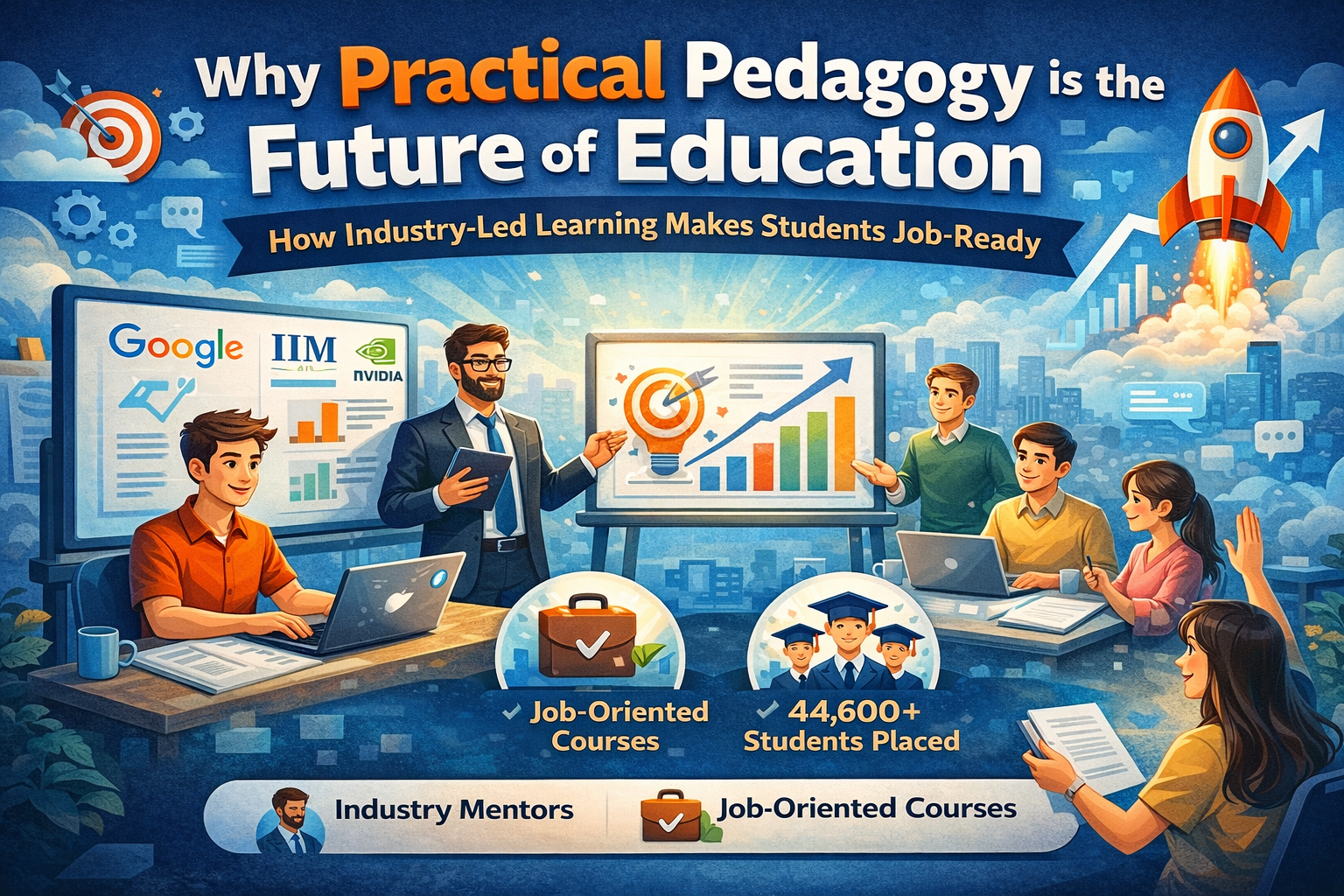
Our curriculum does not come from academic scholars working alone. It is developed in active partnership with industry mentors from companies like Google, IIM, NVIDIA, and other leading companies across India.
These are the professionals in the industries that our students are targeting — and they each make the content of the courses so that it fits the reality of those industries.
Our students don't only hear lectures but use real business software, tackle current problems, create their portfolios through hands-on assignments, and undergo a series of structured mock interview sessions that are very close to the real hiring process.
Interview coaching sessions in Surat, as part of our programme, are not the last piece of the puzzle. They are deeply integrated into the entire learning process — so after a student has the real interview, it should be a case of familiarity rather than fear.
Being in our practical training institute in Surat, the students there develop confidence of a kind that only comes from doing real-world work again and again — not from being told that one is confident.
The best courses for a job after B.Com in Gujarat are not the ones with the longest course list. They are the ones that produce consistent, measurable career outcomes. And that is exactly what our track record reflects.
The Proof Is in 44,600+ Success Stories
Eventually, promises cannot be compared with the real outcomes, which matter the most.
We have helped over 44,600 students get into job positions successfully through our programmes - starting from the students who were unsure of their next step to the professionals who changed their career paths completely. Our students have obtained the highest package of ₹2.6 Crore - this number is a representation of the quality of training, the depth of the industry connections our students have been able to access.
Offering strong placement assistance is one way we ensure our students do not face the job market without any skills or support. They are graduating from a place that not only discovers the talents but also provides the next direction in the career - after all, the network created through our industry mentorship relationships is spanning the best companies all over India.
Such outcomes are not the result of chance or an exceptionally talented batch. Instead, they stem from a properly organized system that really considers the issue of the gap between the education and the employment - and it intentionally bridges it, by means of every single week of each programme.
The Job Market Will Not Wait for You to Feel Ready
Let me tell you the plain truth of the matter.
Each month that you do not acquire practical skills is one more month during which a better-equipped candidate is going to take the role you desire. The competition for significant positions in Gujarat's business and marketing sector is genuine and it is increasing as AI tools raise the bar of companies' expectations for every new employee.
Trying to find the right time, hoping that college will be enough in the end, or thinking that the job market will somehow become less demanding — none of these are plans. They are procrastinating.
Reasons why freshers are not getting jobs after graduation in Gujarat:
This is a problem with a solution. In fact, the solution has been tried and tested, and is within your reach. The only factor is whether you decide to tap into it or not.
Do you want to be job-ready rather than just degree-ready? If you do, then you want to be able to face job interviews with assurance, skill, and constitute proof of your actual work — simply enrolling in the best job-oriented course in Gujarat is the first step.
44,600 students made this choice and founded successful careers they can boast of. Possibly, the greatest triumph of them all is you.
Sign up now. Your degree has brought you this far. The right training will give you the rest of the journey.
Related Post:
Data Analysis in 2026: The Complete Career Guide for Students in Surat & Ahmedabad
How to Optimize Your Linkedin Profile Like a Pro: Complete Step-by-Step Guide