

What Is Python Full Stack? A Complete Guide for Beginners
 Sep 16, 2026

RWn. Piyush Nakrani
Subject Matter Expert
The full stack development process involving Python means that Python is used to develop the back end of the website or web application while developing the front-end along with other aspects. This is what distinguishes a Python full stack developer from others because he or she has the ability to develop the front end and back end.
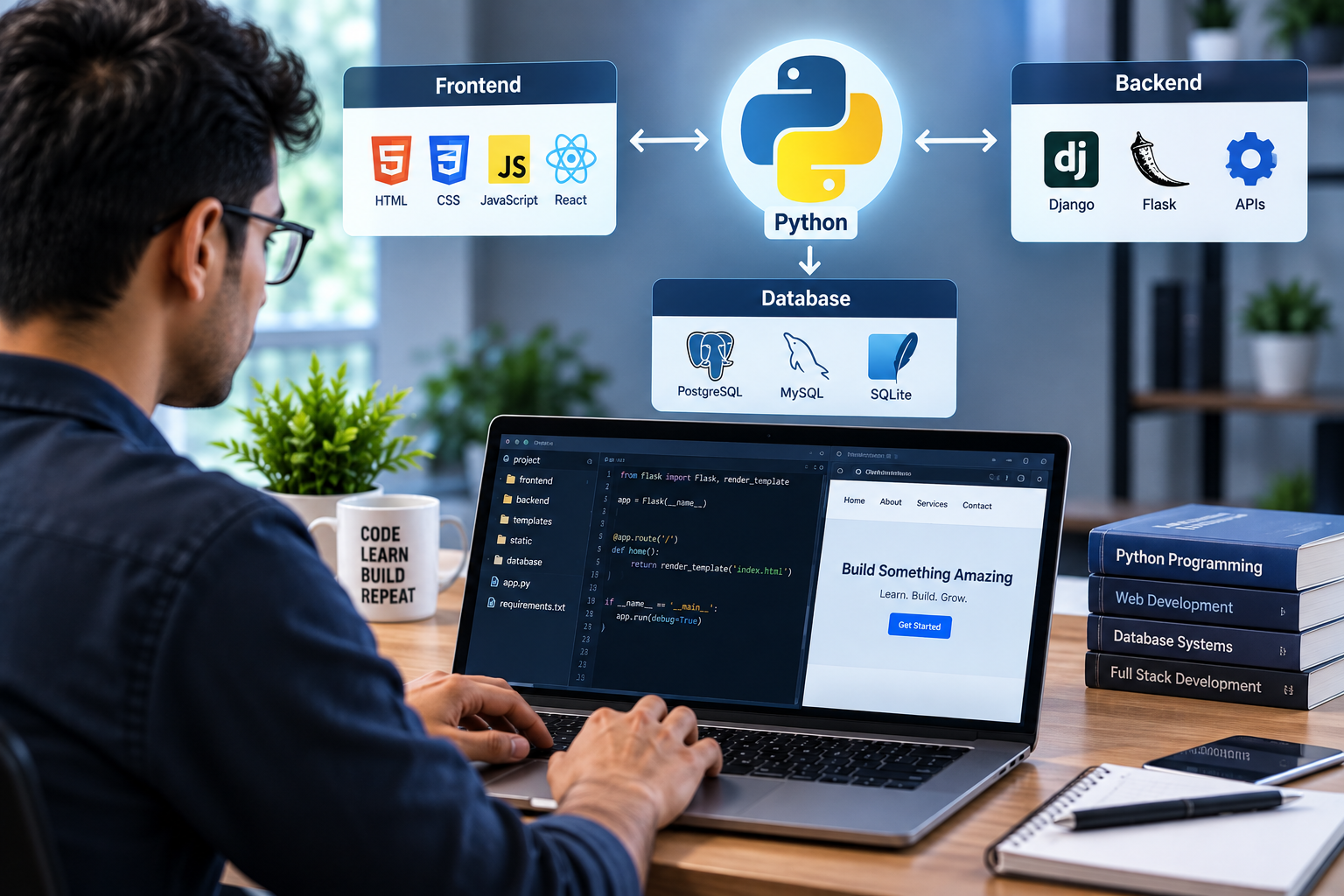
In a normal Python full stack development project, HTML, CSS, and JavaScript can be used to develop the front end of the website while Python with Django or Flask can be used to develop the back end along with MySQL or PostgreSQL for databases.
Those who are new to development can choose this process for gaining experience.
Beginners who want to build a strong programming base can also explore software development course before moving into full stack technologies.
What Does Python Full Stack Mean?
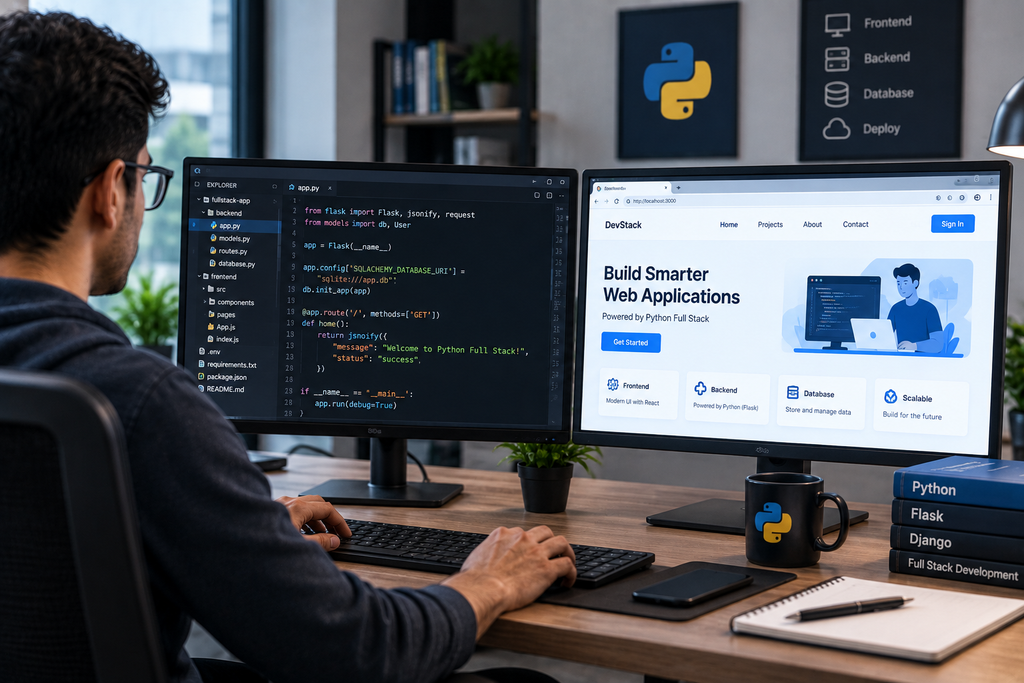
To know about what is Python full stack, we should dissect the term into two parts.
Python is a programming language that is popularly used in web development, automation, data handling, software development, and many more.
By the term full stack development, we mean development of the front end, back end, and the database in the web application.
Hence, a developer who is a Python full stack developer is not confined to writing codes in Python only. There are a lot of technologies that are required to be known by a developer to develop a web application.
For instance, we consider an online shopping portal. The user sees the pages and buttons through his/her browser. This is the front end. As the user clicks on a particular link, adds something to the cart or places an order, then the back end handles all of those requests. The products and customer details can be found in the database.
If you want to understand the broader concepts involved in building applications from front end to back end, learning through a structured full stack development program can be useful.
How Does Python Full Stack Development Work?
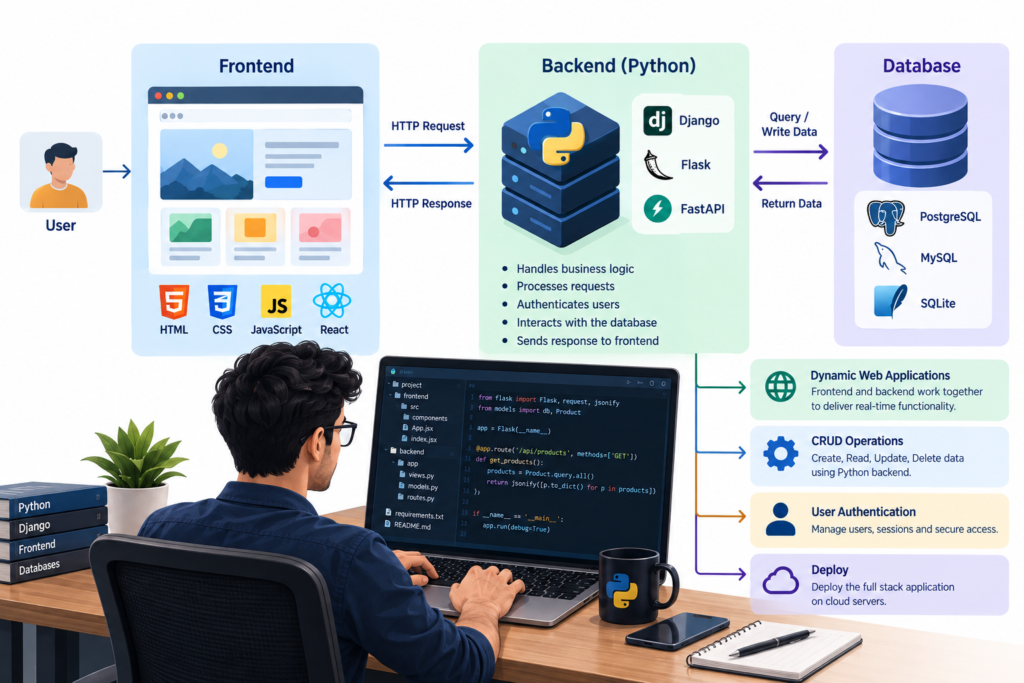
A web application generally has several layers.
1. Front End
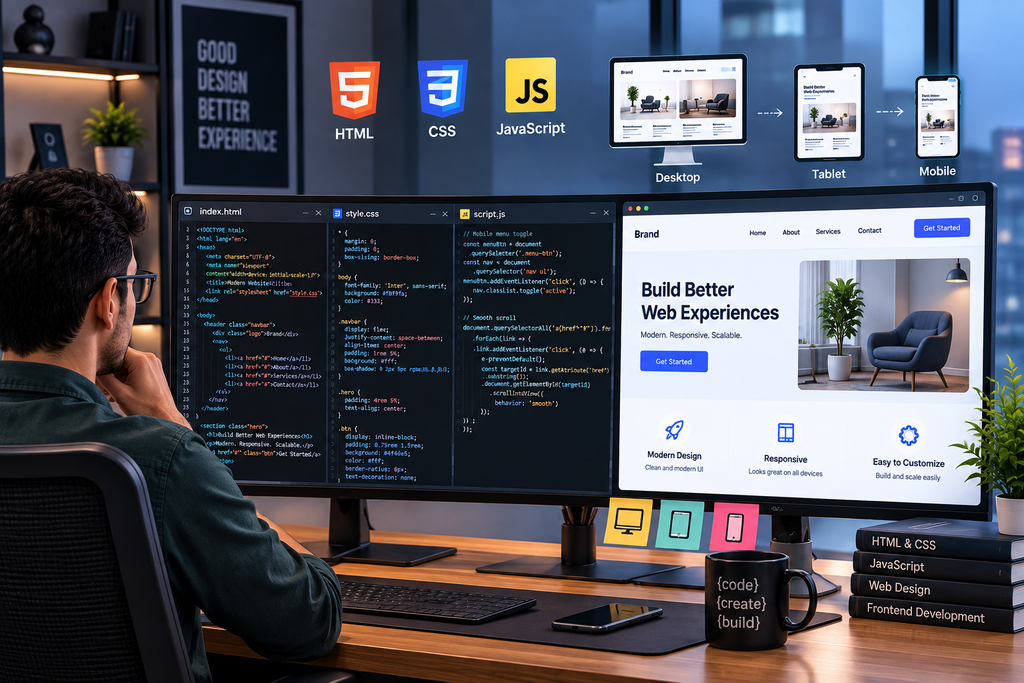
The front end is that portion of the application that users interact with.
Some of the commonly used technologies include:
- HTML for page structure
- CSS for styling and layout
- JavaScript for interactive behavior
- Front-end libraries or frameworks such as React, depending on the project
For instance, the user registration page can have fields to enter the user’s name, email address, and password.
Along with coding skills, understanding UI/UX and graphic design skills can help developers work more effectively on the visual and user-facing parts of web projects.
2. Back End
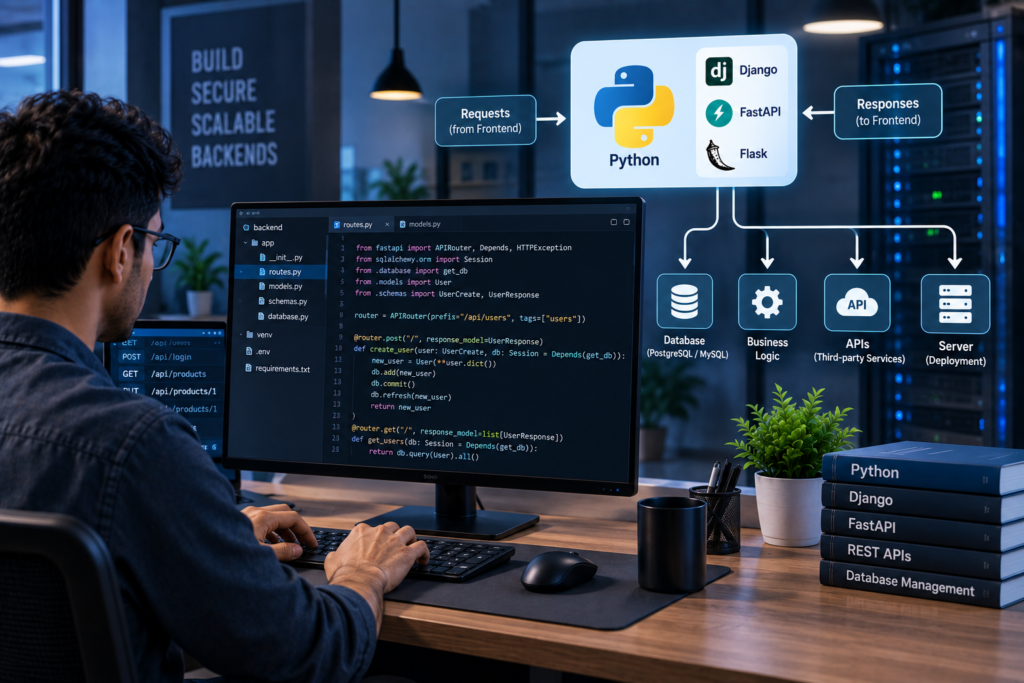
The back end is where the logic for the application is executed.
Python is a popular choice for this with frameworks like:
- Django
- Flask
- FastAPI
For example, when a user fills out a login form, the backend will be able to receive the request, process the data submitted by the user, perform a database lookup, and return an appropriate response.
Django is a fully-featured web framework in Python which is equipped with various tools necessary to develop web applications. Flask, on the other hand, provides developers with greater flexibility in their choices regarding third-party components. FastAPI is typically used to create APIs.
3. Database
There needs to be a way to store information.
Some Python full-stack applications can connect to databases like:
- MySQL
- PostgreSQL
- SQLite
- MongoDB
The choice depends on the application's requirements.
For an e-commerce application, the database might store customer accounts, products, orders, prices, and inventory information.
4. APIs
The role of an API is to allow various components in a software system to interact.
To illustrate, a front-end application may make a request to a Python back-end API to get the list of products. The server will process the request, get the required data, and respond back to the front-end application.
Some of the Python frameworks that can help in creating APIs include Django REST framework and FastAPI.
5. Deployment
Application development is just the tip of the iceberg. The developed application will require deployment onto the server or cloud infrastructure for access.
Based on the project, knowledge of the following will be required:
- Git and version control
- Linux
- Web servers
- Cloud platforms
- Environment variables
- Basic deployment and security practices
While a beginner does not have to know everything about application deployment right away, some familiarity with the process is helpful.
Python Full Stack Technology Stack
There is no one static tech stack that is referred to as the “full Python stack.” Various organizations and projects implement different stacks.
For instance, the following stack is often used:
| Development Area | Common Technologies |
| Front end | HTML, CSS, JavaScript |
| Front-end framework | React or another JavaScript framework |
| Back end | Python |
| Python framework | Django, Flask, or FastAPI |
| Database | MySQL, PostgreSQL, SQLite, MongoDB |
| API | REST APIs, Django REST Framework, FastAPI |
| Version control | Git, GitHub |
| Deployment | Cloud platforms, Linux, web servers |
The exact stack can change based on the application and development team.
What Does a Python Full Stack Developer Do?
A full stack developer in Python can develop in various areas within a web application.
Some of the typical responsibilities can be:
- Web page layout creation
- Front-end programming
- Server-side application development
- Creating and linking APIs
- Database design
- Connecting applications to databases
- Testing the application’s features
- Bug fixing
- Git version control of the source code
- Application deployment
- Software maintenance
There will be a variation in the front-end and back-end involvement in different jobs. Some developers may find themselves doing most of the Python coding, while others may deal with more front-end development.
Python Full Stack vs Python Back-End Development
These terms are related but describe different scopes of work.
| Python Full Stack | Python Back End |
| Covers front end and back end | Mainly focuses on server-side development |
| Includes HTML, CSS, and JavaScript | May have limited front-end work |
| Works with databases and APIs | Works heavily with databases and APIs |
| Can be involved in deployment | May also handle deployment and infrastructure |
| Broader development role | More specialized role |
A person that wishes to specialize in server-side programming should consider back-end development. A person that desires to learn everything about a web application as a whole should go for full stack development.
What Skills Are Needed for Python Full Stack Development?
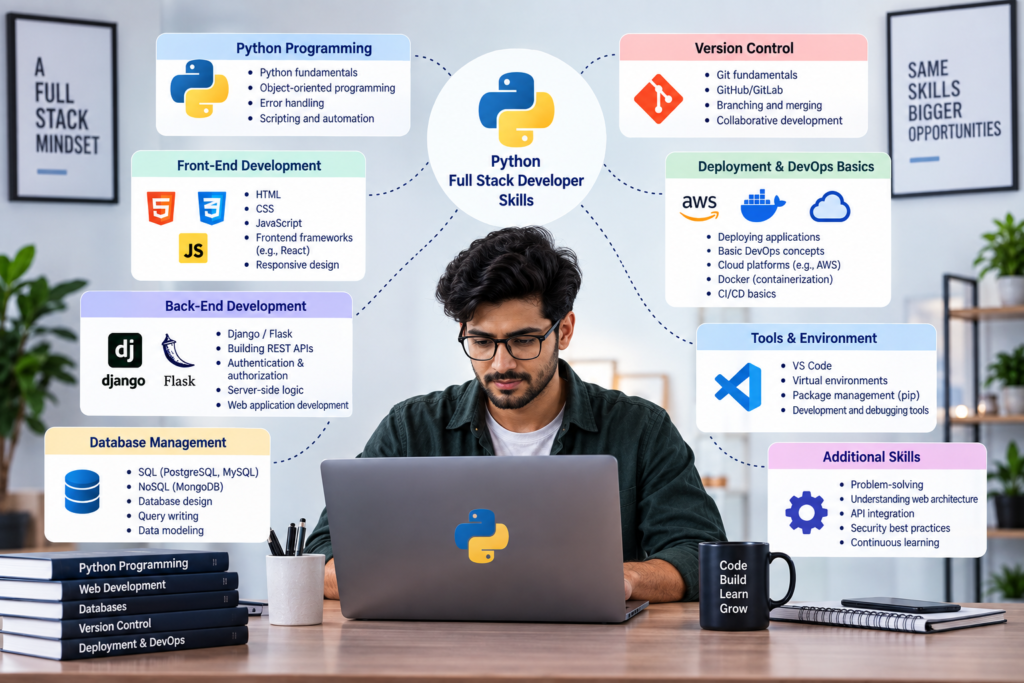
It is not necessary that you know everything at the very beginning. The best way of learning will always be from the basics onwards.
Python Programming
Start with Python fundamentals such as:
- Variables and data types
- Conditional statements
- Loops
- Functions
- Lists, tuples, sets, and dictionaries
- Object-oriented programming
- Exception handling
- Modules and packages
- File handling
A solid understanding of Python makes learning a Python web framework much easier.
Beginners who need a structured approach to learning these concepts can consider Python training before moving on to frameworks such as Django, Flask, or FastAPI.
HTML and CSS
HTML builds up the structure of web pages, whereas CSS handles their styling.
These are some examples of topics that you should be aware of.
JavaScript
JavaScript makes websites interactive.
A little bit of understanding about JavaScript is helpful, even when you mainly use Python for programming, as web applications often use JavaScript for the client-side part.
Python Web Framework
Once you have gained proficiency in Python, you will then need to move on to a framework like Django, Flask, or FastAPI.
It really depends on your preference and on what you intend to do. Django is loaded with functionalities, Flask has fewer functionalities but a small core, and FastAPI is best for developing APIs.
Database and SQL
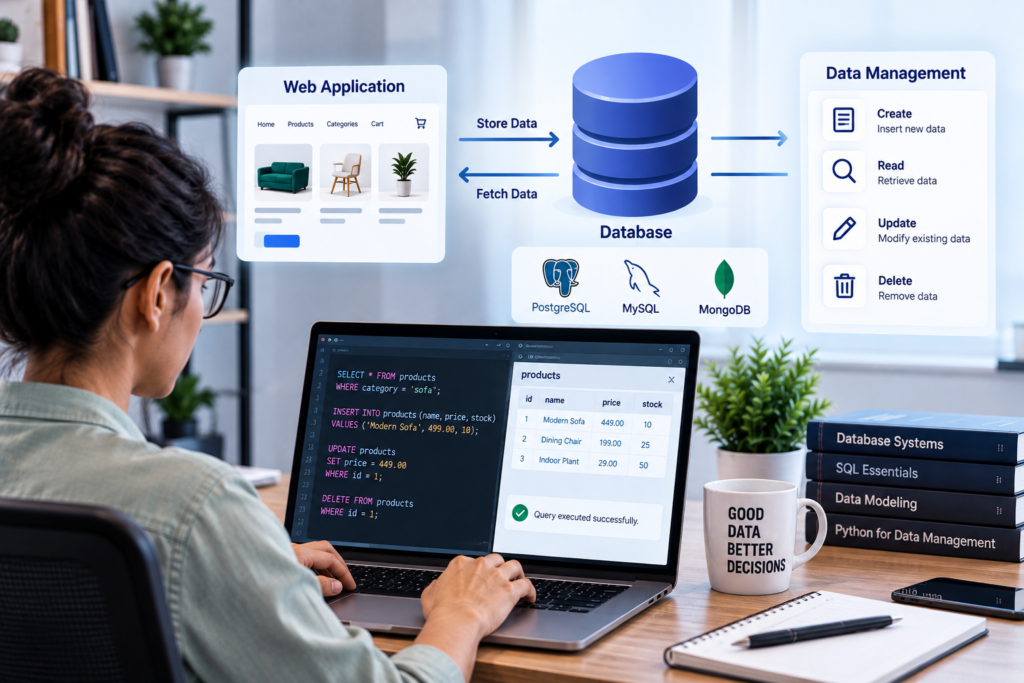
Understanding data storage and retrieval is an important skill for a full stack developer.
Having experience with SQL and a relational database like MySQL or PostgreSQL is a good start.
Git
Version control system Git allows software engineers to monitor modifications made in their code as well as collaborate with other developers.
It is important to be aware of the fundamental commands such as initializing repositories, adding commits, branching and remote repositories management.
Advantages of Learning Python Full Stack Development
A python full-stack development may be helpful for students looking for a wide range of knowledge about web development.
You Learn How a Complete Application Works
Rather than concentrating on a single layer, the interaction between the browser, the server, the database, and APIs can be seen.
Python Is Used Across Different Areas
Apart from its applications in web development, Python can also be used in other domains such as automation, data analysis, machine learning, and scripting. This opens up new horizons for programmers in the coming years.
Apart from web development, Python is also widely used in data analysis and machine learning, so learners interested in these fields can also explore data science and artificial intelligence.
You Can Build Complete Projects
A full stack skill set makes it possible to build projects such as:
- Business websites with dynamic features
- E-commerce applications
- Blog platforms
- Booking systems
- Learning management systems
- Portfolio applications
- REST APIs
- Dashboard applications
Building these projects also gives beginners a way to practice connecting different technologies.
Since Python is also widely used for working with data, learners interested in this area can explore data analytics Course alongside their programming skills.
Limitations and Challenges
Python full stack development is a wide-ranging field, and there could be some instances when beginners find themselves getting overwhelmed with the amount of technologies they have to know.
They might have to master Python, a web framework, HTML, CSS, JavaScript, databases, APIs, Git, and many other things related to the concept of deployment. Trying to learn all of these at once typically complicates the process.
Another difficulty is the fact that technologies change over time, which means that the developer would need to continue learning instead of stopping after taking one particular course or using a specific technology stack.
It could also happen that a person ends up knowing about many different technologies but failing to become proficient in any of them.
Common Mistakes Beginners Make
Trying to Learn Everything at Once
Start by learning basic Python along with web development basics. Move on to frameworks and databases after you have learned the basics.
Copying Code Without Understanding It
Following the tutorials is always a good option but doing someone else's project without even having an idea about it will not make you a good programmer. Modify your application, do your own troubleshooting, and redesign some parts of your application.
Ignoring Front-End Basics
Even if you aim to be a Python developer, basic knowledge of HTML, CSS, and JavaScript helps you understand how the browser interacts with your application.
Avoiding Databases
Web developers must be able to manage data storage, queries, updates, and relationships. Basic SQL would be useful to learn from an early stage.
Building Only Tutorial Projects
With a good understanding of the fundamentals, develop applications with your own set of specifications. Even a simple application would teach you how to deal with errors, code organization, table creation, and component linking.
How to Start Learning Python Full Stack
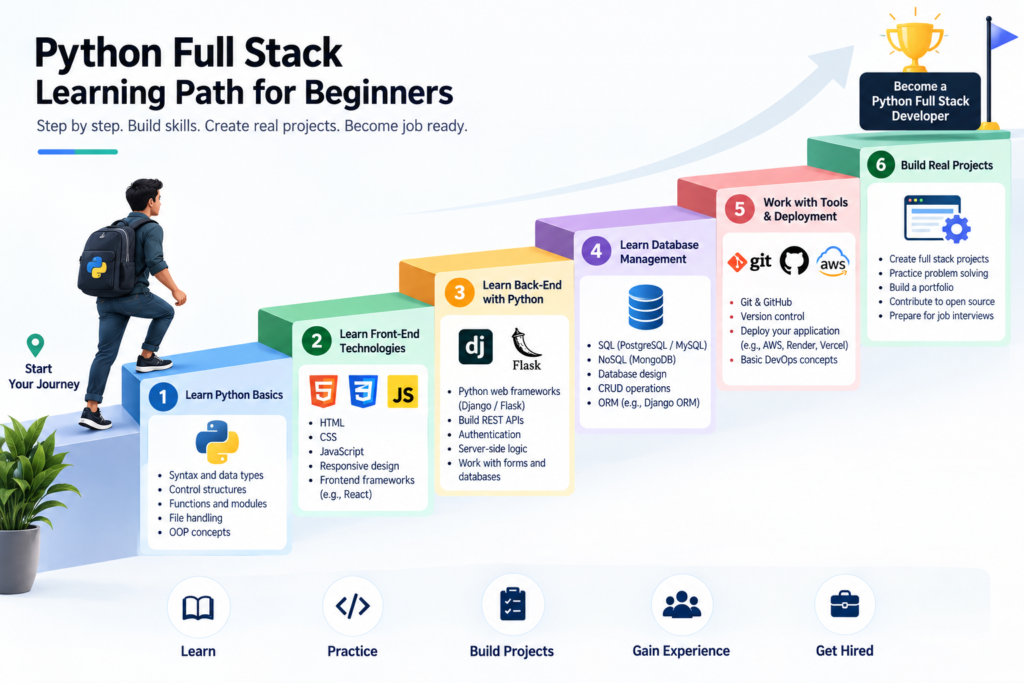
A simple learning path can look like this:
Step 1: Get acquainted with Python basics
Understand the basics of programming and create small Python programs.
Step 2: Get acquainted with HTML and CSS
Learn to create simple webpages and responsive layouts.
Step 3: Get acquainted with basic JavaScript
Understand browser interactions and asynchronous requests.
Step 4: Pick a Python framework
Begin your work with Django, Flask, or FastAPI depending on your purposes.
Step 5: Get acquainted with databases and SQL
Learn to create tables, queries, and integrate your application with the database.
Step 6: Get acquainted with APIs
Learn about HTTP requests, responses, JSON, authentication, and REST API.
Step 7: Use Git
Keep track of your projects and understand how the developers manage the source code.
Step 8: Create projects
Develop applications with the use of learned technologies.
Step 9: Learn deployment basics
Learn how a web application goes from your machine to production environment.
Career Opportunities in Python Full Stack Development
Having Python full-stack development skills would make you eligible for different positions within web development. Job titles differ depending on the organization, therefore, the job description is much more important than the job title itself.
Positions may include:
- Python Developer
- Python Full Stack Developer
- Full Stack Web Developer
- Backend Developer
- Django Developer
- Web Application Developer
- Software Developer
The availability of jobs will depend on many aspects like technical skills, experience in certain projects, geographical location, needs of the employer, and the position itself.
For a beginner, having some completed projects could be much more helpful than just having multiple programming languages listed on a resume.
Who Should Learn Python Full Stack?
Python full-stack development could be a good choice for individuals who love programming and wish to learn about web application development from end-to-end.
It may suit:
- Learning web development
- Python beginners
- Software developers ready to enter employment
- Developers interested in developing their front-end capabilities
- Professionals working towards web application development
Mathematics is not a requirement to start learning web development. Rather programming logic and problem-solving skills, along with some patience, will get you far ahead in this field.
Frequently Asked Questions
Is python full stack the same as full stack development?
No, it’s not. The idea of full stack development is quite comprehensive and includes programming languages and frameworks which may differ. When speaking about Python full stack development, it implies developing in Python in the back end plus using front-end technologies, databases, APIs, etc.
Is Python enough for full stack development?
Python alone may not be sufficient in developing a full stack web app. Apart from knowing Python, developers need to know about front-end technologies such as HTML, CSS, JavaScript, among others.
Is Django necessary for Python full stack development?
No, Django is just one of the possible frameworks. Flask and FastAPI are some of the possible frameworks used for developing web apps using Python.
Is it possible for a beginner to learn full stack Python?
Yes. Those people who are inexperienced in terms of programming will find this way very useful. One may start from Python, HTML, CSS and basics of JavaScript, which will make the process easier.
Is full stack Python good for a career?
This is a valuable set of skills for those who want to work in web and software development industry. However, employment opportunities will depend on one’s skills in these technologies and on requirements of a particular employer.
Summary
So, what is Python full stack? It means a web development technique that involves using Python programming language in the back end along with other technologies of the front end, databases, APIs, and deployment.
The greatest benefit for a newbie is the broad knowledge he/she will have. Rather than just learning how to create Python code, one learns how that code connects with the browser, database, server, and other parts of the app.
The logical way would be to start with learning Python well, and then gradually get skills of working with HTML, CSS, JavaScript, a web framework of Python, SQL, APIs, Git, and project development in general. It does not mean that you should know all the stack at once.