

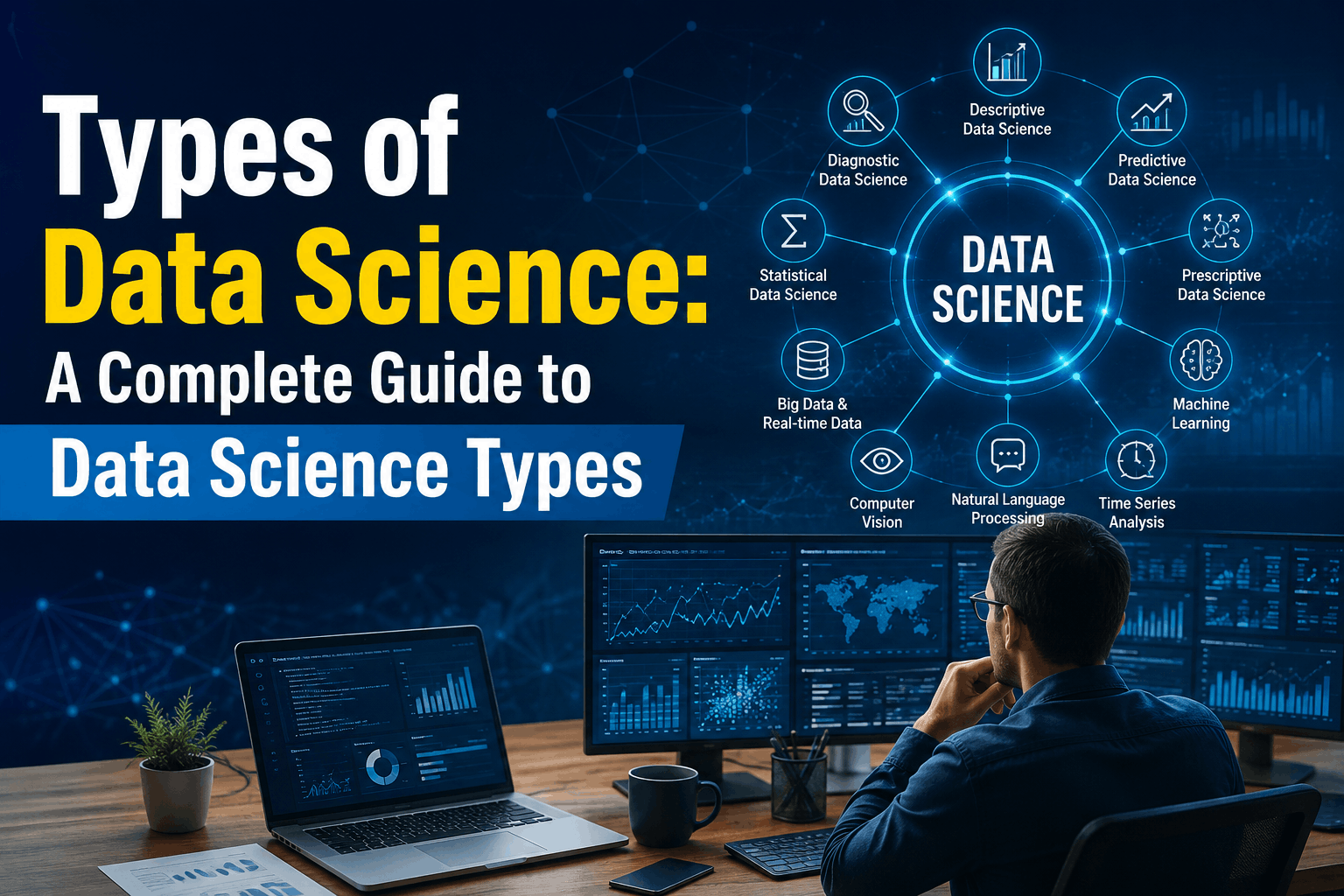
Types of Data Science: A Complete Guide to Data Science Types
 Sep 19, 2026

RWn. Piyush Nakrani
Subject Matter Expert
Data science types is possible on the basis of data type, the problem to be solved, and approaches to the solution. Some data science types focus on analyzing past data, while others predict future results, provide recommendations, process language, and work with images and other complex data.
It is quite confusing at first for beginners because data science has a number of characteristics associated with machine learning, artificial intelligence, statistics, data analytics, natural language processing, and computer vision that are not necessarily distinct fields of science. In reality, a data scientist may use more than one of these approaches in one project.
In this guide, different types of data science will be considered and explained along with their roles and required skills.
What Is Data Science?
Data science involves the practice of using data, statistical methods, programming, and analysis to learn about information and solve problems.
Examples of activities that would be part of a data science project could include:
- Data gathering from different sources
- Data pre-processing and data organization
- Pattern and relationship recognition
- Model building using statistics and machine learning
- Results validation
- Results dissemination
- Predictions applications and decision making
For beginners who want to build these skills systematically, an AI and data science course in Surat can provide structured learning across data analysis, programming, machine learning, and related concepts.
For example, a website selling products online can learn from the buying history of customers which items go together and then make recommendations based on that information.
In doing so, data science goes beyond analyzing data in spreadsheets or creating graphs.
Why Are There Different Types of Data Science?
Forms of data may be numerous, and firms may ask various questions.
Some of the questions that could be asked by the firm would be as follows:
- What went wrong with our sales last month?
- Why are our customers leaving?
- What does the future quarter hold for us in terms of sales?
- Who is most likely to buy from us?
- How are we being reviewed on the internet?
- Can we detect objects from an image automatically?
Different approaches and technologies would be needed to answer these questions. This is why the types of data science are often considered from the perspective of their purpose and technology used.
Main Types of Data Science
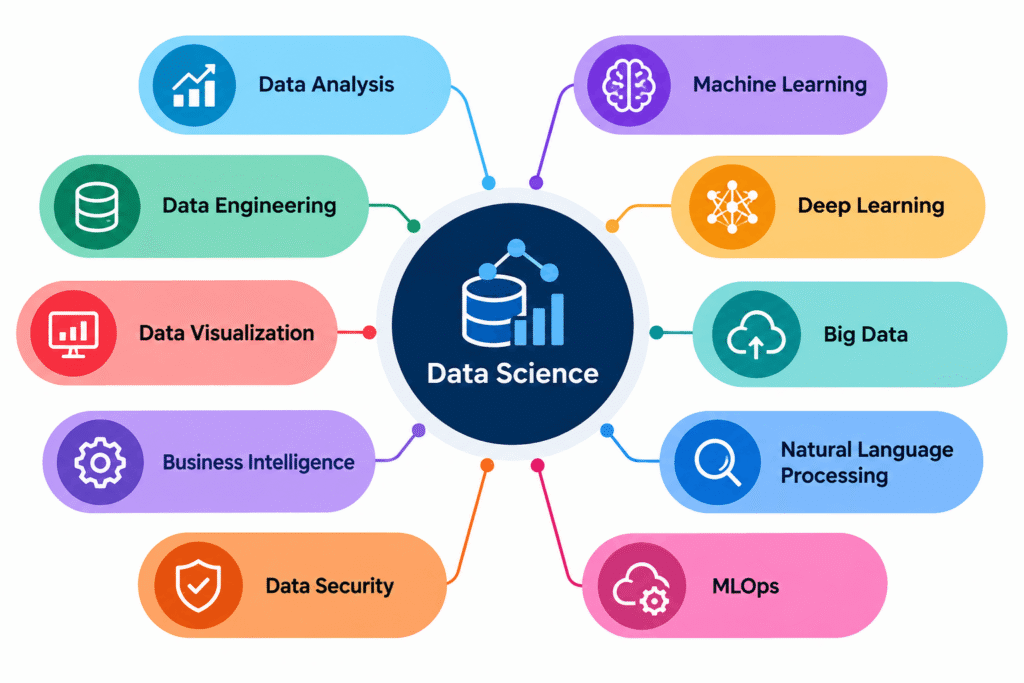
There is no one recognized classification for splitting up data science into specific types. The types may be overlapping.
These, however, are some of the major application areas of data science:
- Descriptive data science
- Diagnostic data science
- Predictive data science
- Prescriptive data science
- Statistical data science
- Machine learning
- Natural language processing
- Computer vision
- Time series analysis
- Big data and real-time data science
Let's look at each one.
1. Descriptive Data Science
Descriptive data science is about understanding the facts. It uses historical data to describe the past and detect patterns.
For instance, an e-commerce company can study:
- Monthly revenue
- Number of orders
- Most popular products
- Customer locations
- Website traffic
- Average order value
Common tools include Python, SQL, Excel, and data visualization platforms.
Example
Let us take the example of a situation in which the number of orders was 10,000 in January while the number of orders in February was 12,000. The descriptive analysis will help in understanding this change and finding out the reasons for this shift.
This need not be a prediction but a mere interpretation of the data.
2. Diagnostic Data Science
Diagnosis data science concentrates on the reason for an event. Having discovered the trend, experts try to uncover the potential reasons for the trend.
For instance, if sales on a website have declined, diagnosis may include:
- Website traffic
- Conversion rates
- Product availability
- Pricing changes
- Customer location
- Marketing campaigns
- Technical problems
Example
An organization found out that its online orders had fallen by 20% within a week's time. More analysis was carried out and revealed that there was a problem with the payment process which made the customers unable to complete their purchase.
Analysis of what occurred came first; diagnostic analysis focuses on finding out why it occurred.
3. Predictive Data Science
Data Science that predicts utilizes past and present data to come up with what may take place in the future. Statistical modeling and machine learning techniques are commonly employed.
Common applications include:
- Sales forecasting
- Customer churn prediction
- Fraud detection
- Credit risk assessment
- Demand forecasting
- Predictive maintenance
Example
Subscription businesses have the ability to predict which subscribers will end up cancelling their subscriptions, based on customer behavior, usage patterns, and accounts.
This prediction cannot be guaranteed. This is just an estimate made from patterns seen in the available data.
4. Prescriptive Data Science
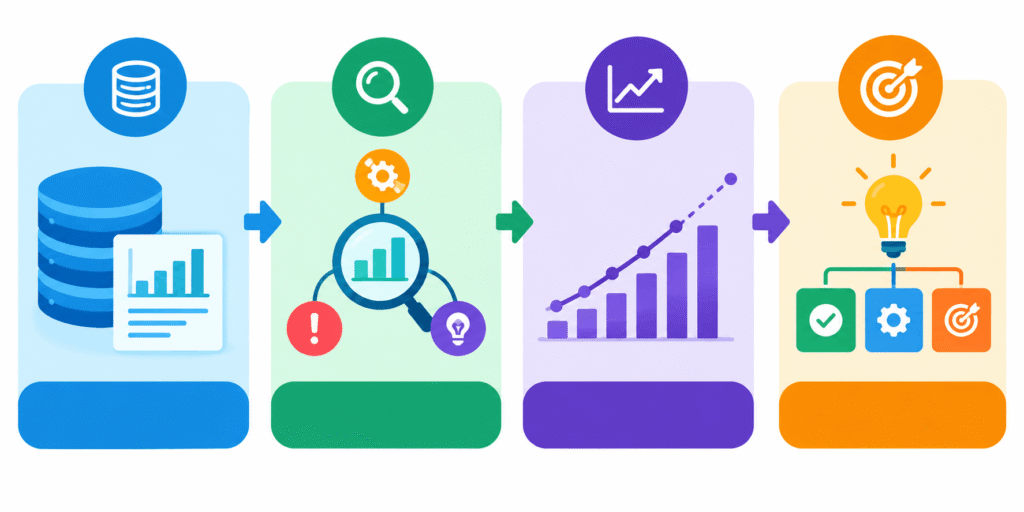
Prescriptive data science goes a step further by asking:
What action should be taken?
It can include forecasting, optimization, business rules, among others, in making suggestions for the actions that can be taken.
For instance, a delivery firm can utilize information regarding:
- Traffic
- Delivery locations
- Vehicle availability
- Delivery times
- Fuel costs
To find more efficient delivery routes.
Predictive analysis could be used to forecast delivery times, whereas prescriptive analysis would help determine the better route/action.
5. Statistical Data Science
Statistics constitutes an integral component of data science.
Methods employed in statistical data science include:
- Probability
- Hypothesis testing
- Regression
- Correlation
- Sampling
- Statistical inference
These techniques help researchers and data professionals understand relationships within data and measure uncertainty.
Example
The business might want to know if the redesign of its website increases the conversion rate. There are statistical methods which can be used in comparing different data sets.
Another example where statistics is helpful in answering a business question is when one wants to know whether a trend in some data set is significant.
6. Machine Learning
Machine learning is one of the most commonly used disciplines in modern data science. Machine learning algorithms do not require that every rule be programmed by hand but rather use patterns found in data for predictions.
Common types include:
- Supervised learning
- Unsupervised learning
- Semi-supervised learning
- Reinforcement learning
Applications include recommendation systems, fraud detection, customer segmentation, image classification, and forecasting.
Example
Machine learning can help a streaming service analyze viewing habits and then suggest to the user what they may want to watch using algorithms.
Machine learning does not necessarily stand alone in data science in all situations. Machine learning is usually one of the approaches used by a data scientist to solve a problem.
7. Natural Language Processing
Natural Language Processing, or NLP, deals with human language in text or speech. It combines ideas from data science, machine learning, linguistics, and artificial intelligence.
NLP applications include:
- Chatbots
- Sentiment analysis
- Text classification
- Search systems
- Document analysis
- Language translation
- Speech-related applications
Example
An organization could examine a large number of customer feedbacks and then classify those into either positive, negative, or neutral reviews.
Manually performing this task would prove to be very difficult, however, using NLP technology would make it automatic.
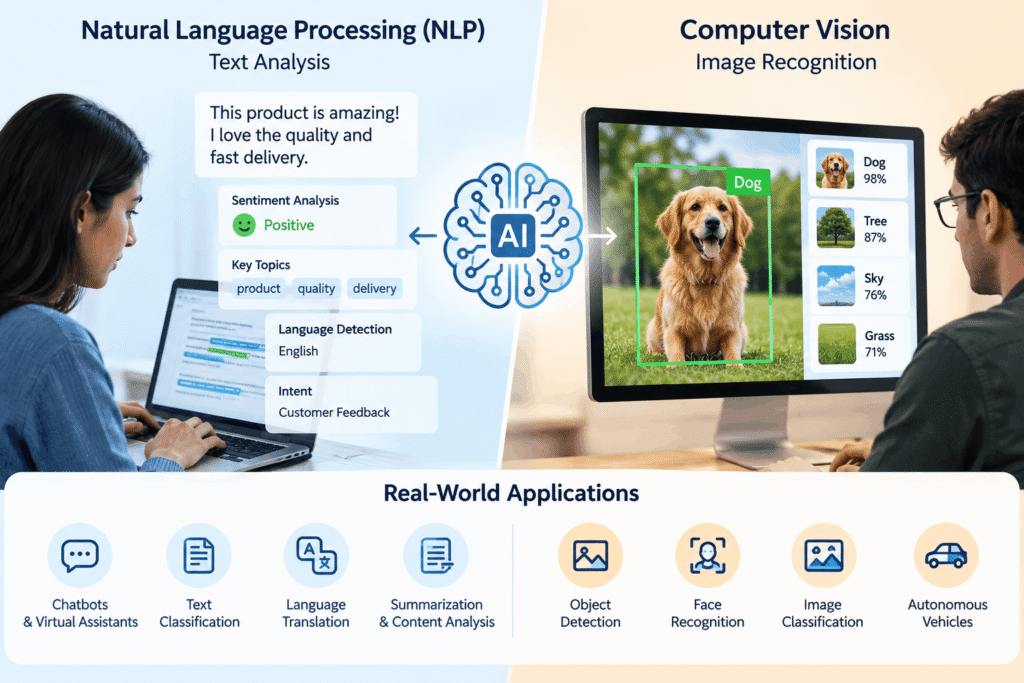
8. Computer Vision
Computer vision focuses on extracting information from images and videos. It is useful when the main data source is visual rather than text or numerical information.
Applications include:
- Object detection
- Face recognition
- Medical image analysis
- Quality inspection
- Image classification
- Autonomous systems
A manufacturing business could utilize cameras and computer vision models to detect defects that are present in their products during the assembly process.
Machine learning is common when using computer vision models.
9. Time Series Data Science
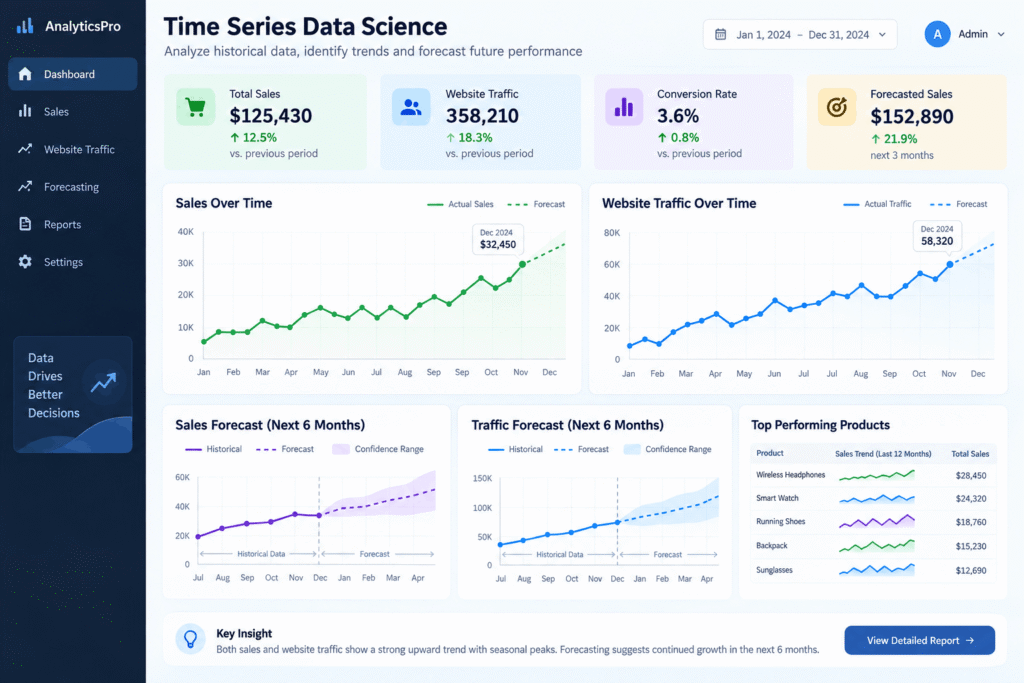
Time series analysis works with data collected over time.
Examples include:
- Daily sales
- Hourly electricity demand
- Stock prices
- Monthly website traffic
- Sensor readings
- Weather measurements
The order in which the observations occur is important since previous observations can contain information about future observations.
Example
A retail store can analyze weekly sales data over many years to predict future demand and manage their stock levels.
Time-series prediction may make use of statistical methods, machine learning algorithms, or both depending on the situation.
10. Big Data and Real-Time Data Science
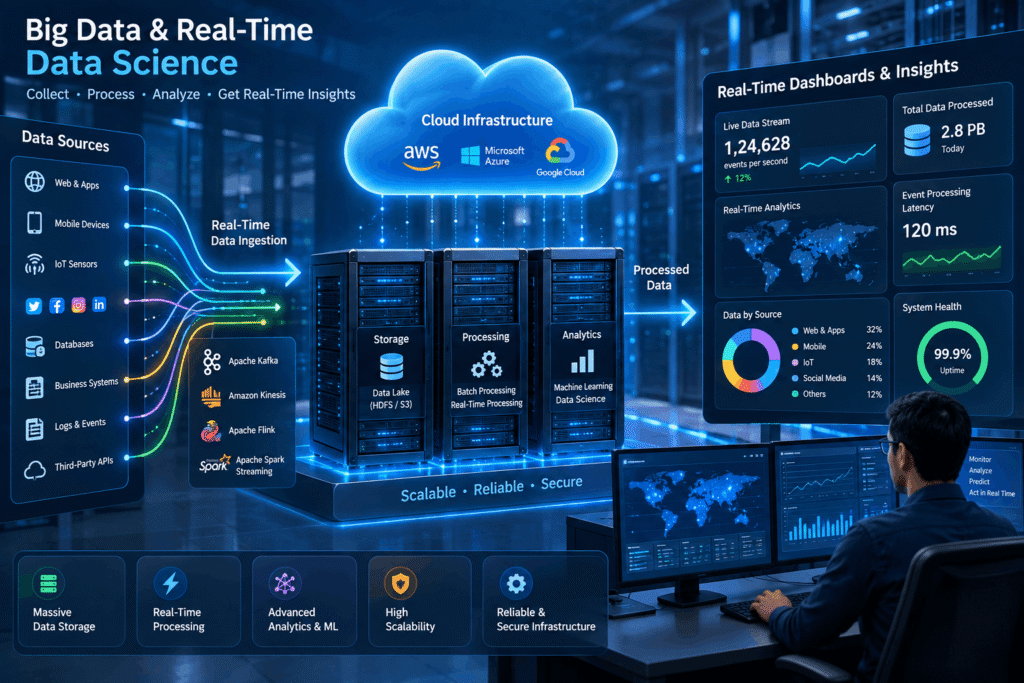
There are companies that use datasets which cannot be handled using the conventional methods of data processing.
Big data initiatives might include:
- Large volumes of records
- Continuous streams of information
- Data from many sources
- Structured and unstructured data
Real-time data science aims at dealing with information in a timely manner as it comes through.
For instance, in case of an online payments application, there is a need to analyze transactions fast so as to detect any fraudulent behavior.
This kind of project can use various technologies including distributed computing systems, clouds, streaming, and specialized databases.
Data Science Types Compared
| Type | Main Question | Common Use |
| Descriptive | What happened? | Reports and business analysis |
| Diagnostic | Why did it happen? | Finding causes and patterns |
| Predictive | What may happen? | Forecasting and prediction |
| Prescriptive | What should we do? | Recommendations and optimization |
| Statistical | What does the data tell us? | Testing and inference |
| Machine Learning | What patterns can a model learn? | Prediction and classification |
| NLP | What can we understand from language? | Text and speech applications |
| Computer Vision | What can we understand from images? | Image and video analysis |
| Time Series | How does data change over time? | Forecasting |
| Big Data | How can we process large-scale data? | Large and fast datasets |
How Different Types of Data Science Work Together
They do not work in isolation.
Suppose there is an e-commerce firm that is trying to lower its customer attrition rate. In this case, descriptive methods can help understand how customers behave while diagnostic methods will be useful in finding out the cause of their attrition.
Machine learning techniques can then help predict which customers are more likely to leave the firm. It may be using prescriptive methods to figure out what retention measures are worth undertaking.
If customer feedback is being analyzed in the process, NLP techniques can come in handy to extract insights from it.
Thus, one project can use a number of data science approaches.
Data Science vs Data Analytics
Data science is similar but not identical to data analytics.
Data analytics tends to deal more with analyzing the available data to solve business problems and make decisions.
Data science encompasses more actions, which might consist of statistics, machine learning, prediction, programming, etc. It all depends on the company.
There is no consistency of job titles used in different companies.
What Skills Are Needed for Different Data Science Types?
The skills you need depend on the area you want to enter.
Core Skills
Most data science learners benefit from learning:
- Python
- SQL
- Statistics
- Data cleaning
- Data visualization
- Basic mathematics
- Problem-solving
- Data interpretation
Basic computer knowledge is also useful when working with data tools and software. Learners who need to strengthen their foundational computer skills can explore a computer fundamentals course before moving into more advanced technical topics.
For Machine Learning
You may need:
- Supervised and unsupervised learning
- Model evaluation
- Feature engineering
- Regression and classification
- Machine learning libraries
For NLP
Useful areas include:
- Text preprocessing
- Language modeling
- Text classification
- Embeddings
- NLP libraries
- Machine learning
For Computer Vision
Useful skills include:
- Image processing
- Computer vision concepts
- Neural networks
- Deep learning
- Image classification and object detection
For Big Data
You may need:
- Distributed computing
- Cloud platforms
- Data engineering concepts
- Databases
- Data pipelines
You do not need to master every area before starting. A better approach is to learn the fundamentals first and then specialize.
Advantages of Learning Data Science
Learning data science can provide a broad technical foundation.
It can help you:
- Work with real-world datasets
- Understand business problems through data
- Build predictive models
- Automate parts of data analysis
- Explore machine learning
- Move toward specialized fields such as NLP or computer vision
- Develop projects for a technical portfolio
Another advantage is that the skills can apply across different industries, although the specific tools and domain knowledge can vary.
Limitations and Challenges
Data science is not simply about choosing an algorithm and getting an answer.
Poor-quality Data
Incorrect or outdated data could affect the output of the analysis or the model.
Data Privacy
Some projects contain private or sensitive data. There are legal or organizational rules that should be followed regarding how such data should be treated.
Model Limitations
Machine learning models can give wrong predictions. A high level of performance on previous data does not mean the same for the new data.
Communication
A technically correct analysis might not be effective if it is hard to understand by the decision makers.
Continuous Learning
Techniques are continuously evolving. The job of a data professional requires constant improvement of skills.
Common Misconceptions About Data Science Types
“The term ‘data science’ is the same thing as ‘machine learning.’”
That’s incorrect. Data science encompasses many more topics such as statistics, data cleansing, analysis, visualization, programming, experiment design, and communication.
“The data scientist must know every technology there is out there.”
False. Everyone has their own skill set, and you don’t need to learn everything before applying some knowledge.
“The larger the amount of data, the better the results.”
Additional information can help, however, quality, relevancy, consistency, and correct gathering of data are all important.
“The predictions made by the model are always accurate.”
False. Predictions include some error that must be considered.
How to Choose a Data Science Specialization
When you learn data science and need to pick a path for yourself, begin with the kind of tasks that you like.
Go for analytics and statistics if you like looking for patterns, playing with numbers, and explaining what happens in business.
Check out machine learning if you like coding and creating predictive models.
Consider NLP if you are interested in languages, chatbots, searching, or text analysis.
Computer vision could be for you if images, video recognition, and similar tasks appeal to you.
You may also investigate several directions before specializing.
A Beginner-Friendly Data Science Learning Path
A possible learning route could be:
Step 1: Learn Python
Master the concepts of variables, conditionals, loops, functions, data structures, and object-oriented programming.
Step 2: Learn SQL
Practice querying databases to extract, filter, combine, and aggregate information.
Step 3: Learn Statistics
Learn about mean, probability, distribution, correlation, regression, and hypothesis testing.
Step 4: Learn Data Manipulation
Handle datasets, cleanse missing values, perform column transformations, and analyze patterns.
Step 5: Learn Visualization
Make graphs and communicate your insights effectively.
Step 6: Learn Basics of Machine Learning
Master basic concepts like regression, classification, clustering, model evaluation, and algorithms.
Step 7: Make Projects
Use actual or open-source datasets and document your analysis.
Step 8: Specialize in a Specific Field
After mastering all the above-mentioned concepts, choose a field for specialization such as NLP, Computer Vision, Time Series, Big Data, etc.
Career Options in Data Science
The data field includes several different roles, and their responsibilities can overlap.
Possible career paths include:
- Data Analyst
- Data Scientist
- Machine Learning Engineer
- Business Intelligence Analyst
- Data Engineer
- NLP Engineer
- Computer Vision Engineer
- AI Engineer
The qualifications depend on the employers and the positions. Some roles may require more statistics and data analysis skills, while some may require good software engineering skills or knowledge of machine learning.
For newbies or students, having a strong understanding of Python, SQL, statistics, and data manipulation can be better than specializing too soon.
Related Technical Skills
Data projects often connect with other technical areas. For example, web applications may use data-driven features alongside front-end interfaces. Learners interested in building modern web interfaces can explore React JS training to understand how data-driven applications can be presented through interactive interfaces.
Understanding how websites are structured can also be useful when working with web-based data and applications. A web design course can help learners develop foundational knowledge of website structure, layouts, and user-facing interfaces.
Frequently Asked Questions
What are the main types of data science?
These can be descriptive analytics, diagnostic analytics, predictive analytics, prescriptive analytics, machine learning, statistical analytics, NLP, computer vision, time series, and big data.
Is machine learning a type of data science?
Machine learning is generally regarded as one of the major areas of data science instead of an entirely different discipline. Machine learning algorithms are used in data science for prediction and pattern recognition purposes.
Which type of data science is best for beginners?
There is no definite answer here. As a beginner, you should start learning data analysis, statistics, Python, and SQL and only then move towards the specializations like machine learning, NLP, and computer vision.
What is the difference between predictive and prescriptive data science?
In predictive analytics, predictions about future events are made. In prescriptive, available data helps figure out the best way to take an action.
Do I need Python to learn data science?
No, but it is very popular among data scientists. There are many other languages and tools that can be used, including SQL, visualization tools, and others.
Can a beginner learn data science?
Yes, he/she can. Start by learning basic programming and statistics, then data analysis and machine learning will follow.
Final Thoughts
All kinds of data science can be considered more like overlapping topics than entirely separate fields. The descriptive and diagnostic approaches provide explanations for the current data, while predictive approaches allow forecasting, and prescriptive methods can help in decision-making.
Machine learning, natural language processing (NLP), computer vision, time series analysis, and big data are aimed at solving certain problems and working with certain kinds of data.
When you start from scratch, there is no hurry in choosing a specialization area. Just concentrate on Python, SQL, stats, data management, and visualization.
To explore professional skill-development options across technology, design, digital skills, business, and other career-focused areas, visit RW Skill.
Learners interested in combining technical knowledge with digital business skills can also explore digital marketing training as a separate skill area.