


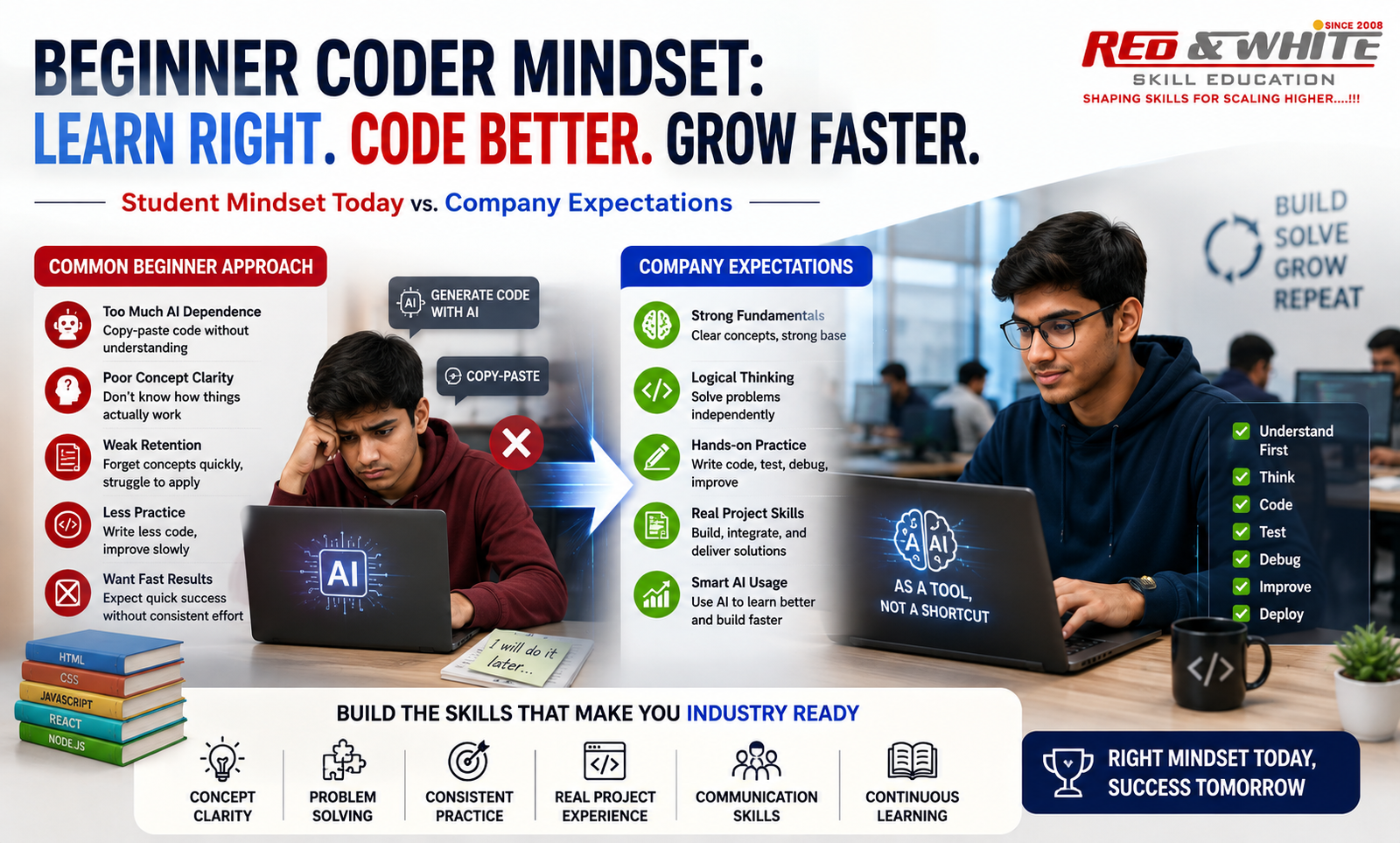
Mindset, Real Learning & Company Expectations
 Sep 07, 2026

RWn. Piyush Nakrani
Subject Matter Expert
Intro
Starting out in the software development industry is exciting, but also not an easy feat.
Learning to program is not simply memorising syntax or passing a course Scared to be honest, it is a long-standing relationship, a process that takes time to develop logical thinking, practical problem solving, real implementation skills and confidence to do something.
Today, Artificial Intelligence redefines students learning and software development. AI tools can generate code, explain concepts, detect faults and help developers complete faster.
But a question pops up:
Students use AI to learn better or students use AI to stop learning?
Not the same way a beginner can shape their future career.
In this article we try to bridge the gap between: what beginners learn, what companies expect and how students prepare for the industry, from our academic and Web Development experience at Red & White Skill Education.
1. Learning to code is a long process
Programming logic is never learned in one single day.
A student might Understand a concept in their class today, but understanding a concept do not mean a student can implement it independently tomorrow.
For a beginner most of the time the cycle will be:
Understood → Try to build → Make mistakes → Fix → Try to build again → Get better
This vastly depends on consistency.
At the beginner level the student should spend a bit of time writing code themselves, trying a new approach, making a mistake.
Because a mistake is not a programmer’s failure.
A mistake is part of the skill of how to think like a programmer.
When a student gets an error and tries to understand why the error happens, that process is helping them become a problem solver.
2. The Problem – Memorizing Code Without Understanding It
This is a problem we see on the beginner level: Learning by memorization. Sometimes the student is more concerned how the code looks, rather than what the code does.
For instance, maybe a student can reproduce a particular program after seeing it several times.
However, when the requirement changes a little bit, the same student struggles to adapt the program.
This lays an important distinction between:
Knowing the Code ≠ Understanding the Logic
A developer doesn’t work in an environment where the exact same question exists everyday.
The requirements change.
The inputs change.
The business rules change.
The errors change.
The solution changes.
So, the student needs to learn how to understand a problem, and come up with a solution, or change an existing solution, rather than simply reproducing a piece of code that the student has already wrote.
3. AI is a Useful Tool, But It Shouldn't Replace Thinking
AI is an essential ingredient of the modern software development experience.
Students can use AI tools to:
- Understand complex concepts
- Generate examples
- Identify bugs
- Improve code
- Learn alternate implementations
- Browse documentation
- Speed up development
Nothing is wrong with AI.
The real problem starts when a student takes the following path:
Requirement → AI → copy code → submit
without taking this route:
Requirement → think → understand → implement → test → improve
When a student continuously relies on AI to write even simple programs, the chance to build independent coding skill is severely diminished.
AI should be an assistant and learning aid, not a substitute for learning.
A decent beginner should first attempt a problem on their own and then leverage AI to improve the solution or learn an alternate approach.
4. Why Independent Coding is Important for Beginners
An experienced developer can use AI to dramatically increase productivity.
But as a beginner, the first goal is to get the fundamentals.
A beginner should first have the ability to write simple programs on their own.while building strong Web Development fundamentals.
For example:
- Variables
- Conditions
- Loops
- Functions
- Arrays
- Objects
- String manipulation
- Basic problem solving
- API basics
- Component concepts
- Basic CRUD operations
The goal does not lie in memorizing hundreds of programs.
The goal lies in the layman of the thinking of those programs.
When this kind of foundation becomes strong, AI will help the developer get faster without getting the developer dependent.
5. What Companies Really Want
Companies generally want to know whether the candidate can contribute to their projects.
There are real requirements, deadlines, existing codebases and business issues.
So companies might test:
🧠 Conceptual Understanding
Does the candidate understand the concept behind the technology?
💻 Practical Implementation
Can apply it practically?
🧩 Logical Thinking
Can solve an unfamiliar problem?
🐞 Debugging
Can identify and fix a bug?
🔄 Adaptability
Can be flexible for the new requirements
🏗️ Project understanding
Can the candidate explain the project he/ she put on his/her resume?
These skills are more important for beginners because companies want to hire people who can learn, contribute and grow within the development environment.
6. Interesting Reality: AI in Interviews versus AI at Work
Interestingly there is a difference between the selection and the real development environment.
When a company does a first technical interview (first round of interviews at a company), they might limit how an applicant can use AI for figuring out problems and writing code.
To see:
“What can this candidate do independently?”
However, when they join a company, it can look quite different.
Many companies allow or even encourage developers to use the company's approved AI tools to be more productive, speed up development and finish coding tasks.
So the real expectation is not:
“Never use AI.”
But:
“First understand the technology, then use AI wisely to be more productive.”
This is extremely important for today's students.
7. Two Kinds of Company Expectations
Not all companies assess their employees in exactly the same way.
In general, companies may have different priorities.
Type 1: Thinking & Skill Focused
Some companies value:
- Technical fundamentals
- Logical thinking
- Problem solving
- Code quality
- Learning ability
- Long term growth
In those cases, a candidate's technical ability independently could be quite valuable.
Type 2: Output & Product Focused
Other companies value:
- Feature delivery
- Deadline delivery
- Requirement understanding
- Working with existing systems
- Using existing tools for development
- Productivity
In those cases, developers might be encouraged to use AI tools responsibly.
So the student needs to be ready for the two different scene.
8. Something about the Student – Company Gap
That puts the rookie in a difficult situation.
Student goes:
“ I can develop the project with AI technology. So I am a Full Stack Developer. ’
Company may ask:
“Can you describe the architecture, change the feature and solve the problem?”
The project may be, but the core skill may not be.
This is where the Student–Industry Skill Gap may exist.
The answer is not to entirely abandon AI.
The answer is to first build the foundation.
9. What should a Beginner Developers do?
A simple learning approach makes a big difference.
Step 1 , Try Yourself First
Without coding AI, spend time understanding the problem.
Ask yourself:
- What is the input?
- What should be the output?
- What logic is needed?
- What idea solves the problem?
Step 2 , Write the Basic Version Yourself
Even if your solution is not great, write it.
Your first code does not need to be great.
It should be your thought process.
Step 3 , Use AI as a Teacher
After making your attempt, ask AI:
“Review my approach.”
Not:
“Build the full project for me.”
A small difference that changes the whole experience.
Step 4 , Understand All the Important Line
If AI create a code, ask:
- Why is it used?
- What if I delete it?
- Can I make changes?
- Is there another approach?
- What error is on here?
If you cannot explain the code, you did not learn the concept yet.
Step 5 , Rebuild Without AI
Once you understand the solution, close the AI and try to implement the feature yourself.
This is one of the most effective ways to determine whether the knowledge really got into you.
10. Not All Students Are the Same
It is also important to understand that not all students use AI the same way.
There are students who truly want to:
- Write the code themselves
- Understand the error
- Build the project by themselves
- Practice a lot
- Ask relevant questions
- Improve the logic
Such students often have a stronger practical ability because they are more easily developing the ability to think independently.
Their progress may sometimes be slower in the beginning.
But in the long run, their foundation will be much sturdier.
Fast completion does not equal deep understanding.
A student who takes time to understand a problem today can become much faster tomorrow.
Conclusion
The software industry is evolving fast.
AI is becoming an integral part of the development, and students absolutely need to learn how to use AI.
But beginners should remember one thing:
Don't let AI write the story of your learning journey.
Let AI to help you to understand.
Let AI to help you to explore.
Let AI to help you to grow.
Let AI to help you to accelerate.
But before that, learn to think, learn to code, learn to debug and learn to solve problems by yourself.
Students' goal should not be simply:
"I did a Fullstack Project"
It should be:
"I know what I did, I can explain what I did, I can tweak what I did, I can solve a new problem with what I learned."
At Red & White Skill Education, we should continue to focus on building solid fundamentals, hands-on skills, and the right learning mindset, so learners can confidently close the gap between classroom learning and industry expectations.
🚀 Learn First. Practice Daily. Use AI Wisely. Build Independently. Keep Growing.