

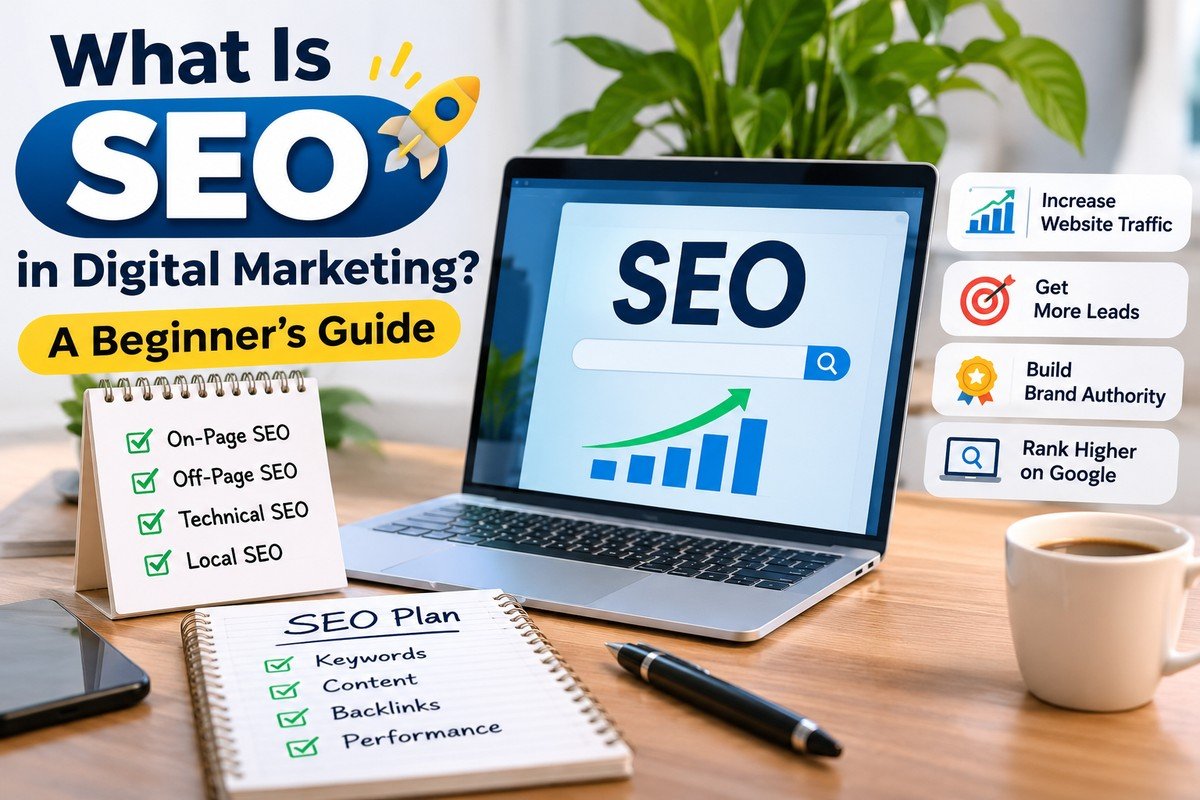
What Is SEO in Digital Marketing? A Beginner’s Guide
 Nov 03, 2026
SEO in digital marketing (search engine optimisation) is the practice of improving a website so that it appears higher in Google's free, unpaid results when people search for what you offer. Unlike ads, you do not pay per click; you earn visibility by publishing useful content, making your site easy for Google to crawl and building trust with links and reviews. It is one of the core modules in any good Digital Marketing course, because almost every business, from a Ring Road textile trader to a Vesu coaching class, wants to be found on Google.
This guide covers how SEO works, the types of SEO, SEO vs SEM, AI Overviews, tools and SEO careers in India.
How SEO Works: Crawling, Indexing and Ranking
To understand how SEO works, you first need to know what Google does with a web page. According to Google Search Central, Search works in three stages:
- Crawling: Google's crawler, Googlebot, discovers pages by following links and reading sitemaps, then downloads and renders them.
- Indexing: Google analyses the text, images, titles and other signals on the page and stores it in its index, a huge database of pages.
- Serving and ranking: When someone searches, Google picks the most relevant, high-quality pages from the index, taking into account things like the searcher's location, language and device.
SEO is the work of helping your pages pass all three stages well. Remember two facts: Google does not accept payment to rank a site higher organically, and it does not guarantee that any page will be crawled or indexed.
Ranking is handled by many automated systems, covering links, freshness, reviews, original content and spam. The helpful content system was folded into Google's core ranking systems in March 2024. The message is the same: write for people, not for search engines.
Types of SEO Every Beginner Should Know
SEO work is usually divided into four types. They overlap in real projects, but learning them separately helps.
1. On-Page SEO
On-page SEO covers everything on the page itself: the title tag, meta description, headings, body content, image alt text and internal links. The goal is to match search intent. If someone searches "how to drape a Banarasi saree", they want steps and photos, not a product catalogue. Writing clear headings and answering the question early is basic on-page work.
2. Off-Page SEO
Off-page SEO is about signals from outside your website, mainly links from relevant sites, brand mentions and reviews. A link from a respected Surat news portal tells Google that others trust you. Buying links breaks Google's spam policies, so earn links through genuinely useful content.
3. Technical SEO
Technical SEO makes sure Google can crawl, render and index your site without trouble. It includes site speed, mobile-friendliness, HTTPS, XML sitemaps, robots.txt rules, clean URLs and fixing broken pages. Many of these fixes need basic HTML, CSS and JavaScript knowledge, which is why SEO professionals who have done a Web Front-End Development course can talk to developers with confidence.
4. Local SEO
Local SEO helps a business appear in the map pack and local results when people search "near me" or add a city name. Google states that local results depend mainly on relevance, distance and prominence, and that there is no way to pay for a better local ranking. A verified, complete Google Business Profile is the starting point.
A Practical Example: A Surat Saree Shop Ranking Locally
Imagine a family-run saree shop near Ghod Dod Road. It has a basic website, but when someone types "bridal saree shop in Surat", competitors show up first. Here is how a beginner could apply SEO in digital marketing to this shop over a few months:
- Local: Verify the Google Business Profile, choose the correct category, add accurate hours and address, upload real photos of the store and reply politely to every review.
- On-page: Create separate pages for bridal sarees, Gharchola sarees and wholesale enquiries, each with a clear title such as "Bridal Sarees in Surat | Shop Name" and helpful text about fabrics, price ranges and alteration services.
- Content: Publish short guides like "Choosing a Saree for a Gujarati Wedding" with original product photos. Good visuals from someone trained in graphic design make these pages far more engaging.
- Technical: Compress large images so the mobile site loads quickly and submit a sitemap in Google Search Console.
- Off-page: Get listed on genuine local directories and ask happy customers for reviews (never fake ones).
A coaching class in Adajan could follow the same playbook, with pages for each course and batch timings. Results usually take months, and no honest professional can promise a number one position.
SEO vs SEM: What Is the Difference?
Beginners often mix up SEO and SEM. SEM (search engine marketing) usually refers to paid search ads, such as Google Ads, while SEO focuses on organic results. Many businesses use both.
| Point | SEO | SEM (Paid Search) |
|---|---|---|
| Cost per click | No payment to Google per click | You pay for clicks or impressions |
| Speed | Slow; usually takes months | Fast; ads can show the same day |
| Longevity | Rankings can last if content stays useful | Traffic stops when the budget stops |
| Placement | Organic listings, map pack, AI Overviews links | Sponsored ad slots |
| Best for | Long-term trust and steady traffic | Quick leads, offers, testing keywords |
AI Overviews and SEO: What Has Changed?
Google now shows AI-generated summaries, called AI Overviews, at the top of many results, with links to the pages it used. AI Mode offers a more conversational search experience. Many students ask whether this makes SEO useless. It does not.
Google's documentation on AI features says there are no additional requirements to appear in AI Overviews or AI Mode. A page needs to be indexed and eligible to show with a snippet, and normal SEO best practices still apply. Google also says you do not need special markup or new files for these features. Clicks from AI features are counted in the Search Console Performance report under the Web search type.
In practice, this rewards pages that answer questions clearly and show first-hand experience.
SEO Tools Beginners Should Learn
- Google Search Console: Shows clicks, impressions, queries and indexing issues, plus the URL Inspection tool. Learn this first.
- Google Business Profile: Essential for local SEO, reviews and map visibility.
- Google Analytics: Shows what visitors do after they land on your site. Reading these reports well is easier if you understand basics from a Data Analysis course.
- PageSpeed Insights: Checks loading speed and Core Web Vitals for mobile and desktop.
- Keyword and audit tools: Google Keyword Planner, Semrush, Ahrefs and Screaming Frog help with keyword research and site audits.
SEO Career in India: Roles and Skills
An SEO career suits people who enjoy writing, analysing data and solving puzzles. Common entry roles include SEO Executive, SEO Analyst, Content Writer with SEO skills and Digital Marketing Executive. With experience, people move into SEO Manager, technical SEO specialist or freelance consultant roles. Surat's growing base of textile, diamond and D2C brands creates steady local demand for people who can do SEO digital marketing work for small businesses.
On pay, AmbitionBox salary data (last updated July 2025) shows SEO Executives in India earning roughly ₹1.2 lakh to ₹4.2 lakh per year, based on about 16,500 reported salaries from people with 0 to 4 years of experience. Your actual package depends on the city, company and your portfolio.
Skills that help you stand out:
- Clear writing in English, and ideally Gujarati or Hindi for local clients
- Keyword research and understanding search intent
- Basic HTML and WordPress
- Reading Search Console and Analytics reports
- Creating simple visuals or short videos; a Video Editing course adds value since video often appears in search results
The best proof of skill is a live project. Rank a small blog, or help a relative's shop improve its Google Business Profile, and document what you changed. At RW Skill Education, digital marketing learners focus on this kind of hands-on practice rather than only studying theory.
Frequently Asked Questions
What is SEO in digital marketing in simple words?
It is the process of improving your website so it shows up higher in Google's free results for searches related to your business, bringing visitors without paying for each click.
How long does SEO take to show results?
There is no fixed timeline. Small local improvements can show within weeks, but competitive keywords usually take several months of consistent work. Anyone guaranteeing quick top rankings should be treated with caution.
Is SEO still relevant with AI Overviews?
Yes. Google says pages need no extra requirements to appear in AI Overviews; they must be indexed and snippet-eligible, and standard SEO practices still apply.
Can I learn SEO without coding?
Yes. On-page, local and off-page SEO need very little coding. Basic HTML helps with technical SEO, but you can start without it.
Which is better for a small business, SEO or Google Ads?
It depends on goals and budget. Ads bring quick leads; SEO builds long-term visibility. Most small businesses benefit from a mix, starting with a strong Google Business Profile.
Can SEO help me start my own business or freelance?
Yes. Many SEO professionals freelance for local shops, clinics and coaching classes. Pairing digital marketing SEO skills with business basics from an Entrepreneurship Bootcamp helps you price services and manage clients.
Your First Step Into SEO
SEO is not a trick to fool Google; it is the habit of making a website genuinely useful, easy to crawl and trusted by others. Start small: set up Search Console on a practice site, optimise one page for one clear search, and track what happens over a few weeks. That hands-on loop of testing, measuring and improving is what turns a beginner into a capable SEO professional.