


GSTR-1 vs GSTR-3B: Meaning, Due Dates and Key Differences
 Nov 03, 2026
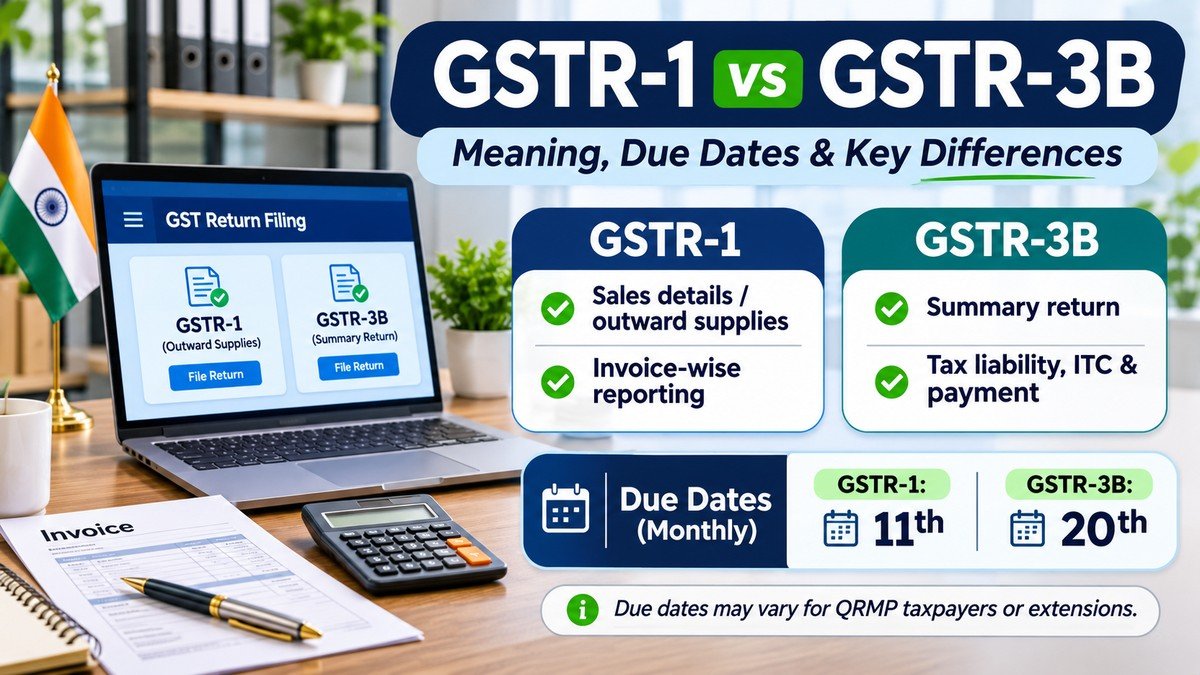
GSTR-1 is the return where a GST-registered business reports the details of its sales, invoice by invoice. GSTR-3B is the summary return where it declares its total tax liability, claims input tax credit (ITC) and actually pays the tax. Put simply, GSTR-1 tells the government what you sold, and GSTR-3B settles how much you owe.
Both are monthly or quarterly GST returns, and since 2025 the link between them has become much tighter. If you are a commerce student, a junior accountant or a small business owner in Surat filing returns for the first time, this guide explains each form, the current due dates, late fees and the practical differences. Learners in an Accounting & Taxation course usually practise these two forms first, because almost every GST-registered client files them. All rules below are as of November 2026; always confirm on the GST portal before filing.
What Is GSTR-1?
GSTR-1 (sometimes searched as GST R-1) is the statement of outward supplies. Every regular taxpayer reports the sales made during the tax period here, including:
- B2B invoices with the buyer's GSTIN, invoice value and tax amount
- B2C sales (large inter-state invoices separately, smaller ones in summary)
- Exports, credit notes, debit notes and advances received
- An HSN-wise summary of goods and services sold
GSTR-1 matters beyond your own compliance. The B2B invoices you upload flow into your buyers' GSTR-2B, which is the basis on which they claim ITC. A Surat textile trader who delays GSTR-1 delays the input credit of every unit that buys from him.
What Is GSTR-3B?
GSTR-3B is a self-declared summary return. It does not ask for invoice-level detail. Instead, you report totals for the period:
- Total taxable outward supplies and tax on them (Table 3)
- Eligible ITC available, reversed and net (Table 4)
- Exempt, nil-rated and non-GST inward supplies (Table 5)
- Interest and late fee, if any, and the final tax payment (Table 6)
The key point: GSTR-3B is the return through which tax is actually paid, using ITC first and then cash from the electronic cash ledger. Until it is filed with payment, your liability for the month remains open and interest keeps running.
GSTR-1 Due Date and GSTR-3B Due Date (as of November 2026)
Due dates depend on whether you file monthly or have opted for the quarterly QRMP scheme. The state-wise split for quarterly GSTR-3B comes from CBIC notifications; Gujarat falls in the 22nd-day group, as listed in Notification 76/2020 – Central Tax and later QRMP notifications.
| Return | Monthly filer | QRMP (quarterly) filer |
|---|---|---|
| GSTR-1 | 11th of the next month | 13th of the month after the quarter |
| IFF (optional, B2B invoices) | Not applicable | 1st to 13th of the next month, for months 1 and 2 of the quarter |
| GSTR-3B | 20th of the next month | 22nd (Gujarat, Maharashtra, Karnataka and other listed states) or 24th (northern and eastern states) of the month after the quarter |
| Tax payment in PMT-06 | Paid with GSTR-3B | 25th of the next month, for months 1 and 2 |
Example: a monthly filer in Surat files October 2026 GSTR-1 by 11 November and October GSTR-3B by 20 November. A QRMP taxpayer in Gujarat files GSTR-1 for the October to December quarter by 13 January and GSTR-3B by 22 January.
How the QRMP Scheme Works
The Quarterly Return Monthly Payment (QRMP) scheme is open to taxpayers with aggregate turnover up to ₹5 crore. Returns are filed quarterly, but tax is still paid every month. For the first two months you deposit tax through Form PMT-06, either by the fixed-sum method (based on past returns) or the self-assessment method (actual liability). You can also upload B2B invoices through the Invoice Furnishing Facility (IFF) so your buyers get their credit without waiting for the quarter to end.
Difference Between GSTR-1 and GSTR-3B
This table sums up the difference between GSTR-1 and GSTR-3B at a glance:
| Basis | GSTR-1 | GSTR-3B |
|---|---|---|
| Nature | Statement of outward supplies | Summary return with tax payment |
| Level of detail | Invoice-wise (B2B), summary (small B2C) | Consolidated totals only |
| ITC claim | No ITC claimed | ITC claimed and set off |
| Tax payment | No payment made | Tax, interest and late fee paid |
| Effect on others | Feeds buyers' GSTR-2B | Affects only your own ledger |
| Monthly due date | 11th | 20th |
| Corrections | Through GSTR-1A or later GSTR-1 | Sales liability locked; fix via GSTR-1A |
The order matters too. GSTR-1 is filed first, and the portal uses it to auto-populate the sales figures in GSTR-3B. That brings us to the biggest recent change.
Key GST Return Changes in 2025–2026
GSTR-3B Sales Liability Is Now Hard-Locked
From the July 2025 tax period, the sales liability auto-filled in GSTR-3B from GSTR-1, GSTR-1A or IFF can no longer be edited in GSTR-3B. GSTN announced this through an advisory dated 7 June 2025. If a sales invoice was reported wrongly, you must correct it in GSTR-1A before filing GSTR-3B for that period. In practice, this makes the accuracy of GSTR-1 far more important than before.
Three-Year Time Limit for Filing Returns
Also from the July 2025 tax period, the portal stopped accepting GSTR-1 and GSTR-3B more than three years after their due date. A business that ignored old pending returns can no longer file them, which can create problems for registration and ITC claims later.
Auto-Calculated Interest in GSTR-3B
From the January 2026 tax period, the portal computes interest on late payment and auto-fills it in GSTR-3B. You can increase this figure but not reduce it. The interest rate on delayed tax is 18% per annum on the net cash liability.
GST Rate Rationalisation From 22 September 2025
The 56th GST Council meeting replaced the four main slabs with two, 5% and 18%, plus a 40% rate for a small list of de-merit goods, effective 22 September 2025 (with some tobacco items moved later). The return forms did not change, but businesses had to update tax rates in their billing software. A September 2025 GSTR-1 could therefore carry both old and new rates, so HSN summaries needed extra care.
Late Fee for GSTR-3B and GSTR-1
The late fee for GSTR-3B and GSTR-1 is the same, as rationalised in 2021:
- Regular return: ₹50 per day (₹25 CGST + ₹25 SGST)
- Nil return: ₹20 per day, capped at ₹500
- Maximum cap per return: ₹2,000 (turnover up to ₹1.5 crore), ₹5,000 (₹1.5–5 crore), ₹10,000 (above ₹5 crore)
For GSTR-3B, the bigger cost is usually the 18% interest on unpaid tax, not the late fee. Filing even one day late also blocks the next period's return, because GSTR-3B must be filed in sequence.
A Simple Monthly Filing Routine
- Close the month's sales register and reconcile it with your billing software by the 5th.
- File GSTR-1 by the 11th; check buyer GSTINs and HSN codes before submitting.
- Review GSTR-2B and accept or reject purchase invoices in the Invoice Management System.
- Fix any outward supply mistakes in GSTR-1A, then file GSTR-3B and pay by the 20th.
Comfort with spreadsheets helps a lot here. Basic computer skills from a CCC course are a starting point, while learning pivot tables and reconciliation through a Data Analysis course makes matching GSTR-2B with purchase registers much faster.
Why These GST Returns Matter for Your Career
Surat's traders, textile units, diamond businesses and service firms all need someone to file GST returns every month. Accounts executives, GST assistants and tax consultants who understand both forms, and who can handle reconciliation and notices, are in steady demand with CA firms and businesses. Graduates from a Business Administration & Commerce course often add GST practice to become job-ready, and first-time founders exploring an Entrepreneurship Bootcamp benefit from knowing what their accountant files on their behalf. At RW Skill Education, GST return filing is taught on live portal-style exercises rather than only theory.
Frequently Asked Questions
Can I file GSTR-3B before GSTR-1?
Technically the portal allows it, but it is not advisable. Since sales liability in GSTR-3B is auto-populated from GSTR-1 and locked from July 2025, filing GSTR-1 first keeps both returns consistent.
Is GSTR-1 required if there were no sales in the month?
Yes. A nil GSTR-1 must still be filed for every tax period. It can be filed quickly, including through SMS on the portal, and the late fee for a nil return is lower.
What is GSTR-1A?
GSTR-1A is an optional form to amend or add outward supplies of the same tax period after GSTR-1 is filed but before GSTR-3B is filed. It is now the main way to correct sales figures that flow into GSTR-3B.
Who can opt for the QRMP scheme?
Registered taxpayers with aggregate turnover up to ₹5 crore in the previous financial year can opt for QRMP. They file GSTR-1 and GSTR-3B quarterly but pay tax monthly through PMT-06.
What happens if GSTR-3B is not filed for several months?
Late fee and interest keep adding up, e-way bill generation can be blocked, and continued non-filing can lead to cancellation of registration. Returns older than three years can no longer be filed at all.
Do composition taxpayers file GSTR-1 and GSTR-3B?
No. Composition taxpayers pay tax quarterly through CMP-08 and file an annual return in GSTR-4 instead of GSTR-1 and GSTR-3B.
GSTR-1 Reports, GSTR-3B Pays: Keep Them Matched
GSTR-1 is your invoice-level sales report and GSTR-3B is your summary return with tax payment. With GSTR-3B sales figures now locked to GSTR-1, a three-year filing limit and auto-calculated interest, accuracy at the GSTR-1 stage decides how smooth the rest of the month goes. File GSTR-1 by the 11th, correct errors through GSTR-1A, pay through GSTR-3B by the 20th (or 22nd for QRMP filers in Gujarat), and check GSTN advisories regularly, since dates and rules do change.