

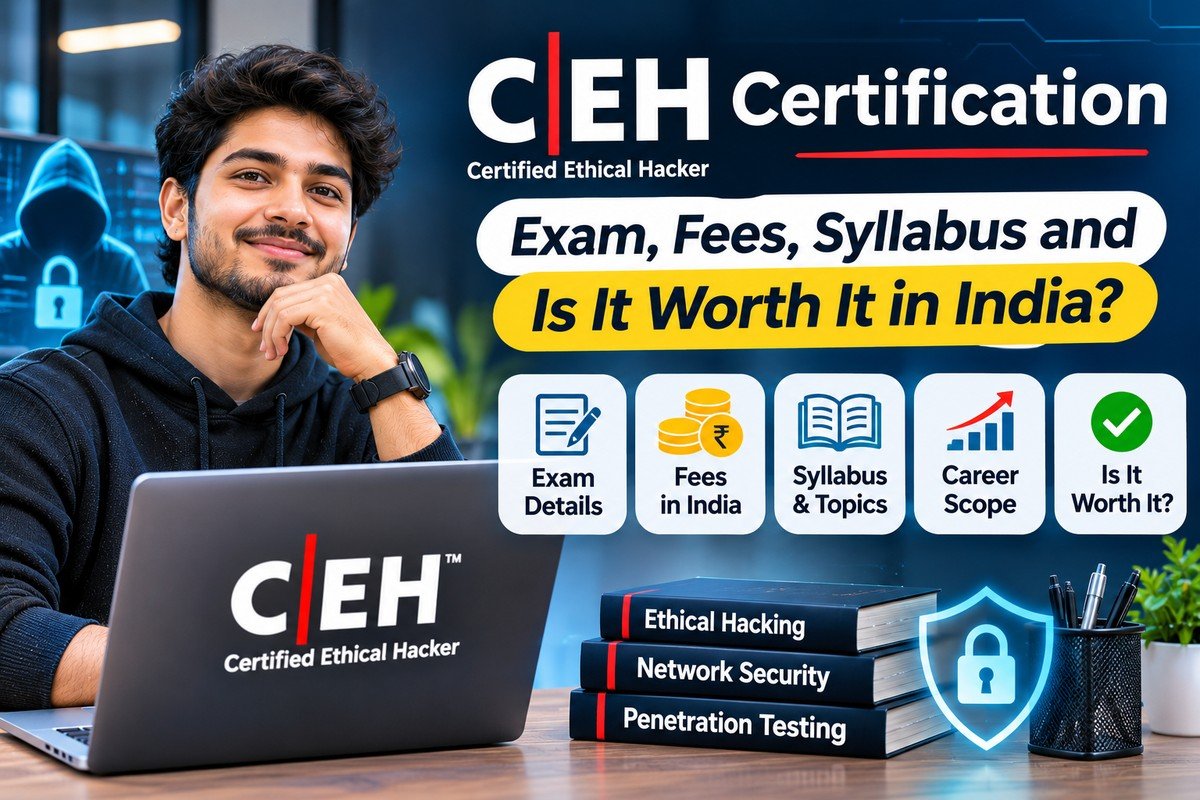
CEH Certification: Exam, Fees, Syllabus and Is It Worth It in India
 Nov 03, 2026
CEH ethical hacking certification (Certified Ethical Hacker) is EC-Council's entry-to-intermediate credential for people who want to test systems the way attackers do, but legally. The current version is CEH v13 AI: a 4-hour, 125-question multiple-choice exam, with an optional 6-hour practical exam for the CEH Master title. It is worth it in India if you want HR-recognised proof of security knowledge, especially for SOC, VAPT and compliance roles, but it works best on top of real hands-on skills, such as those built in a structured Cyber Security course.
This guide covers the CEH exam pattern, eligibility, fees, the v13 syllabus, salary data and how CEH compares with OSCP, so you can decide before spending money.
What Is Certified Ethical Hacking (CEH)?
Certified ethical hacking means a professional has proved, through EC-Council's exam, that they understand how attacks work across networks, web applications, cloud, mobile and IoT, and how to defend against them. An ethical hacker gets written permission from an organisation, finds weaknesses before criminals do, and reports them with fixes.
A practical example: a Surat-based textile exporter moves its order system online. Before launch, a security tester scans the server, finds an outdated plugin and a login form vulnerable to SQL injection, and shows the developers how to patch both. That is the daily work CEH prepares you for.
According to EC-Council's official CEH programme page, version 13 follows a four-part approach: learn (training plus 221 hands-on labs), certify (knowledge and practical exams), engage (a simulated hacking engagement in a cyber range) and compete (12 capture-the-flag challenges spread over a year).
CEH Exam Pattern: Knowledge and Practical
The CEH exam has two parts. Only the knowledge exam is needed for the CEH credential. Passing both earns you CEH Master.
| Detail | CEH (Knowledge exam) | CEH Practical |
|---|---|---|
| Exam code | 312-50 (ECC Exam / Pearson VUE) | Separate practical exam |
| Format | 125 multiple-choice questions | 20 real-world challenges on live machines |
| Duration | 4 hours | 6 hours |
| Passing score | 60% to 85%, depending on the question set | Set by EC-Council per exam form |
| Delivery | ECC Exam Centre (incl. remote proctoring) or Pearson VUE centre | Remote, proctored, in EC-Council's iLabs cyber range |
The pass mark varies because EC-Council uses multiple question banks and sets a cut score for each based on difficulty. Aim for consistent scores above 85% in practice tests rather than chasing the minimum.
CEH Eligibility: Who Can Apply
There is no degree requirement. CEH eligibility depends on one of two routes, as listed on EC-Council's certification site:
- Official training route: complete CEH training through EC-Council or an Accredited Training Centre. You can then book the exam directly.
- Self-study route: show at least 2 years of work experience in information security and pay a non-refundable USD 100 eligibility application fee. EC-Council reviews and approves the application before you can buy a voucher.
For freshers and students, the training route is the realistic option, since most do not yet have two years of security experience.
Skills to build before CEH
Formal eligibility is easy. Actual readiness is harder. Candidates who struggle usually lack basics, not hacking tricks. Before starting CEH preparation, make sure you are comfortable with:
- Networking: IP addressing, ports, TCP/UDP, DNS, HTTP and the OSI model.
- Linux and Windows command line, file permissions and services.
- Scripting, ideally through a Python course, since most security tools and quick automation scripts use Python.
- How programs handle memory and input, which a Software Development Foundation course in C, C++ and DSA explains well and which helps with buffer overflow concepts.
- How websites are built: HTML forms, JavaScript, sessions, cookies and databases.
CEH v13 Syllabus: The 20 Modules
The CEH v13 syllabus has 20 modules. EC-Council says the course covers 550+ attack techniques and 4,000+ tools, with AI-assisted techniques woven into the modules.
| Area | Modules |
|---|---|
| Foundations and reconnaissance | 1. Introduction to Ethical Hacking, 2. Footprinting and Reconnaissance, 3. Scanning Networks, 4. Enumeration, 5. Vulnerability Analysis |
| System and network attacks | 6. System Hacking, 7. Malware Threats, 8. Sniffing, 9. Social Engineering, 10. Denial-of-Service, 11. Session Hijacking, 12. Evading IDS, Firewalls and Honeypots |
| Web and application attacks | 13. Hacking Web Servers, 14. Hacking Web Applications, 15. SQL Injection |
| Modern platforms | 16. Hacking Wireless Networks, 17. Hacking Mobile Platforms, 18. IoT and OT Hacking, 19. Cloud Computing, 20. Cryptography |
Web modules (13 to 15) carry real weight in jobs because most Indian companies run customer-facing web apps. If you understand how a login system or API is built, for example from a Web Back-End Development course, attacks like SQL injection and broken authentication become far easier to grasp. Knowing client-side code from a Web Front-End Development course also helps you spot cross-site scripting.
CEH Course Fees in India and Exam Cost
CEH course fees in India vary a lot because EC-Council does not publish a single India price for training. Here is what is officially listed:
- Pearson VUE exam voucher: USD 1,199 on the EC-Council store, valid for one year from issue. At recent exchange rates that is more than ₹1 lakh before taxes.
- Eligibility application fee (self-study route): USD 100, non-refundable. It is included in the price when you take official training.
- Annual continuing education fee: USD 80 per year to keep the certification active.
Accredited training partners in India usually sell bundles of training, courseware, labs and an exam voucher. Prices differ by partner, format (self-paced, live online or classroom) and ongoing discounts, and EC-Council itself asks learners to speak with an advisor for a quote. Always ask what the bundle includes, whether the voucher is ECC Exam or Pearson VUE, and whether a retake is covered.
Validity and renewal
CEH is valid for 3 years. To renew, you must earn 120 continuing education credits in that period through training, conferences, webinars or writing, and pay the annual USD 80 fee, as per EC-Council's ECE policy.
CEH Salary in India: What the Data Shows
According to PayScale data for CEH holders in India (updated July 2026), the average base salary is around ₹5.1 lakh per year. Entry-level professionals average roughly ₹5 lakh, early-career professionals (1 to 4 years) about ₹5.8 lakh, and the overall range runs from about ₹1 lakh to ₹30 lakh. This is based on only 54 salary profiles, so treat it as a rough guide.
Your pay depends more on role and skill than on the certificate alone. A CEH holder doing alert monitoring in a SOC will usually earn less than one doing web application penetration testing for a bank or a security consultancy. Common job titles include:
- SOC Analyst (L1/L2)
- VAPT Analyst or Junior Penetration Tester
- Security Analyst or Information Security Executive
- IT Auditor or Compliance Analyst (ISO 27001, PCI DSS)
CEH vs OSCP: Which Should You Choose?
The CEH vs OSCP question comes up often. They test different things.
| Factor | CEH (EC-Council) | OSCP (OffSec) |
|---|---|---|
| Exam style | 125 MCQs in 4 hours (practical optional) | 24-hour hands-on exam, plus 24 hours to submit a report |
| What it proves | Broad knowledge of attack types and tools | Ability to actually break into machines |
| Best for | Beginners, HR filters, SOC and compliance roles | Aspiring penetration testers with solid basics |
| Formal prerequisites | Official training or 2 years' experience | None, but strong networking and Linux skills are expected |
| Official cost | USD 1,199 Pearson VUE voucher | USD 1,749 course plus exam bundle (OffSec's official pricing) |
A sensible path for many Indian learners: build fundamentals, earn CEH to clear HR screening and land a first role, then target OSCP once you have hands-on confidence.
Is CEH Worth It in India?
It is worth it if: you are starting in security and want a recognised name on your CV, your target employer or government tender lists CEH, or you work in IT and want to move into security.
Think twice if: you only want penetration testing roles and already have strong hands-on skills (OSCP may serve you better), or the cost would stretch you before you have the basics in place.
The certificate opens doors, but interviews test whether you can actually run Nmap, read Burp Suite output and explain a fix. Labs, home projects and bug bounty practice matter as much as the exam score.
Frequently Asked Questions
Can a fresher do CEH ethical hacking certification?
Yes. Freshers qualify through the official training route. Learn networking, Linux and basic scripting first so the course makes sense.
Can I do CEH after 12th?
There is no academic requirement, so technically yes. Most students benefit from a year of IT fundamentals first. If you are still choosing a field, the CareerX-AI career discovery programme can help you check whether security suits you.
Is the CEH exam difficult?
It is wide rather than deep. The challenge is covering 20 modules and many tools in 4 hours. Regular lab practice and timed mock tests make a big difference.
Can I take the CEH exam online from home?
EC-Council offers remote proctored delivery through its ECC Exam platform. The Pearson VUE voucher is for testing centres. Confirm the delivery mode before buying.
How long does it take to prepare for CEH?
It depends on your background. Someone with networking and Linux basics may need a few months of steady study and labs. Complete beginners should allow extra time for fundamentals.
Does CEH expire?
Yes. It is valid for 3 years and renewed by earning 120 continuing education credits and paying the annual USD 80 fee.
Making CEH Count for Your Security Career
CEH gives you a structured map of how attacks work and a credential Indian employers recognise. Its value grows when you pair it with genuine lab hours, a few documented projects and strong basics in networking and code. At RW Skill Education, learners preparing for security roles focus on that hands-on foundation first, so the certification reflects skills they can show in an interview.