

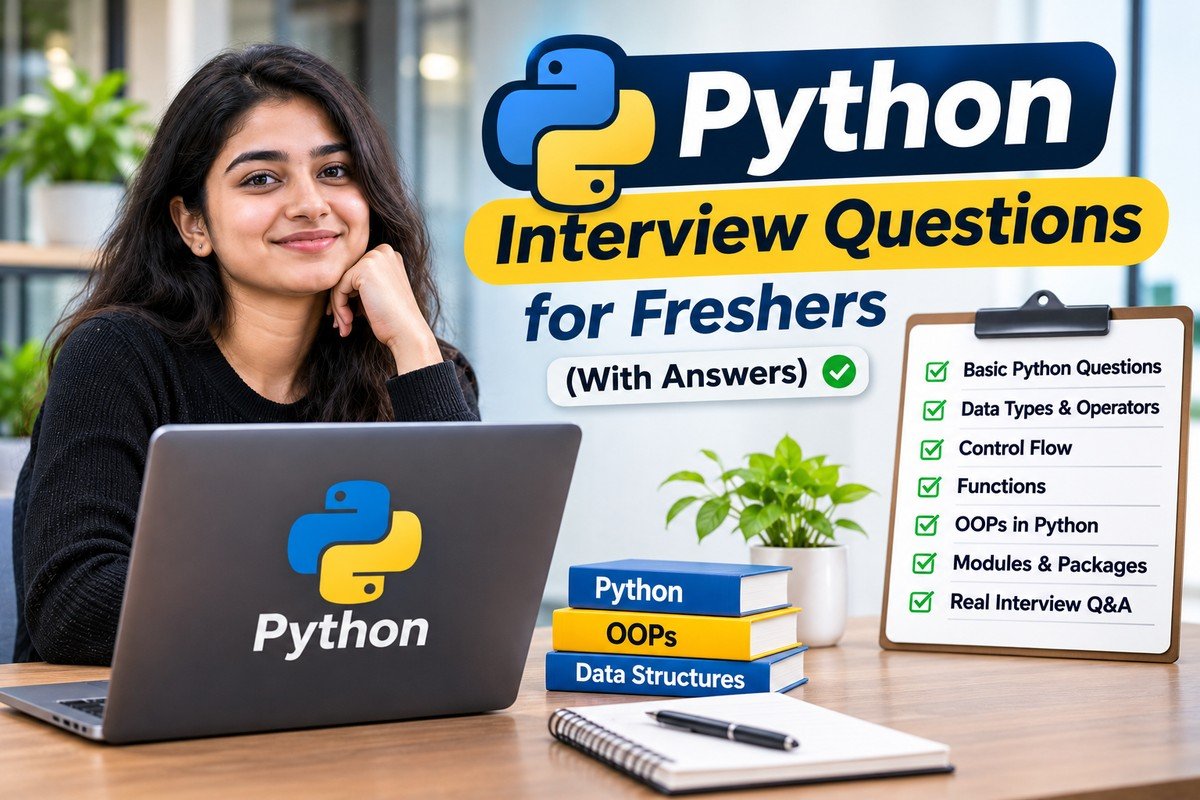
Python Interview Questions for Freshers (With Answers)
 Nov 03, 2026
A typical interview question on Python for a fresher checks three things: whether you understand the core language (data types, mutability, functions), whether you can explain object-oriented programming in your own words, and whether you can solve a small coding problem live. This guide groups the most common python job questions by level, with short answers and code you can run yourself. If you are still building the basics, a structured Python course with daily coding practice will make these answers feel natural instead of memorised.
Read each answer, then close the page and explain it aloud. Interviewers in Surat, Ahmedabad and Pune rarely want textbook definitions. They want to see that you have actually written the code.
How Python Interviews for Freshers Usually Run
Most entry-level rounds follow a similar pattern, whether the role is Python developer, back-end trainee or data analyst:
| Round | What they test | How to prepare |
|---|---|---|
| Basic concepts | Data types, mutability, scope, functions | Explain each with a two-line example |
| OOP | Classes, inheritance, polymorphism | Model one real object, such as a student or invoice |
| Data structures | Lists, tuples, sets, dictionaries | Know when to pick each one and why |
| Coding | Small logic problems on paper or an editor | Solve 30–40 easy problems without an IDE |
Basic Python Interview Questions
1. What is Python, and why is it popular?
Python is a high-level, interpreted, dynamically typed language. Its readable syntax, large standard library and packages such as Django, Pandas and NumPy make it useful for web development, automation, data analysis and machine learning.
2. Which Python version should you mention?
Say you use Python 3. Python 2.7 reached end of life on 1 January 2020. According to the official Status of Python versions page, 3.14 and 3.15 are the current bugfix releases, while 3.11 to 3.13 receive security fixes only. Naming the version you actually installed sounds more credible than quoting the newest one.
3. What is the difference between mutable and immutable types?
Mutable objects (list, dict, set) can change after creation. Immutable objects (int, float, str, tuple) cannot; any "change" creates a new object. This matters because two names can point to the same mutable object:
a = [1, 2, 3] b = a b.append(4) print(a) # [1, 2, 3, 4] (a and b are the same list)4. What is the difference between == and is?
== compares values. is checks whether both names refer to the same object in memory. Use is mainly for None checks.
x = [1, 2] y = [1, 2] print(x == y) # True print(x is y) # False5. What are *args and **kwargs?
*args collects extra positional arguments into a tuple. **kwargs collects extra keyword arguments into a dictionary.
def show(*args, **kwargs): print(args, kwargs) show(1, 2, city="Surat") # (1, 2) {'city': 'Surat'}6. Why is a mutable default argument a bug?
Default values are created once, when the function is defined, not on every call. So a default list keeps growing across calls. Use None as the default and create the list inside the function.
def add_item(item, items=[]): items.append(item) return items print(add_item(1)) # [1] print(add_item(2)) # [1, 2] not [2]OOPs Interview Questions in Python
OOP questions show whether you can structure a real program. Freshers who have studied C++ or Java in a C and C++ programming course usually find these concepts familiar; the Python syntax is simply shorter.
7. What are a class, an object and __init__?
A class is a blueprint; an object is one instance of it. __init__ runs when an object is created and sets its starting attributes. self refers to the current object.
8. Explain inheritance and method overriding with an example.
Inheritance lets a child class reuse a parent class. Overriding means the child redefines a parent method; super() calls the parent version.
class Student: def __init__(self, name): self.name = name def greet(self): return f"Hi, I am {self.name}" class Intern(Student): def greet(self): return super().greet() + " and I am an intern" print(Intern("Riya").greet())9. What are the four pillars of OOP?
- Encapsulation: keeping data and methods together. Python uses a leading underscore (
_balance) as a convention for internal attributes and double underscore for name mangling. - Abstraction: exposing only what the user needs, often with the
abcmodule's abstract base classes. - Inheritance: reusing code from a parent class.
- Polymorphism: the same method name behaving differently for different classes, such as
area()on a Circle and a Square.
10. What is the difference between @staticmethod and @classmethod?
A class method receives the class (cls) and is often used as an alternative constructor. A static method receives neither the class nor the object; it is a plain helper function kept inside the class for organisation.
Data Structure Questions in Python Job Interviews
11. List vs tuple vs set vs dictionary: when do you use each?
| Type | Ordered | Mutable | Duplicates | Typical use |
|---|---|---|---|---|
| list | Yes | Yes | Allowed | A changing collection, such as cart items |
| tuple | Yes | No | Allowed | Fixed records, such as (latitude, longitude) |
| set | No | Yes | Not allowed | Removing duplicates, fast membership checks |
| dict | Insertion order | Yes | Keys unique | Key-value lookups, such as roll number to name |
Dictionaries keep insertion order as a language guarantee from Python 3.7, as noted in the official What's New in Python 3.7 release notes. Interviewers sometimes ask this to see if your knowledge is up to date.
12. What is a list comprehension?
A compact way to build a list from an iterable, with an optional condition:
squares = [n * n for n in range(1, 6) if n % 2 == 1] print(squares) # [1, 9, 25]13. What is the difference between a shallow copy and a deep copy?
copy.copy() creates a new outer object but shares the inner objects. copy.deepcopy() copies everything recursively, so changes to nested lists do not leak across.
Strong data structure fundamentals also help in DSA-heavy rounds at product companies. A Software Development Foundation course covering C, C++ and DSA builds that problem-solving base before you specialise.
Python Coding Interview Questions for Freshers
Write these without looking at the answers first. Then compare, and explain the time complexity.
14. Check whether a string is a palindrome.
def is_palindrome(s): s = s.lower() return s == s[::-1] print(is_palindrome("Madam")) # True15. Remove duplicates from a list but keep the order.
nums = [3, 1, 3, 2, 1] print(list(dict.fromkeys(nums))) # [3, 1, 2]Using set(nums) also removes duplicates, but a set does not preserve order, so mention why you chose the dictionary approach.
16. Find the second largest number.
def second_largest(nums): unique = sorted(set(nums)) return unique[-2] if len(unique) > 1 else None print(second_largest([10, 20, 20, 5])) # 1017. Count the most frequent character.
from collections import Counter print(Counter("banana").most_common(1)) # [('a', 3)]If the interviewer asks you to avoid libraries, build the count with a plain dictionary and a loop. Knowing both versions shows depth.
How to Prepare Beyond These Questions
- Build two small projects. A Flask or Django to-do app pairs well with skills from a web back-end development course, and gives you real stories to tell.
- Match the role. Analyst roles add Pandas and SQL questions, which a Data Analysis course covers. ML roles add NumPy and scikit-learn, part of an AI/ML and Data Science course.
- Practise thinking aloud. Interviewers value a clear approach even when the final code has a small error.
- Keep code on GitHub. A link to clean, commented code backs up everything you say.
At RW Skill Education, Python learners practise these question types through hands-on projects, which helps you get used to explaining your own code clearly.
Frequently Asked Questions
How many Python interview questions should a fresher prepare?
Understanding 40–50 core questions well beats memorising 200. Focus on basics, OOP, data structures and about 30 easy coding problems.
Are Python coding interview questions asked on paper or a computer?
Both are common. Many companies use an online test first, followed by a live round on a shared editor or whiteboard, so practise without autocomplete.
Do I need DSA for a Python fresher job?
For service companies and small firms, basic arrays, strings and dictionaries are usually enough. Product companies ask more DSA, including sorting, searching and recursion.
Which Python frameworks do interviewers ask about?
For web roles, Django and Flask are the usual names. For data roles, expect Pandas and NumPy. Mention only frameworks you have actually used in a project.
Can a non-IT graduate crack a Python interview?
Yes, if you can show working projects and explain your code clearly. Degree background matters less for entry roles than demonstrable skill.
Is Python enough for a full stack developer role?
Python handles the back end, but you also need HTML, CSS, JavaScript and a front-end library. A Full Stack Development course brings these together.
Turning These Answers Into Interview Confidence
Every interview question for Python in this list can be answered in under a minute, but only if you have typed the code yourself. Run each snippet, change it, break it and fix it. When an interviewer follows up with "why?", that hands-on experience is what lets you answer calmly instead of guessing.