


The Design Process Explained: From Problem to Product
 Aug 04, 2026

RWn. Mohit Savliya
CD&T Manager , Subject Matter Expert
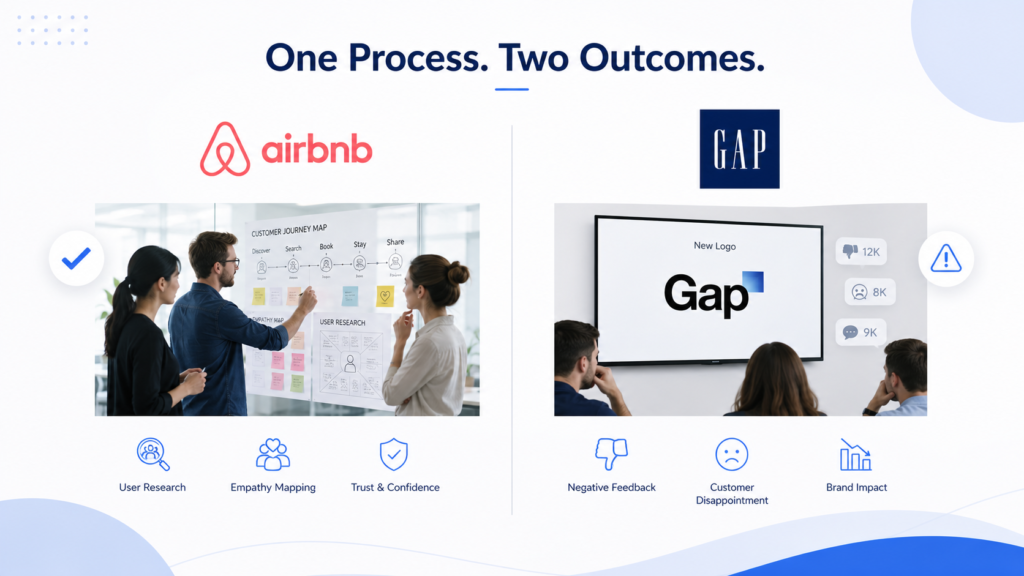
The Gap unveiled a new, word-only logo to replace its well-known blue box in October of 2010, estimated to have cost them more than one hundred million dollars. A mere six days later, following hundreds of thousands of parody designs all over the Internet and negative publicity, the company quietly went back to the old design. No user testing, no gradual rollout, no process—just a reveal.
This stands in stark contrast to the work done at Airbnb late in 2011, where a small team sat down in front of walls of sticky notes and mapped out the entire emotional journey of staying in someone else's home before even touching the computer, which led to completely revamping their product strategy and ultimately allowed them to diversify into Airbnb Experiences.
Same industry, same time period, yet entirely different process—and entirely different outcome.
In this article, we'll walk through what the design process looks like—from problem to product—not the design process described by marketers, but the actual process that real professional design teams follow to get from problem to solution. And throughout, we'll show evidence that proves everything that we claim.
Table of Contents
- What the Design Process Actually Is
- The Double Diamond: The Industry-Standard Model
- Phase 1 — Discover
- Phase 2 — Define
- Phase 3 — Develop
- Phase 4 — Deliver
- The Business Case: What the Data Actually Shows
- Case Study: Airbnb's "Snow White" Redesign
- Case Study: The Gap Logo Failure
- Common Mistakes That Break the Process
- Tips and Best Practices
- Key Takeaways
- FAQ
What the Design Process Actually Is
Most people when asked what "the design process" is will tell you that it's about getting an idea, making it beautiful, and building it. It's not. It's hoping for a result.
A proper design process is a sequence that helps to minimize uncertainty: about the problem, and about the solution. It works since in most cases, both parts of the previous sentence are false initially: the problem stated is usually a symptom, not a cause. And the first solution that comes to mind is rarely the most appropriate one.
Teams don't go directly into execution because going directly to execution is a lot more expensive than the alternative. More numbers on that later. But first, let's take a look at the model that is used by virtually all design teams as a point of reference.
Want to learn the complete design process through hands-on projects? Explore our UI/UX & Graphic Design Course.
The Double Diamond: The Industry-Standard Model
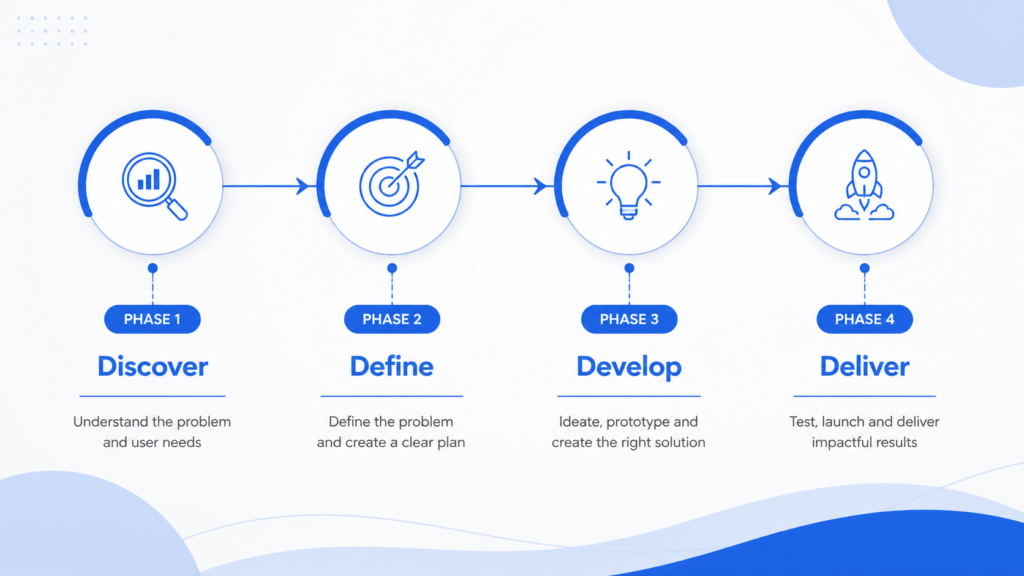
The best-known design process model used in industry is the Double Diamond, created by the UK’s Design Council. The cover, Douncil examined the practice of some of the top design-led firms and, in 2004, extracted from their experience what it learned about four phases of the process, each of which has a clever name: Discefine, Develop, and Deliver.
Names are just as important as shapes here. Both diamonds widen at the beginning and narrow down later: each process is based on two distinct types of thinking, namely divergent (broad exploration) and convergent (narrowing down). The first diamond involves understanding the problem; the second one involves creating the solution. And the point of intersection of two diamonds is the moment when the team has made up its mind about the clear definition of the problem.
That is why the model was later applied far beyond its initial use-case of visual design in such organizations as the UK’s National Health Service and Government Digital Service.
Here's the shape of it, phase by phase:
| Phase | Type of Thinking | Core Question | Typical Activities |
| Discover | Divergent | What's actually going on? | User interviews, field research, stakeholder interviews |
| Define | Convergent | What problem, specifically, are we solving? | Synthesis, journey mapping, problem statements |
| Develop | Divergent | What are the possible solutions? | Sketching, prototyping, concept testing |
| Deliver | Convergent | Which solution actually works? | Usability testing, refinement, launch |
Phase 1 — Discover
Discovery stage is when a team resists the temptation to jump right into the design process. The aim here is just to gain insight into the existing problem space, not the perceived one in the meeting room.
This normally consists of:
- User interviews with the people who'll actually use the product
- Contextual inquiry — watching people in their real environment, not a lab
- Stakeholder interviews to surface business constraints and hidden assumptions
- Competitive and market research to understand what already exists
It is difficult not to be tempted to skip or abbreviate this stage, particularly when there are deadlines pressing on all sides. Moreover, it is one of the most costly areas to economize on. The frequently quoted statistic is based on studies conducted at the Systems Sciences Institute of IBM and is repeated in almost all usability literature. According to this study, the cost of correcting a problem identified after release can be up to 100 times more expensive than the cost of correcting the same problem during the design stage.
Phase 2 — Define
Everything collected during Discovery is just raw data. Define phase is when these pieces get integrated to create a decision – a clear problem definition that the team will try to solve.
This is often where affinity mapping, journey mapping, persona creation, and other methods are used not as design theater, but as a method of making the team agree on the exact problem to be solved. "Improve onboarding" is not a definition; "new users leave onboarding process at the permissions page because they don't understand the necessity to provide access to their contacts" is.
Phase 3 — Develop
Having defined the problem, the team goes back to divergent thinking mode again – only now they are solving the problem rather than understanding it. This phase requires prototyping – sketching, wire framing, and refining the design, while getting feedback from real users as quickly and inexpensively as possible.
It takes discipline not to settle on a single solution too soon. Multiple alternative concepts that receive some quick testing beat out a well-polished concept that gets lots of testing every time, because testing will turn up flaws you haven't thought to ask about.
Phase 4 — Deliver
In Deliver is where the selected solution is developed further, is validated at higher levels of fidelity and is released. It is also the stage that is easiest to rush, since at this stage the stakeholders are already demanding results.
The Design Council describes the phase quite clearly and explains what it consists of: validating the solutions on a smaller scale, discarding those that do not work and making better ones — all before rather than after the product release. This is precisely the point of failure of the process that turns the controlled product release into a failure. We will soon consider an example of this.
If you're passionate about branding, typography, color theory, and digital design, check out our Graphic Design Course.
The Business Case: What the Data Actually Shows
It means nothing for an enterprise if none of the above gets realized into results. This is true and the information is even more abundant than many people imagine.
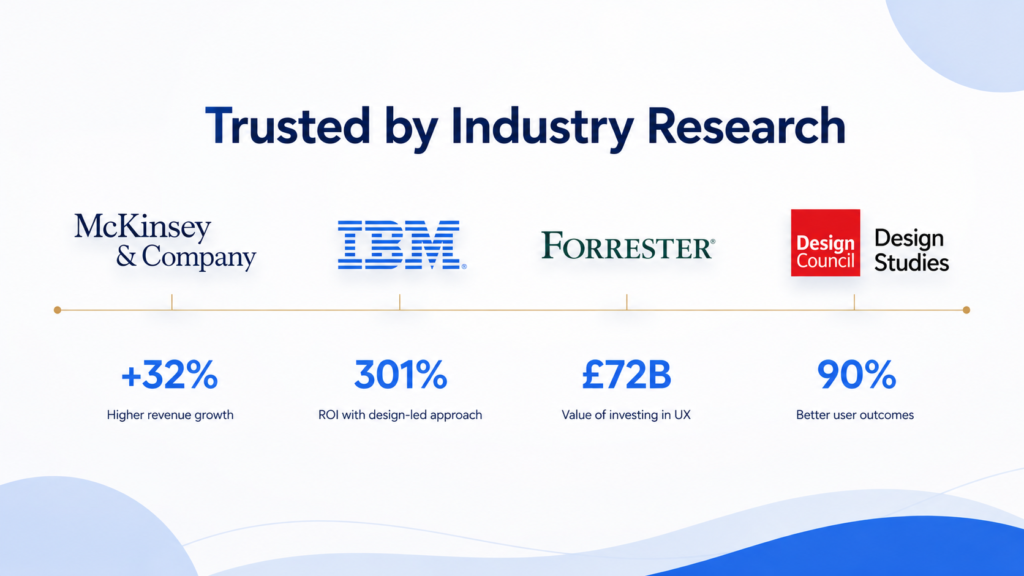
The McKinsey Business Value of Design report analyzed more than 300 publicly traded companies over five years and more than 100,000 design activities carried out. The companies that scored in the top quarter in the McKinsey Design Index – this is the ranking based on analytical leadership, design talent within cross-functionality, constant user testing, and good user experience practice – were 32 percentage points ahead of the competition in terms of revenue growth, and 56 percentage points in terms of total shareholder return in those five years.
In regard to the Forrester's Total Economic Impact study on IBM's Design Thinking, commissioned by IBM and published in 2018, it is estimated that the benefits gained amount to $48.4 million, while the cost equals $12 million; in turn, net present value is $36.3 million, and the calculated ROI is 301% (the analysis of the benefits and costs was based on a model organization created by conducting interviews with actual IBM clients and surveying 60 executives).
It should be also noted that the economic impact of design has been studied by the UK Design Council itself, which found out that design made a contribution of £72 billion to the UK economy in 2013 and comprised about 5% of the UK workforce.
In addition, academic researches prove the benefits of design process on the example of small and medium sized manufacturing enterprises; for example, a 1993 study in the peer-reviewed journal Design Studies has found out that 60% of all design projects and 90% of those that have been implemented successfully can be considered commercially successful.
| Source | What It Measured | Key Figure |
| McKinsey (2018) | 300 public companies, 5-year performance | +32% revenue growth, +56% shareholder return (top quartile) |
| Forrester / IBM (2018) | Design Thinking practice, 3-year composite | 301% ROI, $36.3M net present value |
| UK Design Council | UK design economy, 2013 | £72 billion contribution, 5% of workforce |
| Roy & Potter, Design Studies (1993) | 221 SME manufacturers | 90% of implemented design projects commercially successful |
Case Study: Airbnb's "Snow White" Redesign
Airbnb had scaled quickly by the end of 2011, more than a million nights had been booked in 182 different countries, and management felt that the product was not matching up to the scale of the business. This is where Rebecca Sinclair, who was Airbnb’s Head of User Experience Research and Design at the time, launched an internal project called "Snow White".
This epiphany, as related by Rebecca herself, came while the team was in the Synthesis phase – that is to say the Define phase in terms of the Double Diamond model. The epiphany occurred while mapping out the customer journey on sticky notes, and realizing that the crucial experiences for both guests and hosts were not taking place inside the application; they were happening offline.
This simple realization completely changed the way the company viewed the product. The platform is no longer just a booking tool but a trust and belonging one. This later allowed the opening of entirely new categories like Airbnb Experiences. Here's a clear real-life example of why the Define stage is essential: the team didn't need a more visually appealing app; they needed a properly defined problem.
Moreover, the broader product evolution story of Airbnb supports the above statement as well. Long before Airbnb officially became Airbnb in 2014, the company had already spent substantial effort on implementing the professional photography for its hosts because it had turned out that it is trust rather than aesthetics that prevents people from booking the place.
Case Study: The Gap Logo Failure
The case of Gap's 2010 rebranding effort stands out as the most documented example of design failure in the history of branding precisely due to the fact that the entire process took place in full view of everyone.
In October 2010, the company unveiled a completely new design in which the familiar blue box logo, which had been in use for more than 20 years, was replaced with a bare word mark accompanied by a tiny gradient square. The entire rebranding effort cost about $100 million and the design was made by the agency Laird & Partners. No announcements were made, nor was any customer research made public. After only 24 hours, Gap considered crowdsourcing a solution as a response to the public outrage. Just eight days after its original release, the new design was scrapped altogether.
Whether through whatever mechanism it was designed using, there is nothing in the public sphere demonstrating that any of the convergence strategies within the Double Diamond were followed; namely, no clear discovery of what the meaning behind the logo was to the customers, no well-defined problem other than 'modernizing' it, and importantly, no small-scale deployment before launching it publicly. The expense was not limited to simply paying for the new logo design – it was a highly publicized loss of trust in the brand.
Common Mistakes That Break the Process
- Using "Discover" as an optional step when pushed by deadlines. This is also where the budget gets wasted based on the figures given above.
- Mistaking a request for problem definition. "Make it more modern" is a request, and it doesn't become a problem until someone can identify what exactly "modernizing" will solve.
- Becoming attached to the first prototype. The reason Develop exists is precisely to provide alternatives.
- Not testing a small scale version prior to a full scale rollout. This point makes Gap's experience the most valuable lesson, as a full rollout is never the place to realize that there's a problem.
- Allowing the visual result to be faster than the discovery itself, which happened to Airbnb almost but for the team realizing that the root cause was lack of trust rather than bad aesthetics.
- Following the process in a linear fashion. In reality, project development is never linear — a prototype test during Develop often returns the team to Define stage.
Tips and Best Practices
- Document the problem statement prior to starting on the design process. When you are unable to articulate the problem statement in a single sentence, you haven’t defined it.
- Deliberately timebox phases; it’s as dangerous not to have a defined period of discovery as an undefined discovery process.
- Test using the minimum level of fidelity that answers your questions – a sketch can test an idea; it doesn’t need to be a working prototype yet.
- Document a rationale log for important decisions; what was tried, what was ruled out and why. It will save much grief from having to relitigate.
- Consider delivery testing non-negotiable for any external-facing change regardless of the confidence of the internal team.
Learn how to solve real-world design challenges with our UI/UX Design Course, designed for aspiring UI, UX, and product designers.
Key Takeaways
- First, the design process is meant to minimize uncertainty regarding the problem and then the solution in that order.
- The Double Diamond (Discover, Define, Develop, Deliver), created by the United Kingdom's Design Council in 2004, still stands as the most commonly used structural framework of this process.
- There is empirical real-world financial evidence from McKinsey, Forrester, the Design Council of the United Kingdom, and academic journals that directly correlates an effective design process with successful business results.
- The "Snow White" program from Airbnb demonstrates what occurs when a team properly defines the problem before designing the solution.
- The Gap rebranding in 2010 demonstrates what occurs when a team does not do any discovery, definition, and testing.
Conclusion
The difference between a successful design process and an unsuccessful one is not seen in the final screens or in the final logo itself. This can be seen in what took place before the creation of these final products – if the team was able to figure out what the actual problem was, if they were able to test various alternatives, and if they were able to validate the solution before investing everything on it.
This is something that can be learned, not something inherent to anyone's personality. Begin your next project by figuring out in one sentence what is the problem you're actually trying to solve.
Frequently Asked Questions
What is the design process? The design process is an organized method to take a team from ambiguity in a problem to a well-defined solution. Professional design teams tend to follow some version of the discovery-definition-development-delivery model instead of proceeding directly from idea to implementation.
What is the Double Diamond design process? The Double Diamond is a design process that was created by the Design Council in the UK back in 2004. There are four steps in it: Discover, Define, Develop and Deliver. They are arranged in two diamond shapes and involve first diverging (expanding one’s thinking) and then converging (focusing on the decision).
Is the design process relevant to apps and websites only? Not at all.
Discover-Define-Develop-Deliver structure can be used in designing both tangible objects and services, branding, and even public policy. It has been used by such organizations as NHS and Government Digital Service in the UK.
Are there data showing that the design process does really lead to better business performance? Indeed, according to McKinsey's study on 300 companies, the top design performers had 32 percentage points more revenue growth over five years. The Forrester Total Economic Impact of IBM Design Thinking showed 301% return on investment. The 1993 peer-reviewed article revealed that 90% of implemented design projects among UK manufacturers were commercial successes.
Which is the most overlooked stage in the design process? The most overlooked stage is the Discovery stage (that involves the upfront research) due to the deadline, though the existing evidence suggests that it is also the most costly stage to shortcut.
Is it possible for the design process to be nonlinear? Indeed, it is always such in reality since designers go from Develop back to Define because of testing prototypes. The Double Diamond reflects the pattern of thinking rather than the linear order.
Related Post:
8 Best Free AI Tools Every Data Science & AI/ML Student Should Use in 2026.
Synthetic Intelligence: Foundations, Architectures, Applications, and Future Directions.