


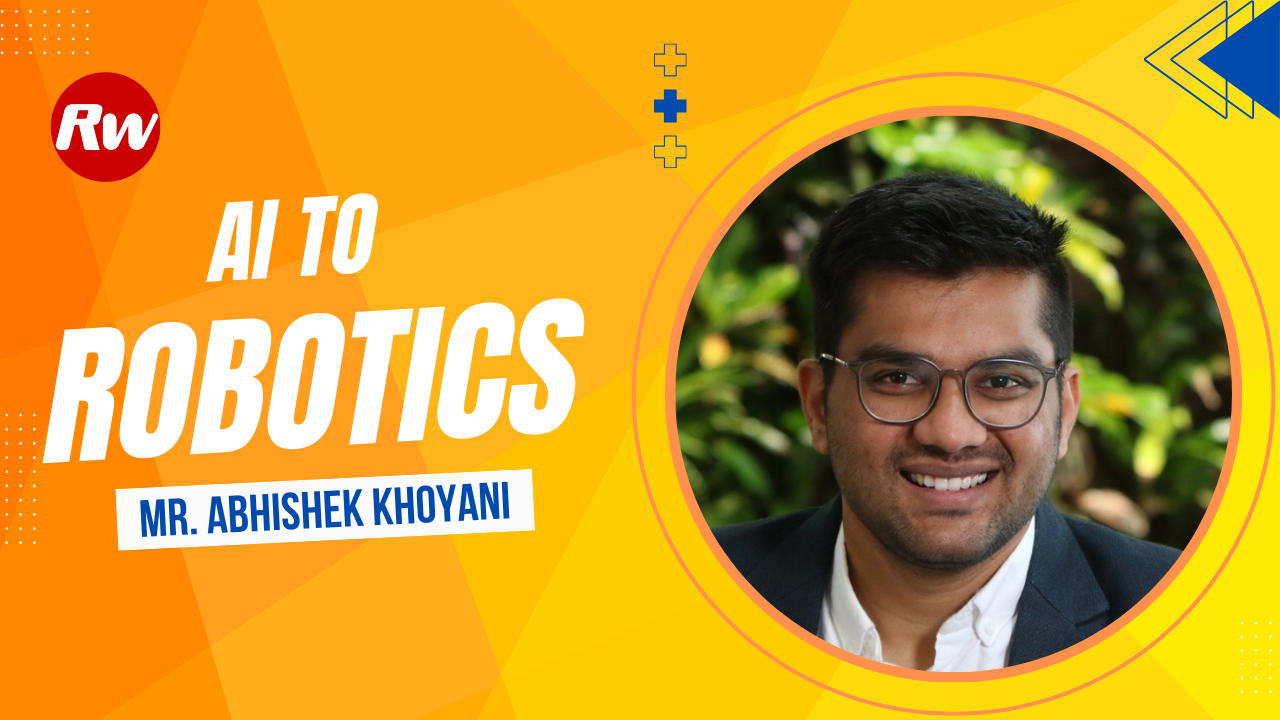
From AI to Robotics: Bridging Intelligence with Physical Action
 Feb 14, 2026
Have you ever wondered how the algorithms you learn in AI/ML courses actually translate into real-world robots that drive cars, perform surgeries, or explore Mars? Well, that's exactly what we explored in an electrifying session with Mr. Abhishek Khoyani, where students from Red & White Skill Education's Ahmedabad, Rajkot, and Surat branches gathered—both physically and virtually—to discover the fascinating world where artificial intelligence meets robotics.
The energy in the room (and on the screen!) was palpable. When asked to rate their excitement on a scale of 1-10, the unanimous response was a resounding 10! And trust me, by the end of this session, that excitement was more than justified.
What Actually IS Robotics?
Before diving deep, Mr. Khoyani started with a fundamental question that often gets overlooked: Where does the word "robot" even come from?
Here's something fascinating from etymology (the study of word origins): The term "robot" originates from the Japanese word "robota." But interestingly, this wasn't even a real word initially! A science fiction author coined it to describe biological entities that could work on command without emotional senses. From that fictional concept emerged what we now call robotics—the science of creating machines that can perform tasks autonomously or semi-autonomously.
The Core Concept
Mr. Khoyani emphasized a crucial point that became the thread throughout the session:
"Robotics is essentially applying computer algorithms to the real world. It's mathematics meeting physical reality."
Think about it: When you give a command to any machine and it responds—that's robotics at play. But it's not limited to humanoid robots like Tesla's Optimus. Robotics encompasses everything from self-driving cars to warehouse automation systems.
The Two Pillars of Robotics
Throughout the session, Mr. Khoyani repeatedly returned to two fundamental components that exist in virtually every robotic application:
1. Perception (The "Seeing" Part)
This is where your AI/ML knowledge becomes invaluable! Perception involves:
- Computer Vision: Giving machines the ability to "see" their surroundings
- Object Detection: Identifying that something exists in an image (using algorithms like YOLO - You Only Look Once)
- Object Classification: Determining what that object actually is (human, vehicle, animal, obstacle)
- Object Segmentation: Understanding exactly which pixels belong to which object
Mr. Khoyani used a brilliant analogy: "Your smartphone camera is the 'eye' for the machine. But just taking a photo doesn't mean the machine understands what's in it. That's where algorithms come in."
2. Control & Navigation (The "Acting" Part)
After perceiving the environment, robots need to make decisions:
- Where to move
- How fast to go
- When to stop
- Which path to take
- How to manipulate objects
This is where robotics engineering specifically comes into play—translating digital decisions into physical movements through actuators, motors, and mechanical systems.
Real-World Applications: Where Theory Meets Reality
The most engaging part of the session was exploring diverse robotics applications. Let me walk you through each one:
1. Self-Driving Cars: The Open Road Challenge
Self-driving cars represent one of the most complex robotics applications because they operate in uncontrolled environments.
Key Challenges:
- Roads can have potholes, unexpected obstacles
- Humans, animals, other vehicles can appear from anywhere
- Real-time decision-making is critical (accelerate, brake, turn)
Technical Requirements:
- Multiple cameras for 360° perception
- Sensor calibration (knowing exactly where each sensor is positioned)
- GPS navigation
- Real-time processing of visual data
Mr. Khoyani explained: "Think about how you drive. First, you check your surroundings. Then you start driving. While driving, you navigate—you don't just follow any road; you know your destination. Robots need to do exactly the same thing."
2. Warehouse Automation: The Structured Environment
Unlike self-driving cars, warehouse robots operate in controlled, structured environments.
How It Works: Amazon's same-day delivery magic happens because:
- Warehouses have precise maps of every item's location
- Robots navigate along predefined, structured paths (90° connected routes)
- When an order comes in, robots know:
- Start point: Where the item is stored
- End point: Where to deliver it
- Exact route to take
The difference from self-driving cars? "Here we have very structured roads, saved maps, and predictable environments," explained Mr. Khoyani.
3. Farming Robotics: Revolutionizing Agriculture
This application particularly fascinates me because it shows how robotics solves labor challenges in unexpected ways.
Applications Include:
- Plowing: Autonomous tractors that cover entire fields
- Sowing: Precise seed placement
- Fertilizer Spraying: Targeted application
- Weeding: The most advanced application!
Advanced Weeding Technology: Modern farming robots use cameras to distinguish crops from weeds in real-time. When a weed is detected, a laser immediately targets and eliminates it—all while the tractor moves through the field!
Mr. Khoyani showed a video of a completely autonomous tractor with no human operator in the cabin (in fact, no cabin at all!). The robot independently perceives the field and performs plowing tasks.
Why This Matters: In countries like the US, Canada, and Australia with vast farms and labor shortages, farmers can:
- Program the tractor once with the field map
- Start it and let it work 24/7 (day or night)
- Change attachments for different tasks (plowing, sowing, spraying)
4. Marine Exploration: Going Where Humans Can't
Deep-sea exploration presents unique challenges for humans:
- Heavy oxygen tanks required
- Time limitations underwater
- High risk of accidents
- Physical limitations in extreme pressure
Robotic Solution: Underwater robots equipped with:
- Cameras for seabed mapping
- Sensors for biodiversity analysis
- Ability to operate at extreme depths indefinitely
The data collected benefits marine scientists researching climate change, oxygen-producing algae, and underwater ecosystems—demonstrating how robotics enables cross-disciplinary collaboration.
5. Surgical Assistance: Precision Medicine
Mr. Khoyani introduced two fascinating surgical applications:
Tele-Surgery (Remote Operations):
- Doctor wears AR/VR equipment
- Manipulates controllers that mirror hand movements
- Robotic surgical tools replicate those movements at the patient's location
- Doctor could be in a different city or country!
Precision Surgery: Even when doctor and patient are in the same room, robots enable:
- More precise incisions
- Targeted cancer cell removal (unlike chemotherapy that affects entire organs)
- Reduced human error through steady, computer-controlled movements
6. Entertainment: Drone Shows
"Robotics isn't just for engineering and medical fields," Mr. Khoyani reminded us. "It's also transforming entertainment!"
Coordinated drone shows, where hundreds of drones create formations in the sky, require:
- Swarm Robotics: Multiple robots communicating with each other
- Each drone knowing its position relative to all others
- Coordinated movement to maintain formations
- Real-time communication protocols
This is similar to the concept shown in the movie "Robot" where multiple robots work together as a coordinated unit.
7. Manufacturing Assembly Lines
While similar to warehouse automation, assembly line robotics focuses on:
- Precise robotic arms with different gripper types
- Repetitive tasks (car manufacturing, device assembly)
- High precision in structured environments
- Relative positioning calculations (mathematics in action!)
8. Space & Military: Extreme Environment Exploration
Mr. Khoyani showcased NASA's Curiosity Rover exploring Mars—the ultimate example of autonomous navigation in unknown territory.
Unique Challenges:
- No GPS on Mars
- No prior maps available
- Must create maps while exploring
- Operates in extreme, harsh environments
Technical Approach:
- Mapping: First, create environmental maps
- Analysis: Decide where to collect samples
- Navigation: Move to those locations autonomously
Mining Application: In Australia's mining sector, autonomous "road trains" (one engine pulling 3-4 trailers) transport materials:
- Travel at 60-80 km/h
- Carry massive loads
- Stopping distance: 400-500 meters!
- Require extremely skilled drivers (or autonomous systems)
The solution? Sensors placed along the entire route communicate with the truck, enabling it to "see" and plan 1 kilometer ahead—far beyond what a single camera could detect.
The Critical Role of Mathematics
Throughout the session, Mr. Khoyani emphasized something that might surprise you: Mathematics is at the heart of robotics.
Why Math Matters:
Sensor Calibration: "We need to calibrate our sensors to tell machines exactly where each sensor is positioned relative to the robot body."
Think about human perception: We know we have two eyes in front. If we had eyes in the back too, our brain would need to know which eyes are seeing what. Similarly, robots need this "awareness" of their sensor positions.
Coordinate Systems:
- Cartesian Coordinates: Understanding 3D space (X, Y, Z)
- Relative Positioning: Calculating where objects are in relation to the robot
- Transformation Matrices: Converting between different reference frames
Real-World Example: If a laser pointer and camera aren't at the exact same location, mathematical calculations determine where the laser should point based on what the camera sees. "Two physical entities cannot occupy the same location, so we need to know the relativity between them."
Skills Required for Robotics: Your Roadmap
Based on Mr. Khoyani's insights, here's what you need to transition from AI/ML to robotics:
1. Strong AI/ML Foundation
- Python programming
- Computer vision algorithms
- Machine learning models
- Deep learning frameworks
2. Mathematical Proficiency
- Linear algebra (matrices, transformations)
- Calculus (for movement and optimization)
- Probability and statistics
- Coordinate geometry
3. Mechatronics Understanding
- How actuators work
- Sensor types and capabilities
- Mechanical systems basics
- Electrical engineering fundamentals
4. Control Systems
- PID controllers
- Feedback loops
- System stability
- Real-time processing
5. Programming Beyond Python
- C++ (for real-time systems)
- ROS (Robot Operating System)
- Embedded systems programming
The Interactive Learning Approach
What made this session particularly valuable was Mr. Khoyani's interactive methodology. He constantly engaged students:
Opening Question: "When you hear 'robotics,' what imagery comes to mind? What kind of machine do you visualize?"
Continuous Participation: "This isn't going to be an 80-20 lecture. It's going to be 50-50. I need as much participation from you as I'm giving."
Real-World Connection: Students from Data Science and AI/ML backgrounds realized that what they're learning in their courses—object detection, classification, segmentation—directly applies to robotics.
One student insightfully noted: "AI is something that helps automation of your tasks, completing tasks easily with low effort."
Another explained computer vision perfectly: "We're basically preparing vision for computers—creating eyes for machines."
Key Takeaways from the Session
1. Robotics = AI + Physics
Your AI algorithms are the "brain," but you need to understand how to translate those digital decisions into physical actions.
2. Perception is Half the Battle
Computer vision skills you're learning (object detection, segmentation, classification) are directly applicable to robotics.
3. Context Matters
The same robotic principles apply differently in:
- Controlled environments (warehouses, assembly lines)
- Semi-controlled environments (farms, mines)
- Uncontrolled environments (open roads, space)
4. Mathematics is Non-Negotiable
You can't escape it—coordinate transformations, sensor calibration, and positioning all require solid mathematical understanding.
5. Interdisciplinary Collaboration
Robotics brings together:
- Computer scientists (for AI algorithms)
- Mechanical engineers (for physical design)
- Electrical engineers (for sensors and actuators)
- Domain experts (marine biologists, surgeons, farmers)
The Fundamental Pattern
By the end of the session, a clear pattern emerged. Every robotic application follows this structure:
1. PERCEIVE → See and understand the environment
2. PROCESS → Analyze the data and make decisions
3. ACT → Execute physical movements based on decisions
Whether it's a self-driving car avoiding pedestrians, a warehouse robot fetching inventory, or a farming tractor identifying weeds, this three-step process remains constant.
Looking Forward: Career Opportunities
Mr. Khoyani's session illuminated exciting career paths:
- Autonomous Vehicle Engineers: Working on self-driving cars, trucks, or drones
- Agricultural Robotics Specialists: Revolutionizing farming technology
- Medical Robotics Engineers: Advancing surgical precision and tele-medicine
- Space Exploration Technologists: Enabling Mars rovers and beyond
- Industrial Automation Engineers: Optimizing manufacturing and logistics
The Challenge Ahead
The session concluded with an empowering realization: The skills you're currently learning in AI/ML are not separate from robotics—they're the foundation for it.
What bridges that gap? Understanding how to apply your algorithms to physical systems. That's where the "robotics engineering" part comes in—the mathematics, sensor calibration, control systems, and mechanical understanding.
Personal Reflections
As someone deeply invested in skill education, I'm constantly amazed by how topics like robotics capture students' imagination. During this session, I noticed students leaning forward, asking clarifying questions, and making connections between their coursework and real-world applications.
The beauty of Mr. Khoyani's approach was breaking down the intimidation factor. Robotics often seems like a distant, complex field. But by showing its connection to familiar AI/ML concepts, he made it accessible and achievable.
Your Next Steps
If this session has sparked your interest in robotics:
- Strengthen Your Fundamentals: Master computer vision thoroughly
- Brush Up on Mathematics: Linear algebra and coordinate geometry are your friends
- Start Small: Build simple projects—maybe a line-following robot
- Learn ROS: Robot Operating System is industry-standard
- Study Real-World Cases: Follow developments in autonomous vehicles, agricultural tech, space exploration
- Cross-Pollinate Skills: Don't just stay in software—understand hardware basics
The Bigger Picture
Robotics isn't just about building cool machines (though that's definitely part of it!). It's about:
- Solving Human Limitations: Going where we can't, working longer than we can
- Enhancing Human Capabilities: Surgical precision, heavy lifting, dangerous tasks
- Creating Efficiency: 24/7 operation, consistent quality, reduced costs
- Enabling Discovery: Deep-sea exploration, space missions, scientific research
Closing Thoughts
The session with Mr. Abhishek Khoyani wasn't just informative—it was transformative. It showed how the theoretical concepts we learn in AI/ML courses translate into tangible, world-changing applications.
Whether you're sitting in a classroom in Surat or watching from Ahmedabad or Rajkot, the message was clear: The future of robotics is being built by people who understand both artificial intelligence and its physical implementation.
Your journey from AI to robotics doesn't require you to abandon what you've learned—it requires you to expand it, to think beyond the screen, to imagine algorithms moving in the physical world.
So here's my challenge to you: Next time you're learning about object detection or neural networks, don't just think about accuracy metrics. Ask yourself, "How would this help a robot navigate a warehouse? How would this enable a surgical robot to be more precise? How would this let a farming tractor identify weeds?"
Because that's where the magic happens—at the intersection of artificial intelligence and physical reality.
About the Session: This expert session was conducted by Mr. Abhishek Khoyani as part of Red & White Skill Education's ongoing commitment to providing practical, industry-relevant knowledge to Data Science and AI/ML students across our Ahmedabad, Rajkot, and Surat branches.
Want to Attend Future Expert Sessions? Stay tuned to Red & White Skill Education's announcements for more exciting sessions bridging theory with real-world applications!
Were you part of this session? What application of robotics excited you most? Share your thoughts in the comments below, and let's keep this conversation going!
And remember: The robots of tomorrow are being programmed by the AI/ML students of today. That could be YOU.
– Your Learning Partner in Tech Innovation
Share


Take the Leap - Enroll Today & Kickstart Your Career
Enquire Now